

 Share
Share 



The fight over who controls prediction markets intensified this week as the Commodity Futures Trading Commission signaled it is done playing defense.
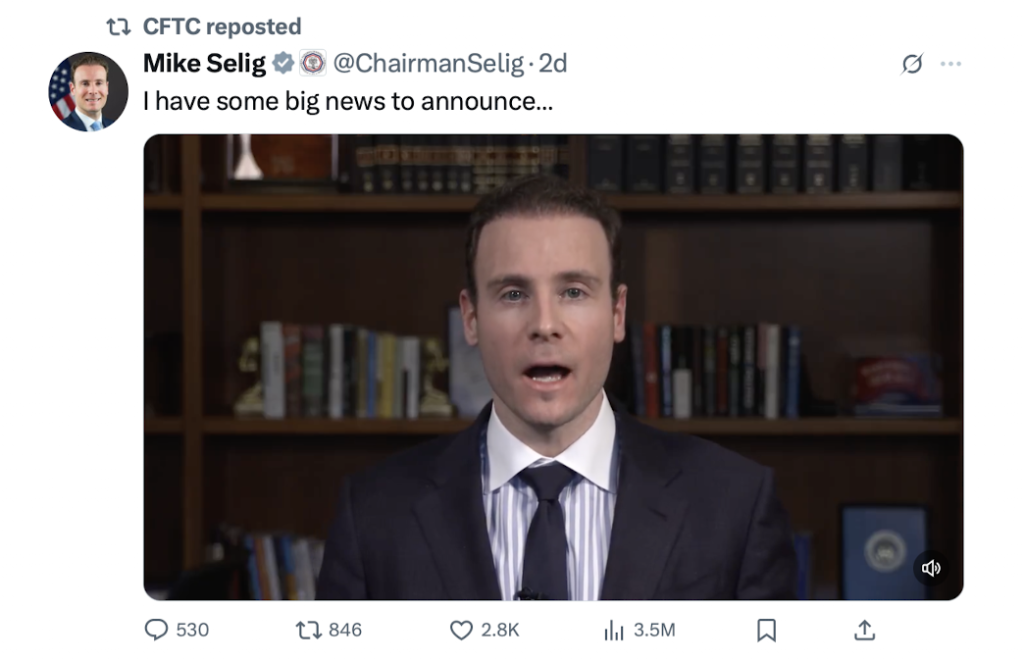
CFTC Chairman Michael Selig announced the agency filed an amicus brief in the 9th U.S. Circuit Court of Appeals, backing Crypto.com in its dispute with the Nevada Gaming Control Board. His message to states challenging platforms like Kalshi and Polymarket was blunt: The CFTC believes it holds exclusive jurisdiction.
In a Wall Street Journal op-ed and a social media video, Selig said the agency will no longer “sit idly by” while states attempt to shutter what he calls legitimate derivatives markets. He went a step further in the video, warning critics, “We will see you in court.”
Federal authority vs. state sovereignty
At the heart of the clash is a high-stakes question: Are prediction markets federally regulated derivatives exchanges, or gambling platforms subject to state gaming laws?
The CFTC and the industry argue that event contracts are legally classified as swaps. A swap is a financial contract in which parties exchange payments based on changes in an underlying variable—in this case, the outcome of a sporting event, an election, or the weather.
States disagree. Regulators in Nevada and Massachusetts have already taken legal action against prediction platforms. Utah Gov. Spencer Cox, whose state bans gambling, publicly mocked Selig’s position on X. Cox questioned the idea that the CFTC should oversee what he described as the “derivative market” of LeBron James’ rebounds. The disagreement cuts to the core of how the U.S. divides gambling and financial markets.
The sports betting vs. derivatives debate
While prediction markets cover diverse topics, sports event contracts drive the majority of trading volume. Selig downplayed sports in his public remarks, but the agency’s 41-page amicus brief reportedly references them multiple times. The filing argues that if courts rule these contracts are not swaps, it could fundamentally redraw the boundaries Congress established for federal oversight of derivatives.
Critics counter that federal law was never intended to cover what amounts to sports betting. Gaming attorney Dan Wallach has argued that legislative history does not support the idea that contracts on player statistics fall under federal commodities law.
Why the CFTC is withdrawing prohibitive rules
Selig’s aggressive approach marks a pivot from his earlier caution. During his November confirmation hearing, he called prediction markets a “complex issue” and suggested the courts would ultimately decide if certain contracts constituted gaming.
Since taking office in December, his stance has sharpened. He withdrew a proposed rule that would have prohibited contracts for sports and political events, signaling instead that the agency plans to craft clearer rules for the industry.
The states, however, are not backing down. The 9th Circuit recently denied Kalshi’s request to pause a lower court order, allowing Nevada regulators to proceed with enforcement actions. Legal observers expect the jurisdictional tug-of-war to eventually reach the Supreme Court.

