


 Share
Share 



The new chair of the U.S. Commodity Futures Trading Commission is moving quickly to set the tone for the agency’s next chapter. In a sweeping message to markets and lawmakers, Michael S. Selig describes his tenure as the beginning of a “golden age” for American financial markets — one built on modernization, lighter-touch regulation and a more welcoming posture toward emerging technologies.
The message is clear: Regulatory priorities are shifting, particularly for prediction markets, blockchain-based products and cryptocurrencies.
Legacy of adaptation meets blockchain markets
The Commodity Futures Trading Commission has never been a static agency. It began as an overseer of agricultural futures before expanding to regulate energy contracts, financial futures and complex derivatives.
Selig argues that this evolution uniquely positions the CFTC for today’s transition. Markets powered by blockchain, artificial intelligence and always-on digital platforms resemble earlier waves of financial innovation more than traditional securities trading. From that perspective, the agency’s history of adaptation becomes a strength rather than a limitation.
Prediction markets, crypto push the pace
Digital markets now operate around the clock, are accessible to anyone with a smartphone and allow participants to hedge risks in ways that were barely imaginable a decade ago. AI-driven strategies, decentralized trading platforms and prediction markets are no longer fringe experiments.
Selig contends that regulators face a binary choice: Drive these markets offshore or meet them where they are. That urgency has intensified as cryptocurrency derivatives and prediction markets continue to expand, even as legal uncertainty persists.
A clear rejection of regulation by enforcement
One of Selig’s most pointed critiques targets recent regulatory strategy. He faults the Biden administration for relying too heavily on enforcement actions instead of clear, forward-looking rules.
According to Selig, that approach discouraged domestic innovation and forced new products into outdated regulatory frameworks. Retail participants lost access to regulated alternatives, while businesses scaled back or shifted operations overseas. He presents his leadership as a deliberate reversal of that pattern.
The ‘future-proof’ initiative
At the center of the shift is the CFTC’s new “Future-Proof” initiative, which calls for a comprehensive review of agency rules — many of which were written decades ago for agricultural and traditional futures markets.
While those rules remain effective in their original context, they rarely account for blockchain-native assets, AI-driven trading systems or event-based contracts. Selig emphasizes that the goal is not deregulation, but precision. He describes it as delivering the “minimum effective dose” of regulation — enough to deter fraud and manipulation without stifling innovation.
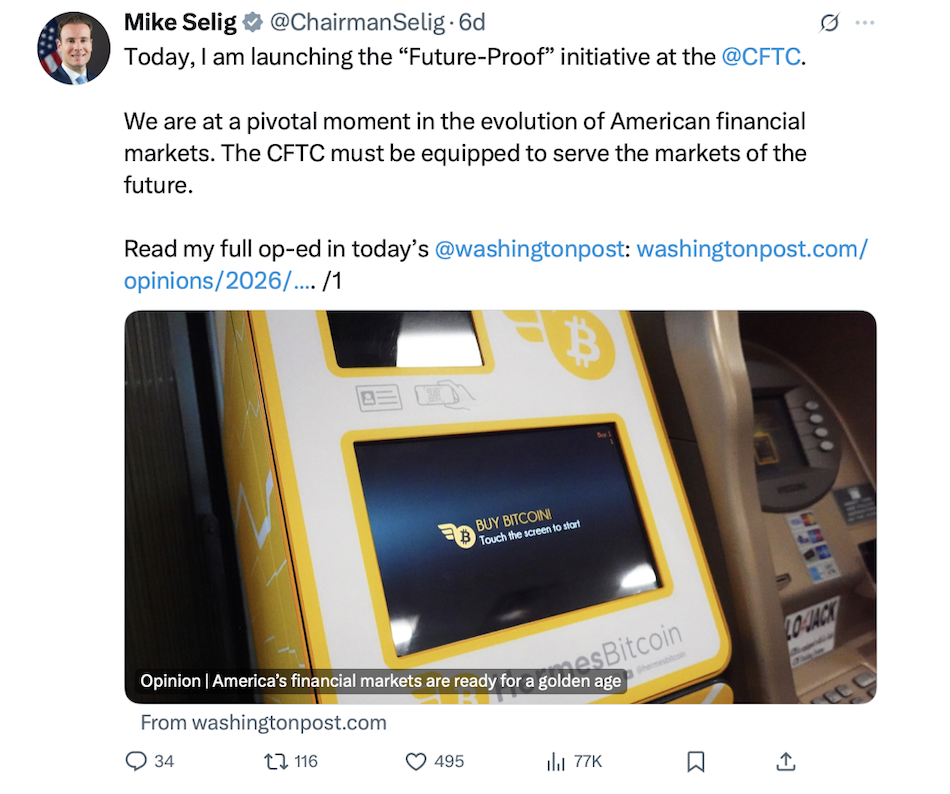
The CFTC makes its pitch to lawmakers
Momentum in Washington is adding weight to the effort. Selig credits former President Donald Trump with pushing Congress toward digital asset market structure legislation that could formally expand the CFTC’s authority.
If enacted, such legislation would give the agency a central role in overseeing large segments of the crypto economy. Selig is effectively asking lawmakers to entrust the CFTC with that responsibility, pledging stable rules developed through public input rather than surprise enforcement actions.
The stakes for prediction markets and crypto
The vision outlined is ambitious, but coherent. Clearer and more uniform regulations could draw builders back to U.S. markets while strengthening protections for participants. AI-powered trading tools, cryptocurrency platforms and prediction markets all stand to benefit from regulatory clarity.
Whether this promised “golden age” materializes will depend on execution, congressional follow-through and market response. What is already evident is a marked shift in the regulatory conversation surrounding cryptocurrency and prediction markets.

