
Reset your sheet. Log injuries and potential role changes. Note matchups that look fast or high scoring. List three games you might target and three you will likely avoid. Keep it light and clean.
NFL DFS Guide: Daily Fantasy Football Strategy and Tips


Welcome to the best NFL DFS guide for beginners. Here, you’ll learn how NFL daily fantasy sports works, how to build smarter lineups, and apply clear strategies that win in cash games and tournaments.
We’ll cover projections, ownership, stacks, and weekly workflows, plus fast position cheatsheets and a picks template you can reuse, all tailored to make you feel like a pro in no time. You’ll also find the best daily fantasy football apps and sites in the US. Start here and make better DFS NFL decisions every slate!
Top NFL Daily Fantasy Sports Sites in 2026
Here are our most trusted social sportsbooks and DFS sites. Choose one and get started!
| Operator | Bonus | Promo Code / Claim |
|---|---|---|
| Fliff | Get up to $250 in Free Play (Deposit Match) | GTODAY |
| Rebet | Up to $100 Rebet Cash Bonus | GTODAY |
| Betr | Up to $210 in Bonuses | GTODAY |
Best NFL DFS Sportsbooks by Use Case
Looking for a site that meets your specific needs? We categorized them for you below, highlighting what we think they are best for.
Fliff: Best for Newbies and Free-to-Play Starts
If you’re new and want a low-pressure place to learn, Fliff is a friendly first stop. It offers a social, free-to-play feel that lets you practice making NFL picks without risk. Currently, there’s a new customer welcome promo where you get a first-purchase match that scales with the size of your first purchase (from 10% up to 100%), for up to $250 in free play.
You can test simple strategies, learn scoring, and build confidence before you scale up. Always review the rules page so your picks match how the platform scores outcomes.
On top of that, you get Fliff Superstars P2P betting, available in states where sports betting is restricted.
Helpful when you’re starting:
- Practice lineup ideas without risking real money
- Build a routine for reading totals, props, and news
- Forget about NFL odds and traditional betting
Up to $250 In Free Play
Up to $250 In Free Play
More Ways to Play, Earn & Win!
Compete in Challenges & Climb the Leaderboards
More Ways to Play, Earn & Win!
Compete in Challenges & Climb the Leaderboards
Rebet: Best for Social Play, Friend Challenges, and Tournaments
Rebet pushes community features. You can join seasonal events, enter tournaments, and challenge friends, which adds a social layer to NFL pick’em.
If you want a steady stream of events and head-to-head fun, Rebet keeps slates engaging.
Why choose it:
- Social challenges keep sessions fun
- Regular events add structure to your week
10,000 Rebet Coins + 1 Rebet Cash On Sign Up
10,000 Rebet Coins + 1 Rebet Cash On Sign Up
Plus 100% Match up to $100 in FreePicks
Hundreds of Leagues to Place Picks on
Live Betting, Prop City, Gamer Paradise, Live Game Chats
Plus 100% Match up to $100 in FreePicks
Hundreds of Leagues to Place Picks on
Live Betting, Prop City, Gamer Paradise, Live Game Chats
Betr: Best for Micro-Betting and Real-Time Action
Betr focuses on instant markets. Instead of waiting for game outcomes, you can bet on specific plays and moments as they happen, making every snap meaningful.
If you want to stay engaged with constant action and quick results, Betr keeps the adrenaline going.
Why choose it:
- Micro-bets let you wager on every drive or play
- Real-time markets create non-stop excitement
4 No Sweat Tokens + Up to $200 Back & a Free Pick
4 No Sweat Tokens + Up to $200 Back & a Free Pick
4 No Sweat Tokens, Up to $200 back in Bonus if Your Entries Lose + A New User Free Pick
Higher Payouts & No Pushes
4 No Sweat Tokens, Up to $200 back in Bonus if Your Entries Lose + A New User Free Pick
Higher Payouts & No Pushes
What is NFL DFS and How Does It Work?
NFL daily fantasy sports lets you build a lineup of real NFL players for a specific slate of games. Your players earn fantasy points from their real-life stats. If your lineup scores more than other entries in your contest, you win.
How a slate works, step by step:
- Pick a contest for a set slate.
- Build a lineup within the site’s rules and salary cap or pick’em format.
- Watch the games and track your points.
- Payouts are based on where your lineup finishes.
Think of it like a one-day season. You draft, you compete, and it settles the same day. It’s a great fun alternative to betting on NFL games.
Scoring Basics
All sites award points for the same core stats, but values can differ. Passing yards, rushing yards, receiving yards, and touchdowns drive most scoring. Defenses score for sacks, turnovers, and touchdowns. Some platforms add bonuses when a player hits a yardage milestone.
Those small differences matter. For example, formats that pay for receptions make high-volume receivers more valuable.
Before you build, open the rules page and note how many points you get for a catch, a touchdown, a turnover, and any bonuses. A one-page scoring cheat sheet beside you speeds every decision.
Contest Types
Most contests fall into two buckets.
- Cash games pay a steady prize to many entries. Your goal is a safe, solid lineup that beats about half the field.
Tournaments pay much more to the top finishers. Your goal is a higher-ceiling lineup that can finish near the top when the right game goes off.
You will also see single-entry or 3-max rooms that limit how many times each person can enter. These are good places to learn because everyone has fewer lineups. Showdown is a one-game format with fewer roster spots and one multiplier slot. Because the player pool is small, choosing pieces that work together matters more.
Simple starting tip: use cash games to learn with safer players, and try a small tournament or two for upside.
Site Rules Change Things
Each platform sets its own roster spots, salary cap, and swap rules. A Superflex spot increases quarterback value. A tight cap makes choices harder. Late swap lets you replace players whose games have not started if news breaks.
Before you enter, take two minutes to check:
- Roster requirements and whether there is a FLEX or Superflex
- Salary cap and the minimum salary for players
- Late-swap policy and lock times
This quick check keeps your lineup aligned with how the site pays and prevents easy mistakes.
How to Start Playing NFL DFS: Tips to Get Started
Following these steps will keep you on the right path for the best daily fantasy football experience possible.
1
Choose Your Platform
Start by picking one place to play so you can learn the scoring and lobby flow. Different from NFL sportsbooks, each DFS platform sets its own roster rules, contest mix, and lock times, so read the rules page before you enter.
Create your account, look around the lobby, and note how contests are organized. If you are new, start in smaller fields while you get comfortable.
A fast pre-signup check helps:
- Scoring and roster spots
- Contest variety and entry limits
- Late swap policy and lock times
2
Create a Simple Bankroll Plan
Decide how much you can spend for the season, then set a weekly limit that fits your life. Break that weekly number into slates so you never feel rushed or overexposed. A clear split between safe contests and tournaments keeps you steady while you learn.
Use this starter plan:
- Season cap you won’t exceed
- Weekly limit you stick to
- 70 percent cash games, 30 percent GPPs to begin
- Stop for the week if you hit your limit
3
Set Up Your Tools
You only need a few tools to start strong. Keep a scoring cheat sheet for your platform. Track injuries, depth charts, and weather so your decisions match the latest news. Use projections to anchor your choices and ownership reads to spot when the field is crowded on the same plays. A simple spreadsheet with positions, salaries, projections, and notes is enough.
Your basic toolkit:
- News and inactives source
- Projections and a place to compare salary vs points
- Ownership estimates to guide pivots
- Weather and Vegas lines for context
4
Build a Quick Pre-Slate Routine
Give yourself a short checklist you can repeat every slate. Scan the rules, scan the lobby, shortlist three to four games you like, and set your cash and GPP allocation for the day. When inactives drop, make one last pass and enter your lineups with a few minutes to spare. Consistency beats last-second scrambling.
NFL DFS Strategy Guide: Core Rules That Win

A good football DFS strategy is based on good fundamentals. The advice below will help you set strong pillars so you can build your own strategy on top of them.
Start With Contest Selection
Pick the room before you pick players. The contest you choose sets your risk, your payout curve, and how much creativity you need. Cash games reward steady volume and safe floors. Tournaments reward ceiling and leverage. If you pick the wrong room, even a good lineup can feel bad.
When in doubt, begin with a small mix. Enter one or two cash contests to anchor your night. Add a few small-field tournaments for upside. As you gain comfort, shift toward the formats you enjoy most.
Bankroll Management
A bankroll plan protects you from swings. Set a season budget you will not exceed. Break it into weekly limits. Keep your average entry size small so one result cannot ruin your week.
A simple plan works well:
- 70 percent of entries in cash games when learning
- 30 percent of entries in tournaments for growth
- Cap single-entry size so no entry is more than 5 percent of your weekly spend
Lineup Construction Basics
Your lineup is a story. It needs a main plot, a few supporting roles, and a clean ending. In cash games, you chase stable volume. Rushing attempts, targets, and short-yardage roles matter. In tournaments, you chase a ceiling that beats thousands of entries. Correlation helps you reach that ceiling.
You create correlation when you stack a quarterback with one or two pass catchers. You add a bring-back from the other team if you expect a shootout. You avoid negative correlation like a running back and the opposing defense in the same lineup. Tell a clear story with your lineup, and you give yourself more paths to first.
Ownership and Leverage
Ownership shows how popular a player might be. When a player is very popular, your lineup rises or falls with the crowd. In cash games, high-owned value is fine. In tournaments, you often want one or two pieces that the field ignores.
Leverage is the art of gaining when others lose. If a chalk running back has a teammate wide receiver who benefits when the team throws more, that receiver can be your leverage. If the field loves one game, look at similar total games with lower ownership. Small, smart pivots beat wild fades.
Ceiling vs Floor
Floor is the most likely safe outcome. Ceiling is the realistic high end. Cash games care more about the floor. Tournaments care more about the ceiling. Each slot in your lineup should match the contest goal.
A cash lineup may use a target hog wide receiver, a pass-catching running back, and a quarterback with rushing yards. A GPP lineup may lean into a high total game stack, add a bring-back, and use a low-owned value play for leverage.
Late Swap and News
NFL news changes fast. Late swap lets you react after early games start, as long as your player’s game has not kicked off. Use it to fix a trailing lineup or to block when you lead.
Simple rules help:
- If your early players fail in a GPP, swap late pieces to lower-owned pivots
- If your early players smash, keep solid, popular options to protect your lead
- Always leave at least one flexible spot late when you can
Weather and Injuries
Weather and injuries can tilt a slate, but not every note matters. Rain is not always bad. Wind and extreme cold matter more for passing games. Injuries that change roles matter the most. A backup thrust into a starting job at a low salary can define a slate.
Keep a short list of actionable items. Check wind speed, check field conditions, and confirm inactives. Do not overreact to mild rain or coach speak. React to real role changes and game-level wind.
NFL DFS Projections 101
NFL DFS projections are estimates of how many fantasy points a player will score. They include median outcomes, floor, and ceiling. Medians help you compare players at the same salary. Floors help you stay safe in cash. Ceilings help you win tournaments.
Projections are a guide, not a rule. Use them to shape your pool. Use news and roles to refine your choices. The best results come when you merge numbers with clean lineup stories.
Here are a few things you can do to make the most out of DFS projections:
You can build a basic projection in a spreadsheet. Start with the expected volume. For quarterbacks, estimate attempts and rushing attempts. For running backs, estimate carries and targets. For receivers and tight ends, estimate targets and average depth of target. Apply simple efficiency rates, like yards per carry or catch rate. Convert stats into fantasy points using your site’s scoring.
Keep it simple at first. Track your assumptions and compare them to the results each week. Your model improves as you learn from misses and wins.
Vegas totals and spreads help you set context. High totals support more touchdowns. Big favorites support more late carries and short fields. Pace and play volume also matter. A fast matchup raises the floor for everyone involved.
Translate totals into expected touchdowns for each team. Translate spreads into likely game scripts. Marry those notes with your volume estimates, and you have a strong baseline.
Your sheet is your control center. Update injuries, depth chart changes, and weather. Track role changes, like a backup receiver moving into a starting job. Save your notes so you can spot patterns over time. A simple sheet beats a messy process.
Salary is the other side of the NFL DFS projection. You need players who score well for their price. Points per dollar is a fast way to see value. Cheap value unlocks expensive ceiling plays that carry your lineup.
Do not force a bad value. If a cheap player has a weak role, the savings can trap you. Aim for value plays with clear snaps and clear paths to points.
Ownership projections tell you where the crowd will land. In cash, you can follow good chalk. In tournaments, you balance projection and ownership. A slightly lower projection at half the ownership can be a better play.
As you build more lineups, think in terms of a portfolio. Spread exposure across stacks and leverage plays. Build around two or three primary game environments on each slate. Add secondary stacks for balance.
Create a cash core and a GPP pool. Your cash core uses strong median projections and safe roles. Your GPP pool focuses on correlation and ceiling. Add rules to your optimizer or follow manual rules, like always pairing a quarterback with a pass catcher and limiting negative correlations.
NFL DFS Research: Metrics That Matter Most
DFS comes with a world of new terms, some of them pretty technical (and geeky). Most of those terms come from all the metrics and data points used to make decisions when playing.
To be as helpful as possible, we’ve picked the metrics we consider core to the game and more important to understand to have higher chances of success. Tap in the names below to learn more.
Usage tells you who is on the field and who sees the ball. Snap share shows trust. Route rate shows passing role. Carry share and target share show volume. These metrics are more stable than raw fantasy points.
When you have to choose between similar players, pick the one with the cleaner role. Predictable roles produce predictable results.
Air yards show the total yards the ball travels to a receiver. Average depth of target (aDOT) shows how deep the routes are.
Deeper routes raise ceiling, even if catch rates fall. Pair air yards with target share to find receivers who can change a slate with two plays.
Touches inside the 20 and inside the 5 turn into touchdowns. Running backs with goal line work and tight ends with end-zone targets carry hidden value.
Track these roles weekly. When salaries do not reflect these roles, you get an edge.
More plays equal more chances to score. Pace numbers tell you how fast teams snap the ball. Situation neutral pace removes garbage time noise.
A fast opponent can pull a slow team into a faster game. Use this to spot sneaky shootouts.
Pressure rate and run block grades matter. A quarterback under pressure throws shorter and takes sacks. A line that opens lanes sets up efficient rushing.
You do not need advanced scouting to use this. A basic weekly note on strong vs weak lines is enough to guide tie-breakers.
Coverage types change who gets the ball. Some receivers win against man coverage. Others find space in zone. Slot receivers may dodge top perimeter corners.
You do not need to master schemes. Just note key injuries and shadow corners, and favor players who move around the formation.
Best NFL DFS Picks by Position: QB, RB, WR, TE, DST, FLEX
Here are some cheatsheets with quick rules and tie-breakers you can use to help you make the right picks. Our NFL DFS advice is supported by years of experience, so rest assured, this will help you win more.
Quarterback is your lineup engine. In cash, you like efficiency and rushing yards. A quarterback with designed runs or goal line carries gives you a steady floor. In tournaments, you want access to a four-touchdown ceiling. That usually comes from game environments with high totals or fast pace.
Stack your quarterback with a primary pass catcher. Add a second teammate in games with strong totals or narrow target trees. Consider a bring-back if you expect both teams to push the pace. Avoid thin plays from slow, low total matchups unless ownership and salary create a strong case.
Role is king at running back. Snap share, carries inside the five, and targets drive scoring. A back with early downs, third downs, and goal line work is a core cash piece. In tournaments, you can chase explosive runners tied to strong offensive lines or heavy favorites.
Home favorites often support positive game scripts. That can mean more second half carries and more red zone chances. If the back also catches passes, you get both floor and ceiling. If a back does not catch passes, you need a likely lead or a touchdown path to feel good.
Targets and air yards drive receiver scoring. A route runner with steady snaps and a strong target share is useful in cash. In tournaments, ceiling comes from deep targets and big play ability. Situations with narrow target trees are ideal for stacks.
Use price tiers to find value. A cheap receiver with full-time routes can beat a part-time deep threat. If you need a punt, look for injuries that open routes for a priced-down player. Add those punts to stacks so one game script can lift your whole lineup.
Tight end is often a weak pool. You can pay up for elite usage, or you can punt and spend salary elsewhere. In cash, cheap tight ends with five to seven targets and red zone roles can be enough. In tournaments, elite tight ends can be strong leverage when the field punts the position.
Check route rate first, then target share, then red zone usage. A tight end who rarely leaves the field and runs real routes can beat his projection without a touchdown. Touchdowns still swing outcomes, so I prefer players with goal line routes.
Defense scoring is volatile. Pressure and sacks lead to turnovers and scores. You want cheap defenses that can create pressure, face backup linemen, or play against mistake-prone quarterbacks.
Do not overpay for defense in cash. In tournaments, a slightly more expensive unit with clear pressure advantage can separate you. Target ugly offensive lines and pass heavy scripts where sack chances rise.
Your FLEX is a lever. In cash, FLEXing a wide receiver often raises your floor because targets are predictable. In tournaments, FLEX a high ceiling piece that fits your stack or creates leverage. If salary is tight, a pass catching running back in FLEX can smooth your build.
Match FLEX to contest goals. If you stacked a game at wide receiver, consider a running back FLEX from another high total game for diversification. If your stack is chalky, use FLEX to add a contrarian swing.
NFL DFS Showdown Strategy for Single-Game Slates
Getting into more advanced territory, here’s a quick overview of captain logic, correlation, and duplication control.
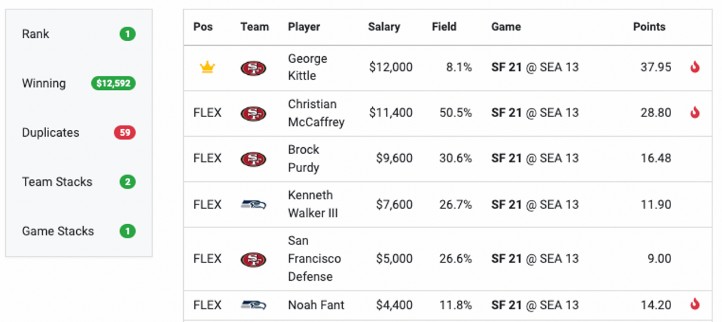
Captain or MVP Choices
The multiplier slot defines your build. In most slates, a winning captain is a player who can lead the game in raw points. Wide receivers and running backs often fit. Quarterbacks win when they spread the ball efficiently or add rushing.
Match captain to game script. If you expect a pass heavy shootout, captain a receiver. If you expect a grind with short fields, captain a workhorse running back.
Correlation Still Matters
Even in one game, your lineup is a story. Pair captain receivers with their quarterback. Add a bring-back from the other side when you expect push and pull. If you play a defense captain, pair it with a running back for a control script.
Duplication Control
You need to beat the field and avoid splitting first place too many ways. Leave salary on the table when the field spends to the cap. Use less common roster builds, like a 2–4 or 1–5 split when the game script supports it. One or two unique choices can multiply your payout.
NFL DFS Weekly Workflow and Checklist
Monday to Tuesday
Wednesday to Friday
Watch practice reports. Track upgrades and downgrades. Adjust projections for players trending up or down. Revisit your game list. If news shifts a role, update your value pool.
Saturday
Check the weather, Vegas moves, and late injuries. Compare projections and ownership one more time. Build sample stacks and see how salary shapes your choices. Prepare a few swap plans for late games.
Sunday Morning
Confirm inactives. Make final updates to projections and ownership. Enter lineups with a few minutes to spare. Keep an eye on late swap windows so you can react with a calm plan.
NFL DFS Bankroll Management Plans
Let’s take a look at a few practical examples of how you should approach bankroll management in DFS NFL football.
$100 Bankroll
Play small and steady. Use $7 to $8 per full slate. Enter one head-to-head, one small double-up, and one low-dollar single-entry GPP. This keeps variance low while you learn and still gives you a shot at a nice return.
$500 Bankroll
Use $35 to $40 per slate. Play a mix of head-to-heads and double-ups. Add several single-entry or 3-max tournaments at low stakes. Keep individual entries small. Aim to enter multiple lineups across a few small-field rooms.
$5,000 Bankroll
Use $350 to $400 per slate. Split across cash, single-entry GPPs, and a light multi-entry pool. Cap any single lineup at no more than 2 percent of your weekly plan. Treat your builds like a portfolio and review exposure each week.
Common DFS NFL Football Mistakes to Avoid
Want to avoid fantasy pain? Here are some fast guardrails to save you from fantasy shame land.
- Chasing Last Week: Last week’s points often inflate salaries and ownership. Roles and matchups change. Anchor on usage, not box scores.
- Ignoring Ownership: In tournaments, playing the best median lineup with all the chalk can trap you. Balance projection with popularity so you still have a path to pass the field.
- Over-Stacking Bad Games: Low total games rarely support three or four pieces. Keep stacks tight when the total is low. Use skinny stacks or one-offs in slow matchups.
- Fading Late News: Injuries create cheap volume. If a starter sits, a backup can become the best value on the slate. Adjust quickly and stay flexible.
- Getting Too Cute in Cash: Cash games reward simple, solid plays. Do not fade the best value for the sake of being different. Save creativity for GPPs.
Top NFL DFS Tools and Resources
There are tons of free and premium tools, plus communities and pods that you can access to complement our DFS NFL guide, such as:
Free Resources
Use team depth charts, official injury reports, and weather updates. Follow beat reporters for last-minute notes. Look at Vegas totals and spreads to frame your slate.
Premium Tools
Consider a projection set that includes median, floor, ceiling, and ownership. An optimizer can speed up builds if you set strong rules. Do not let the tool build your NFL daily fantasy sports lineup without your plan. Your rules matter more than the button.
Communities and Podcasts
A good community speeds your learning. Read strategy threads. Listen to process-focused shows. Keep notes on what resonates and test ideas with small entries first.
Short NFL DFS Glossary: Key Terms
Lost in translation? Here are some helpful definitions to make you sound like a DFS NFL pro.
- aDOT: average depth of target, the average yards downfield on targets.
- Air Yards: total yards the ball travels toward a receiver on targets.
- Bring-back: a player from the opposing team you stack with your main game stack.
- Chalk: a popular player with high ownership.
- Ceiling: the realistic high end of a player’s scoring range.
- Correlation: how one player’s scoring relates to a teammate or opponent.
- Floor: the safer, lower end of a player’s outcome range.
- GPP: guaranteed prize pool tournament.
- Late Swap: ability to change players whose games have not started.
- Median Projection: the middle outcome in a distribution of scores.
- Ownership: an estimate of how many lineups will include a player.
- Skinny Stack: a quarterback with one pass catcher, or a simple two-player game stack.
- Tilt: emotional reaction to results that can hurt your process.
The Bottom Line on NFL DFS
Winning at NFL DFS comes down to process, not gut feel, and the details above matter more than which quarterback looks best on paper.
🎯 Match Your Format to Your Skill Level: Cash games reward consistent, safe lineups, while tournaments reward high-ceiling, differentiated picks, so choose the contest type that fits your bankroll and risk tolerance.
📊 Usage Beats Name Recognition: Red zone touches, air yards, and snap share tell you more about a player’s real weekly ceiling than name value alone.
🧩 Stack Smart, Not Just Big: Correlating a quarterback with his top target can raise your lineup’s ceiling, but overloading a low-total game can just as easily sink the whole thing.
🏆 Four Ways to Play Beyond Traditional DFS: Fliff, Rebet, and Betr each offer their own take on NFL contests, giving you options beyond a single salary-cap format.
📈 Avoid the Common Traps: Chasing last week’s box score and ignoring ownership are two of the fastest ways to turn a good process into a bad week.
Frequently Asked Questions
Rules depend on your location and the platform. Check the terms on the site you plan to use. Look for a clear list of supported areas and any age requirements before you play.
Start small. Set a weekly limit. Enter one or two cash contests and one small-field tournament. Use players with stable roles and good projections. Review results after each slate and write one lesson you can apply next time.
In cash, one pass catcher is enough. In tournaments, two pass catchers work well when the game total is high or the team’s target tree is narrow. Add a bring-back when you expect the opponent to keep pace.
Treat ownership as a tiebreaker. If two players project similarly, favor the one who will be less popular in tournaments. In cash, do not fear popular value if the role is strong.
Volume comes first. A heavy role beats a soft matchup with a weak role. When roles are similar, matchup and pace break the tie.
Plan for it. Leave at least one flexible spot in a late game. If your early players fail, swap to lower-owned options. If your early players smash, use safer choices to hold your lead.
Route rate, target share, and red zone targets matter most. A tight end who never leaves the field and sees end zone looks can beat a projection without many catches.
Duplication happens when many lineups are the same. If you split first place with hundreds of entries, your payout drops. Leave salary, mix roster builds, and tell a unique game story to avoid heavy duplication.
Responsible DFS Play
Play for fun with money you can afford to lose. Set deposit and time limits. Take breaks after long sessions. If you feel stress or chase losses, pause and reset. Most platforms offer tools to help you manage your play. Use them. If you need help, look for support resources in your area.


