


 Share
Share 



California Prop 26 is now before voters in what could either be a winning or losing day for sports betting legalization in California in 2022. Going into the election, Prop 26 was a definite longshot. Only 34% of likely California voters planned to vote yes on the measure, according to a Public Policy Institute of California poll released in late October. The same poll showed 57 percent of likely voters plan to vote against the measure.
Should it somehow manage to pass, Prop 26 would allow in-person-only sports betting at tribal casinos and four horse racing tracks in California. The 2022 ballot initiative is backed by at least 80 tribal and non-tribal organizations through the Coalition for Safe, Responsible Gaming.
The proposed initiative appears alongside Prop 27 — a rival initiative that would allow mobile sports betting. Tribes that back Prop 26 say in-person sports betting is the best path forward by allowing tribes and the state to get comfortable with sports betting and what could come next. And they say tribes are more than capable of leading the effort.
“Don’t underestimate tribes,” Morongo Band of Mission Indians Vice Chair James Siva said during a tribal gaming update at G2E in Las Vegas last month.
The gaming tribes backing the initiative certainly stand to do well under Prop 26. All 82 casinos in the state (and potential sports betting locations) are tribal-owned and operated, giving those casinos an obvious edge should Prop 26 succeed.
Now it is up to California voters to agree or disagree.
Prop 26, Explained
Prop 26 is a proposed state statute and proposed state constitutional amendment. It would allow tribal casinos to offer in-person sports betting, pending state and federal approval of amended tribal gaming compacts between California tribal nations and the state. It would also allow retail sportsbooks at four privately-owned racetracks — Santa Anita Park, Del Mar Race Track, Los Alamitos Race Course, and Golden Gate Fields.
Prop 26 would trigger two major legal changes that could potentially bring sports betting to California:
- It would mean passage of the In-Person Tribal Sports Wagering Act, which would allow sports betting on tribal land and at the four horse racing tracks.
- It would amend the California state constitution to permit California’s governor and federally-recognized tribes to negotiate gaming compacts that would allow expanded gaming – including sports betting – at tribal casinos, with state and federal approval.
Added table games like craps, now off-limits to the casinos, could also be written into the amended tribal-state gaming compacts required to offer sports betting.
Quick Guide
- Betting on professional, college*, or amateur* sports and athletic events
- Betting on in-state or out-of-state games played by California college teams would remain illegal, except during tournament play. Betting on high school sports and events would remain illegal*
- A 10% tax on sports betting profits at nontribal horse racing tracks only
- No sports betting by persons under the age of 21
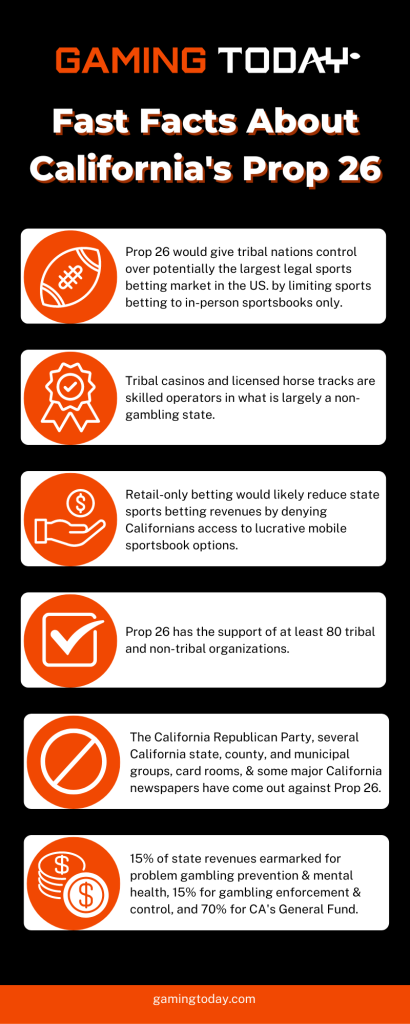
- 15% of state revenues earmarked for problem gambling prevention and mental health
- 15% earmarked for gambling enforcement and control
- 70% earmarked for the state’s General Fund
Prop 26: Pros and Cons
Prop 26 would give tribal nations almost complete control over what is potentially the largest legal sports betting market in the US. It would do that by limiting sports betting to in-person sportsbooks only.
So how would that impact overall revenue in a state with a potential estimated sports betting handle of $20 billion to $30 billion per year? That’s uncertain, for now. But retail-only betting is expected to put top online sportsbooks like FanDuel, DraftKings, and BetMGM at a significant disadvantage, with little room for negotiation.
Online sportsbooks took notice and filed a $100 million counter initiative in Aug. 2021 that would allow online and mobile sports betting by operators tied to tribal partners. That initiative is now qualified for the November 8 ballot as Prop 27. Voters will be able to select Prop 26 or Prop 27 at the polls this fall.
The winner will be decided by which proposal receives the most “yes” votes, according to local news reports early this year — unless a court battle gets in the way.
Pros
Tribal casinos and licensed horse tracks are skilled operators in what is largely a non-gambling state. (Card rooms, bingo, and the state lottery are the only other legal options in California.) That primacy was made clear in 2019 when the initiative was filed with the Office of the California Attorney General by four tribes — the Pechanga Indian Reservation, Barona Band of Mission Indians, Yocha Dehe Wintun Nation, and Agua Caliente Band of Cahuilla Indians.
Cons
Retail-only betting would likely reduce state sports betting revenues by denying Californians access to lucrative mobile sportsbook options. Additionally, a provision in the ballot measure that would allow private lawsuits against legal cardrooms for any suspected gambling violation could jeopardize the cardrooms and dozens of cities that rely on tax revenue from those businesses.
Prop 26: The Polls
Less than 50 percent of registered California voters polled on Prop 26 in Feb. 2022 said they approved of the ballot measure. The poll was conducted by the University of California Berkeley Institute of Governmental Studies between Feb. 3-10.
As reported by Ballotpedia, the poll asked 4,477 participants for their “initial opinions about a proposed statewide constitutional amendment to allow sports betting in California (Prop 26).” The results were as follows:
- 45 percent of participants said they approved of Prop 26
- 33 percent said they did not approve of Prop 26
- 22 percent of respondents were undecided
Prop 26: Who Supports It?
Prop 26 has the support of at least 80 tribal and non-tribal organizations, according to a June 22 press release from the Yes on 26 – Stand With Indian Tribes campaign behind Prop 26.
American Indian Chamber of Commerce of California President Tracy Stanhoff called Prop 26 “the responsible approach to authorizing sports wagering because it’s modeled off the successful model that Indian tribes have used to operate gaming for more than 20 years,” according to the release.
“The revenue generated by this measure will bring tens of millions of dollars each year to our state budget and local governments alike. It will also support tens of thousands of jobs. It’s a win for tribes and all Californians,” Stanhoff was reported as saying.
Click Here To Learn More About California’s Sports Betting Legislation
Among dozens of other organizations named as supporters of Prop 26 in the June 22 press release are the California District Attorneys Association, Los Angeles Urban League, local chambers of commerce, public safety agencies, several tribal groups, and the California Young Democrats.
Prop 26: Who Is Against It?
The California Republican Party voted to oppose both Prop 26 and Prop 27 in August. The decision was announced by state Republican Party chair Jessica Millan Patterson in an Aug. 19 statement, without elaboration on any specific initiative: “Voters are with Republicans on the ideas, and with our final ballot initiative positions now in place, we are ready to put in the work to ensure that voters are with us again this November,” Millan Patterson stated in a California GOP (CAGOP) press release dated Aug. 19.
Several California state, county, and municipal groups oppose Prop 26 for what they see as its potential negative impact on legal cardrooms and cities. These groups seem most concerned with what they call a “poison pill” provision in Prop 26 that would allow tribes to take legal action against cardrooms for suspected gambling violations. The groups — including American Federation of State, County and Municipal Employees (AFSCME) locals and the California Contract Cities Association, among others — say the provision is a ploy designed to bankrupt cardrooms that are a major source of tax revenue for many California cities.
Major California newspapers have also come out against Prop 26. Both the Los Angeles Times and The Orange County Register published editorials in late summer railing against the tribal-led initiative. An Aug. 26 editorial in The Orange County Register called Prop 26 “a raw money grab and has nothing to do with ‘self-reliance’ and ‘responsible’ gaming. We strongly support legalizing sports betting, but not by letting tribes crush their old and new competitors alike. We urge a no vote on Prop. 26.” Likewise, a scathing editorial in the Sept. 11 edition of Los Angeles Times called the ballot measure “a toxic brew of industry interests designed not only to enrich the funders but also to push away their competitors.”
Also read: An Apolitical Guide to Operation Sports Betting California


