


 Share
Share 



Like sports betting odds, a prediction platform’s contract prices can change as events unfold or news breaks. If a team clinches a playoff spot and plans to rest starters, users who initially bought “yes” contracts for that team winning its Week 17 game may see the value of their contracts decline as more users buy “no” contracts for the game.
How much — and how quickly — contract prices change depends on the events they’re tied to, and prediction markets may not always move at the same speed as Las Vegas odds.
A major injury sends markets into free fall
Trade on Sports, Politics, and MORE
Largest Prediction Market in the US
Hundreds of Markets to Choose From
Trade on Sports, Politics, and MORE
Largest Prediction Market in the US
Hundreds of Markets to Choose From
On Dec. 14, 2025 the Kansas City Chiefs were fighting for their playoff lives against their division rival, the Los Angeles Chargers. Late in the fourth quarter, the Chiefs were driving and trailing by three points.
With two minutes left in the game and the Chiefs inside the Chargers’ 50-yard line, star quarterback Patrick Mahomes dropped back to pass. As he tried to avoid pressure, Mahomes wrenched his knee and fell to the ground.
Although the extent of the injury was unclear at the time, prediction markets reacted as if it were season-ending.
One way to see this shift in sentiment is to look at the prediction market for the Chiefs’ next game against the Tennessee Titans.
Before the Chiefs’ game against the Chargers, “yes” contracts were the most popular. Based on contracts sold on its platform, Kalshi forecast the Chiefs’ chances of beating the Titans at 84% around 24 hours before the Chiefs-Chargers game.
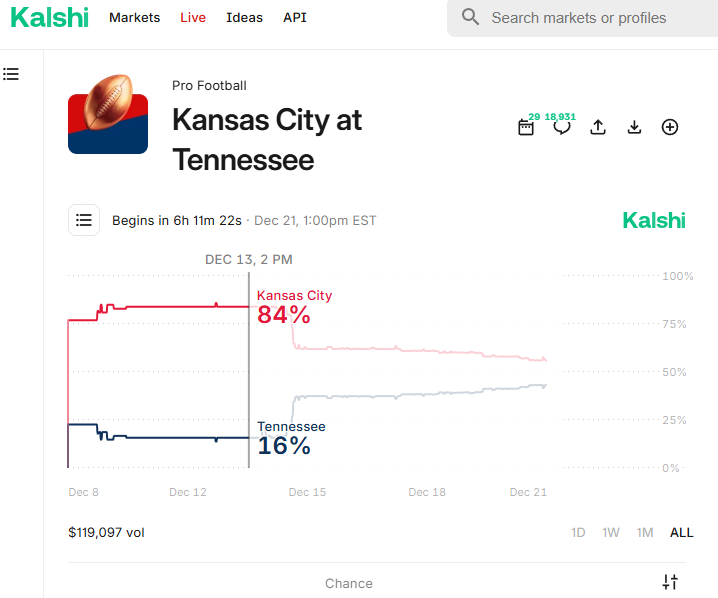
During the game, the “yes” and “no” spreads fluctuated as the market reacted to scoring plays by both teams. The most dramatic change occurred around 4 p.m. ET, when Mahomes went down with the injury.
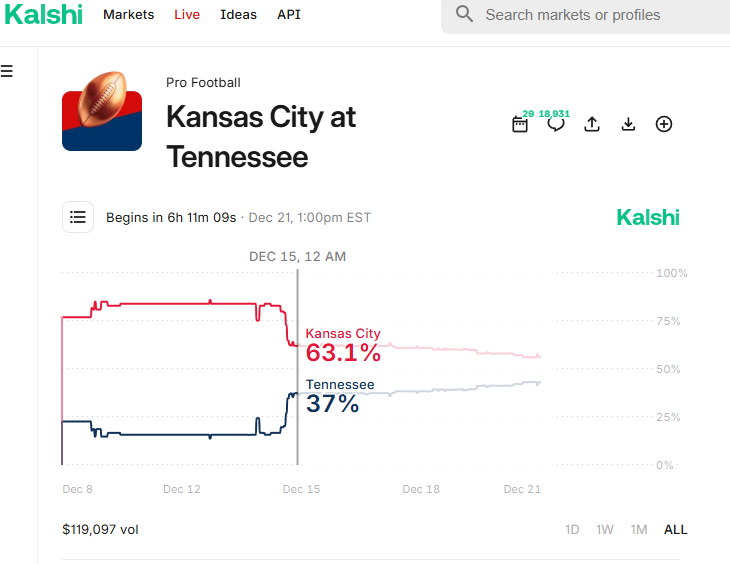
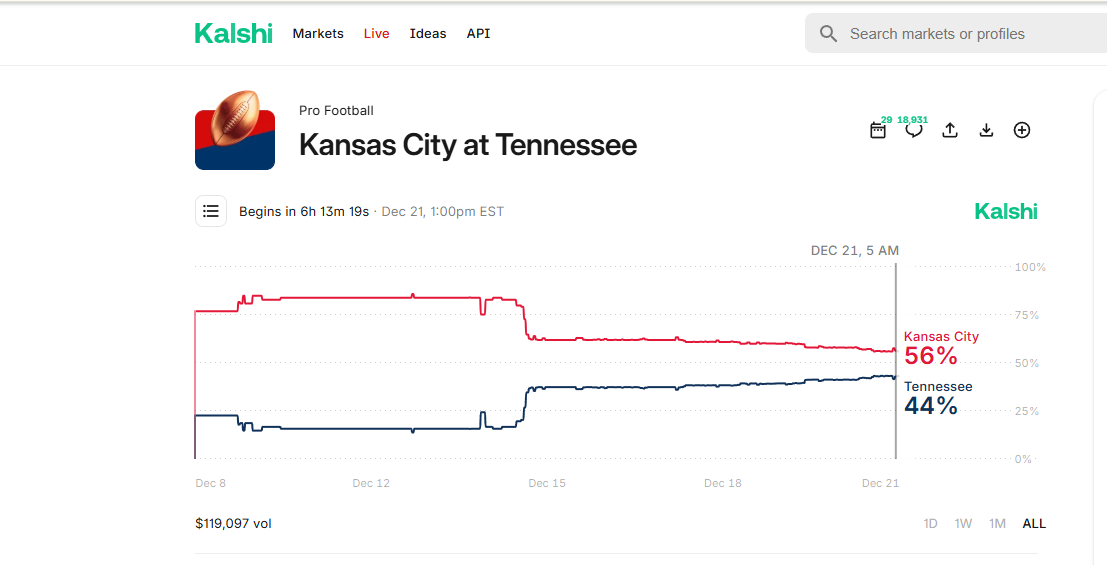
Whether from “yes” contract holders selling off positions or a surge of buyers purchasing “no” contracts, the spread between the two contracts collapsed. By the morning of the Titans game, the Chiefs’ implied chances of winning — based on sold “yes” contracts — had fallen by more than 30 percentage points from the day before the Chargers game.
A blowout win sparks rapid market repricing
Another example of how prediction markets respond to unfolding news is Kalshi’s “yes” and “no” contracts for a Jacksonville Jaguars-Los Angeles Rams Super Bowl matchup. Before the Jaguars’ Dec. 14 game against the New York Jets, “yes” contracts were priced at 4 cents.
The Jaguars routed the Jets, and by the end of the game, the price of a “yes” contract doubled to 8 cents.
Lillard’s Achilles drop-kicks the market
In the first round of the 2025 NBA playoffs, Milwaukee Bucks star Damian Lillard suffered a torn Achilles tendon during Game 4 against the Indiana Pacers, instantly ending his postseason run and his team’s title hopes.
Lillard’s injury was confirmed after the game and quickly dominated NBA news cycles, forcing bettors and analysts to reassess the Bucks’ prospects in real time. While sportsbook futures and odds shifted significantly on this news — moving Milwaukee from a competitive series contender to heavy underdogs — prediction markets immediately reflected the updated expectations as traders dumped “Yes” contracts on the Bucks advancing and shifted into “No” or rival outcomes.
The sudden change in available information about Lillard’s health caused rapid repricing in NBA playoff markets, illustrating how breaking injury news can sharply alter collective expectations in prediction markets.
How markets digest breaking sports news
Together, these examples show how sports-related prediction markets can react sharply — and sometimes instantly — to breaking news, while still lagging or diverging from traditional betting markets. Contract prices don’t just reflect outcomes on the field but also how quickly participants process new information, assess uncertainty and reposition their bets.


