


 Share
Share 



Sportsbooks have long been the primary platforms for sports betting. However, the rise of prediction markets has introduced a different option. Unlike traditional sportsbooks, prediction markets cover a wider range of event types and allow users to trade contracts rather than place fixed wagers.
On these platforms, users buy and sell event-based contracts across multiple categories, including sports. The markets operate similarly to financial exchanges, with prices reflecting implied probability and changing as new information becomes available. This guide reviews the top sports prediction markets currently in operation.
1. Kalshi
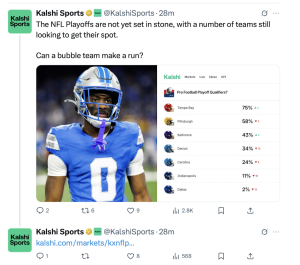
Kalshi is a US-based prediction market regulated by the Commodity Futures Trading Commission. Rather than operating as a traditional betting site, it functions as a regulated financial exchange. The platform offers a broad selection of sports markets, including the NFL, college football, the NBA, the EuroLeague, college basketball, tennis and soccer.
Contract prices range from 0 to $1, reflecting the market’s implied probability. A winning trade settles at $1, while a losing trade settles at $0.
Kalshi stands out for its transparent pricing model and its wide range of available events. Users can trade contracts tied to major sporting, political and economic outcomes, with prices updated in real time. Unlike sportsbooks, Kalshi does not build a margin into its pricing and instead charges transaction fees.
The platform is not available in all states because of ongoing regulatory issues. Kalshi is best suited for users who value deep event coverage and clear, market-driven pricing.
2. Polymarket
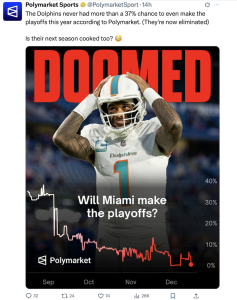
Often referred to as the world’s largest prediction market, Polymarket is a leading operator in this space. The platform recently launched a mobile app, improving accessibility for users. Its sports markets include the NFL, college football, the NBA, the NHL, soccer, tennis, esports and cricket.
Polymarket operates using blockchain technology and accepts cryptocurrency payments. It also supports fiat payment options such as Visa and Mastercard, expanding access for users who prefer traditional payment methods.
3. PrizePicks Predict
PrizePicks Predict is a sports-focused prediction market product launched by the popular daily fantasy sports operator. Built using regulated prediction market infrastructure, the platform allows users to trade event-based contracts tied to real sports outcomes in eligible states.
The interface is designed to feel familiar to existing PrizePicks users, with simple contract structures and an emphasis on major leagues and high-profile events. Pricing is straightforward, and contracts clearly define settlement conditions, making the platform accessible to users new to prediction markets.
PrizePicks Predict stands out for blending fantasy sports familiarity with prediction market mechanics. It is well-suited for sports fans who want a regulated alternative to traditional sportsbooks without the complexity of advanced trading platforms.
4. FanDuel Predicts
FanDuel Predicts is a newer entrant in sports prediction markets and is owned by the FanDuel brand. Officially launched in December 2025, the platform was designed primarily for traditional sports bettors.
Users familiar with FanDuel’s sportsbook products will find the interface easy to navigate. The platform offers quick access to a variety of markets and operates under CFTC oversight. FanDuel Predicts also provides its services in partnership with CME Group, an established exchange operator.
5. Fanatics Markets
Fanatics Markets launched at the end of 2025, marking the company’s entry into sports prediction markets. Built on the strong recognition of the Fanatics brand, the platform is designed to feel approachable for users who may be new to prediction markets.
The interface is straightforward and focuses on major sports and high-profile matchups. Contracts are clearly presented, making it easy for users to understand what they are trading and how outcomes are determined. Integration with the broader Fanatics ecosystem adds convenience for existing customers.
As a newer platform, liquidity is still developing and may be more limited for smaller events. Fanatics Markets is best suited for first-time users and casual fans who prioritize ease of use over advanced trading features.
6. Underdog
Underdog, a well-known sports gaming and fantasy brand, has expanded into prediction markets through partnerships rather than by operating its own exchange. The company has explored offering sports event contracts in select jurisdictions using regulated market infrastructure.
The Underdog platform emphasizes ease of use and a sports-first experience, targeting fans who are already comfortable with fantasy contests and player-focused markets. Its prediction market offerings align closely with popular sports and mainstream events rather than niche contracts.
While Underdog’s prediction market presence is more limited than that of dedicated exchanges, the brand’s strong sports audience and intuitive design make it a noteworthy option as prediction markets continue to evolve.
7. Robinhood Prediction Markets
Robinhood has entered the prediction market space by integrating event-based contracts directly into its trading app. Rather than operating its own exchange, Robinhood partners with federally regulated prediction market operators, including Kalshi, to offer access to event contracts, including select sports markets.
The experience closely mirrors Robinhood’s core trading products, making it familiar to users who already trade stocks or cryptocurrencies on the platform. Contracts are presented with clear pricing that reflects implied probability, and users can buy or sell positions as market conditions change.
Robinhood’s approach lowers the barrier to entry for prediction markets by placing them alongside traditional financial products. While sports coverage is more limited than on dedicated prediction market platforms, Robinhood appeals to users who want occasional sports exposure within a broader investing environment.
How sports prediction markets work
Sports prediction markets and sportsbooks operate under different models. Prediction markets use prices that represent implied probability, allowing prices to move as new information becomes available. Users can often enter and exit positions before an event concludes.
Sportsbooks, by contrast, offer fixed odds and adjust lines primarily to manage risk. Once a wager is placed, there are typically fewer options to adjust or exit the position.
When evaluating a sports prediction market, users should consider several factors.
- The platform should be easy to understand, with clear pricing and well-defined contract terms that explain settlement outcomes.
- Strong liquidity is essential, as it allows users to trade without sharp price swings.
- Fees and spreads should be competitive, since high costs can reduce returns.
- Sports coverage also matters. A strong platform offers access to multiple leagues and a wide range of contract types.
- Proper licensing and user protections are equally important, particularly as regulations continue to evolve across states and markets.
Prediction markets may appeal to users who value transparency and flexibility, while sportsbooks may be more attractive to those who prefer simple bets, standard formats and promotional offers.
Risks, limits and choosing the right platform
Sports prediction markets carry risks that users should understand. Regulatory frameworks are still developing, and changes in rules or court decisions may affect platform availability in certain states.
Liquidity can be limited for smaller or less popular events, which may create wider price gaps and make trades harder to execute. Settlement rules and timelines also vary by platform, meaning outcomes may not resolve immediately after an event ends.
There is no single best sports prediction market for every user. Each platform has its own strengths and limitations. Personal goals, experience level, risk tolerance and local availability all play a role in determining the best fit. The most important factor is choosing a platform that aligns with your needs and allows you to trade responsibly.


