


 Share
Share 



The Winter Olympics have always been unpredictable, but prediction markets approach that chaos very differently from sportsbooks. Instead of asking who will win and at what odds, these markets ask a simpler question: What is most likely to happen right now?
That shift in framing makes the Olympics a natural fit. With dozens of sports, rapidly changing conditions and constant new information, prediction markets turn the Games into a live probability exercise rather than a guessing contest. For anyone looking to trade on Olympic outcomes rather than bet on them traditionally, this is where things get interesting.
Prediction markets fit the Winter Olympics
Get $100 in Predicts Bonus When You Trade $1 for 5 Days
Make Predictions on Real World Events Right in Your Phone
Trade on Sports to Culture, Financials, Crypto and More
Get $100 in Predicts Bonus When You Trade $1 for 5 Days
Make Predictions on Real World Events Right in Your Phone
Trade on Sports to Culture, Financials, Crypto and More
Trade on Sports, Politics, and MORE
Largest Prediction Market in the US
Hundreds of Markets to Choose From
Trade on Sports, Politics, and MORE
Largest Prediction Market in the US
Hundreds of Markets to Choose From
Huge Range of CFTC-Approved Markets (Sports, Tech, and More)
Compete with Others & Climb the Leaderboards
No User Limiting on Trades
Huge Range of CFTC-Approved Markets (Sports, Tech, and More)
Compete with Others & Climb the Leaderboards
No User Limiting on Trades
Earn 50% Back on Football Trades
Fully Licensed & Regulated in all 50 States
Trade Contracts across Crypto, Politics, Sports & More!
Earn 50% Back on Football Trades
Fully Licensed & Regulated in all 50 States
Trade Contracts across Crypto, Politics, Sports & More!
Deposit $10, Get a $25 Trading Bonus
Live Trade with the Biggest Payouts at the Largest Prediction Market in the World
Deposit $10, Get a $25 Trading Bonus
Live Trade with the Biggest Payouts at the Largest Prediction Market in the World
America's #1 Sports Prediction Market
Same Sports Moments, Bigger Payouts
Choose from Straights, Player Props, Parlays & More
America's #1 Sports Prediction Market
Same Sports Moments, Bigger Payouts
Choose from Straights, Player Props, Parlays & More
PLUS Get up to $1,000 in $NVDA Based on Net Deposit Amount
Earn up to 8.1% APY on uninvested cash balances
Trade CFTC-regulated event contracts, stocks & options
PLUS Get up to $1,000 in $NVDA Based on Net Deposit Amount
Earn up to 8.1% APY on uninvested cash balances
Trade CFTC-regulated event contracts, stocks & options
Get $200 in Bonuses Paid Over 21 Days
DraftKings is Now Available Nationwide
Browse Markets like Sports, Crypto, Tech & More
Get $200 in Bonuses Paid Over 21 Days
DraftKings is Now Available Nationwide
Browse Markets like Sports, Crypto, Tech & More
Complete a Task in the Crypto.com App to Unlock up to 1 Bitcoin Worth of CRO Rewards
America’s All-In-One Trading Platform
Manage Your Crypto, Stocks, Predictions & Card Spend Seamlessly
Complete a Task in the Crypto.com App to Unlock up to 1 Bitcoin Worth of CRO Rewards
America’s All-In-One Trading Platform
Manage Your Crypto, Stocks, Predictions & Card Spend Seamlessly
Prediction markets think in probabilities, not payouts. Every contract reflects the crowd’s current belief about how likely an outcome is to occur, and that belief changes as new information arrives.
The Winter Olympics generate nonstop data. Weather reports, training times, injuries, equipment adjustments and early-round results all reach the market quickly. In a prediction market, those inputs move prices in real time instead of being locked into pregame odds.
Another advantage is scale. Sportsbooks often focus on a narrow set of Olympic events. Prediction markets are more comfortable with big-picture questions such as medal totals, country dominance or whether a specific nation finishes first in a discipline. Those questions attract sustained interest throughout the Games, not just during a single race or match.
Where to trade on the 2026 Winter Olympics
Among available platforms, Kalshi stands out as the most complete option for Winter Olympics markets in 2026.
Kalshi operates as a federally regulated exchange, allowing it to offer event-based contracts across most U.S. states. Instead of betting against the house, users buy and sell yes-or-no contracts priced between 1 cent and 99 cents. That price reflects the market’s real-time implied probability.
For the Olympics, Kalshi focuses on clean, well-defined outcomes. Medal count leaders, gold medal races and sport-level dominance markets tend to be the most active. Liquidity matters in prediction markets, and Olympic medal boards draw consistent volume from the opening ceremony through the final event.
Another advantage is transparency. Each contract clearly defines its settlement rules, which is especially important in events where ties, disqualifications or judging revisions can complicate outcomes.
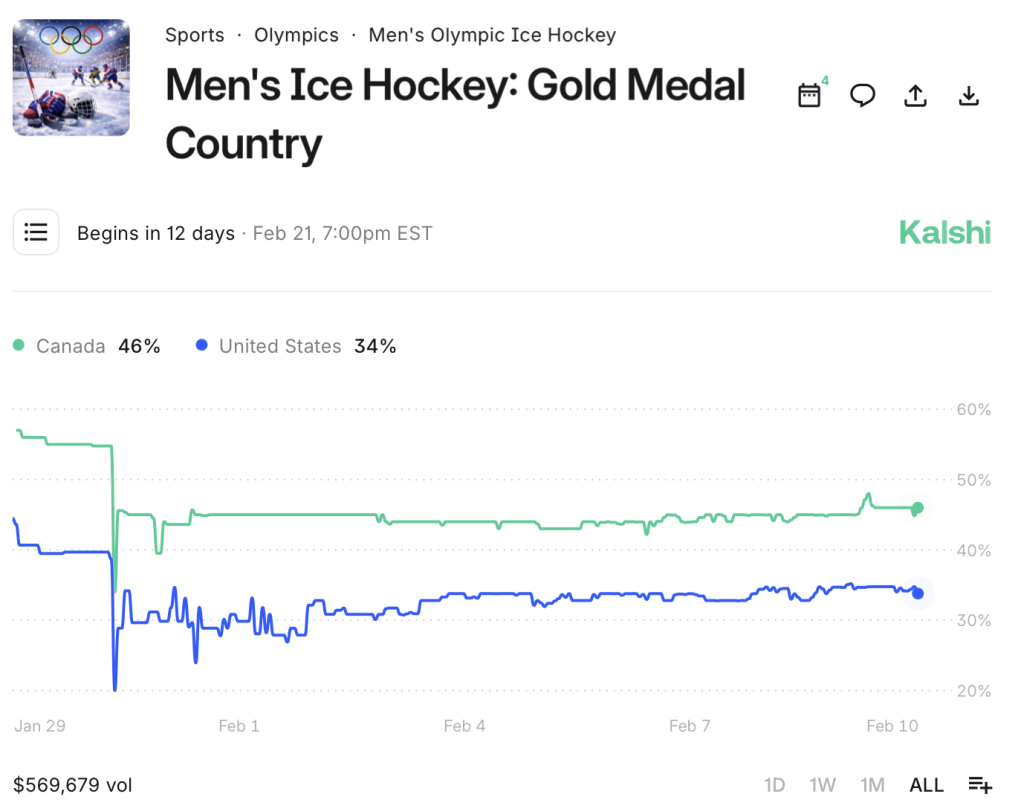
How markets price Olympic outcomes
Prediction markets care less about who looks dominant and more about how often dominance holds up under pressure. A favorite priced at 70 cents is not a lock; it reflects how confident the crowd feels at that moment.
Markets react quickly to uncertainty. A weather shift in Cortina can move alpine skiing contracts before a sportsbook adjusts. A strong early performance by a country can push medal totals higher, while still leaving room for pullbacks if momentum stalls.
Narratives still matter, but they appear as mispricing rather than hype. When public sentiment pushes a popular athlete too high, traders looking for value can fade that confidence rather than follow it.
The most reliable Winter Olympics markets
Not every Winter Olympic sport behaves the same way in a prediction market. Some categories reward structure and consistency, making them easier to model.
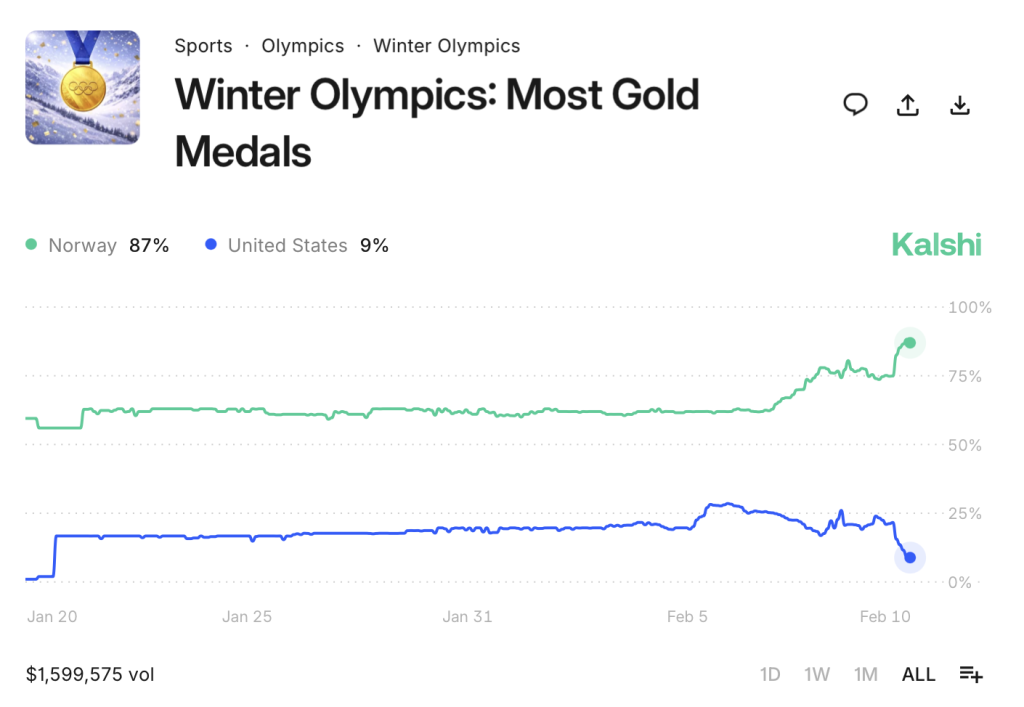
Medal count markets are the backbone of Olympic prediction trading. Countries with depth across multiple sports tend to perform reliably over a two-week window. These markets evolve slowly, giving traders time to adjust positions.
Speed skating and cross-country skiing also lean toward predictability. Performance trends, track conditions and recent results provide strong signals. Sudden collapses are rare without visible warning.
Biathlon sits in the middle ground. Ski speed and shooting accuracy are measurable, but penalties introduce enough variance to create opportunity when the market overreacts to a single poor round.
The most volatile Winter Olympic markets
Some Olympic sports resist clean probability modeling, especially in short formats or volatile conditions.
Alpine skiing, particularly downhill and super-G, carries significant environmental risk. Wind, visibility and course wear can flip outcomes in seconds, and markets often struggle to price that uncertainty accurately.
Ski jumping presents a similar challenge. Small changes in wind conditions can dramatically affect distances, and start order can matter more than form.
Judged events such as figure skating and freestyle skiing involve subjective scoring. While patterns exist, judging decisions can diverge just enough to punish overconfident pricing.
Short track speed skating is famously chaotic. Crashes, disqualifications and tight pack racing make even heavy favorites vulnerable.

Where traders gain an edge
The biggest edge in Olympic prediction markets comes from timing, not bold predictions. Early prices can be soft when markets first open. Late prices can swing too far when public sentiment spikes after a highlight moment.
Experienced traders watch volume as closely as price. Heavy trading without long-term commitment often signals emotional activity rather than conviction. Quieter markets with steady open interest tend to reflect a stronger consensus.
Geography also plays a role. Events that take place overnight in U.S. time zones can shift significantly before mainstream coverage catches up.
The appeal of probability-first Olympic markets
Prediction markets strip away the noise. There are no boosted odds, parlays or promotional distractions. Every contract is a statement about probability, nothing more.
For the Winter Olympics, that simplicity is powerful. With so many moving parts, trading probabilities can feel more honest than locking in a fixed bet.

