
Robinhood Prediction Markets Review & Promo Code for October 2026




- The Widest Category Spread We've Reviewed | Robinhood spans 13 categories, from sports and politics to climate, metals, and esports, well beyond the sports-and-politics core most competitors lean on.
- One Tap From an Account You Already Have | If you already use Robinhood for stocks, options, or crypto, Prediction Markets sits right inside the same app, with no new download or login required.
- Sports Contracts Nearly Everywhere | Because Robinhood isn't competing against a sportsbook of its own, sports event contracts are live in nearly every state, including several where traditional sports betting isn't legal.
Robinhood’s prediction markets feature lets users trade yes/no event contracts right inside the existing Robinhood app, covering one of the widest ranges of categories in the industry, including sports, politics, economics, crypto, commodities, and more. Contracts trade between $0.01 and $0.99 based on implied probability, settling at $1 if you’re right or $0 if you’re wrong, and traders can hold to settlement or close a position early. Trading is currently mobile-only, with support for limit orders and combo bets up to 10 legs, and it’s available in nearly every state.
Robinhood Prediction Markets Bonus and Promo Code for October 2026
Robinhood doesn’t run a welcome offer built specifically for prediction markets. What you’ll find when you sign up is Robinhood’s standard account bonus: a free stock worth $5 to $200, awarded for opening a brokerage account, verifying your identity, and funding it. Most new users land on the $5 end, but the process is identical for everyone. No promo code is required, since the bonus applies automatically once those steps are done.
Here’s the part worth reading twice: that stock bonus can’t be used to open or fund event contract trades. It’s tied to your core Robinhood brokerage account, not to Prediction Markets specifically. Robinhood runs a matching referral program in the same $5 to $200 range for existing users, and it carries the identical restriction: referral stock, not trading credit.
Actually trading on Prediction Markets takes one extra step that several sportsbook-style competitors skip entirely. Once your brokerage account is open, you still need to separately apply for and be approved for a Robinhood Derivatives account before you can place your first trade. It’s not a hard barrier, and approval is usually quick, but it’s a real one worth planning around if you’re hoping to fund an account and start trading the same day.
Here’s the quick-reference rundown on eligibility, fees, and everything else worth checking before you sign up.
| Detail | Info |
|---|---|
| 🎁 Welcome Offer | Free stock worth $5–$200 for opening & funding a Robinhood account (not Prediction Markets-specific) |
| 🎟️ Promo Code | None needed — bonus applies automatically after verification and funding |
| 🔁 Referral Bonus | Same $5–$200 free stock range for referring a friend; same trading restriction applies |
| 💵 Contract Price Range | $0.01 to $0.99 per contract; no stated minimum account deposit to open Predictions |
| 🪪 Account Verification | Full brokerage-style identity verification (name, DOB, SSN, address) |
| 📝 Derivatives Approval | Separate application and approval required for a Robinhood Derivatives account before trading |
| 🎂 Minimum Age | 18+ |
| 🌎 Eligible States | Available nationwide except Maryland (all event contracts) and Nevada (new sports event contracts, as of Dec. 1, 2025) |
| 🏛️ Regulator | Robinhood Derivatives, LLC — CFTC-regulated futures commission merchant & NFA member |
| 🔗 Clearing Exchanges | KalshiEX LLC, ForecastEX LLC, or Rothera Exchange and Clearing LLC, depending on the contract |
| 📊 Markets Offered | Sports, politics, climate, commodities, crypto, economics, education, entertainment, financial, metals, technology, racing, esports & more |
| 💳 Payment Methods | ACH bank transfer, instant bank transfer, debit card (Visa/Mastercard only), crypto transfer |
| 🧮 Trading Fees | Probability-weighted commission: 10% (5% with Gold) × price × (1 − price) × contracts, capped at $0.01/contract |
| 💎 Gold Discount | $5/month Robinhood Gold subscription cuts the commission rate in half |
| ⏱️ Withdrawal Time | ACH 1–5 business days; instant transfer is instant; debit card within 24 hours (1.75% fee, $1–$150 range) |
| 📱 Platform Access | Mobile app only for trading; web allows viewing markets, not trading; not available on Robinhood Legend |
| 💬 Customer Support | 24/7 live chat, weekday phone callback (7am–9pm ET), email support (~24-hour response) |
| 📅 Terms | Set by Robinhood — confirm current bonus and state details in-app before opting in |
What Is Robinhood Prediction Markets? Prediction Market Explained
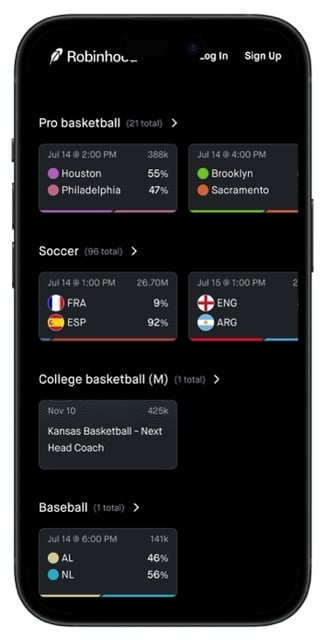
Robinhood Prediction Markets is Robinhood’s take on the prediction market category, built directly into the investing app millions of people already use for stocks, options, and crypto. Instead of opening a separate account somewhere else, you trade yes or no contracts on real world outcomes right alongside your existing portfolio. The category list is unusually broad, spanning sports, elections, climate, commodities, crypto, economics, education, entertainment, financials, metals, technology, racing, and esports, among others.
Robinhood didn’t build its way into this space the way some competitors have. Rather than acquiring an exchange or standing up its own, Robinhood routes event contracts through Robinhood Derivatives, LLC, which clears trades through one of three already regulated partners: KalshiEX, ForecastEX, or Rothera Exchange and Clearing, depending on the contract. Robinhood’s first foray into the category came via presidential election contracts back in October 2024. The much wider Prediction Markets hub you see today is the result of steadily layering new categories on top of that original bet.
How Robinhood Event Contracts Work
Every market on Robinhood boils down to the same yes or no format. Will Bitcoin close above $100,000 by the end of the month? Will a named storm make landfall in Florida this week? You buy a “Yes” contract if you think it will happen, or a “No” contract if you don’t.
Contract prices move between $0.01 and $0.99, and that price reflects the market’s live view of the odds. A contract sitting at $0.35 implies roughly a 35% chance of that outcome. Guess right, and your contract settles at $1. Guess wrong, and it settles at $0. You’re not locked in either way. Positions can be sold before the event resolves if the price moves in your favor, or if it moves against you and you’d rather walk away early.
So What’s Attractive About Robinhood Prediction Markets?
The biggest hook is convenience. If you already have money sitting in a Robinhood brokerage account, Prediction Markets is one tap away, with no new app to download, no separate login, and no re-verifying who you are. That’s a lower bar to clear than signing up somewhere unfamiliar just to trade a handful of contracts.
The category spread is the other selling point, and it’s the widest of any prediction market operator we’ve reviewed. Where some platforms lean heavily on sports or politics, Robinhood spreads its markets across climate, metals, education, technology, and esports about as comfortably as it does football or the Fed. Sports contracts are also live in nearly every state, since Robinhood isn’t a sportsbook competing against itself the way some rivals are. More on exactly where in the next section.
Is Robinhood Prediction Markets Legit and Where Is It Available?
Yes, Robinhood Prediction Markets is legitimate. Event contracts are offered through Robinhood Derivatives, LLC, a registered futures commission merchant and member of the National Futures Association, regulated by the Commodity Futures Trading Commission. That’s the same regulatory framework used across the prediction market industry, not something Robinhood invented for this product.
Regulation & Oversight
Robinhood doesn’t operate its own exchange the way a couple of competitors do. Instead, Robinhood Derivatives clears trades through one of three CFTC regulated exchanges, KalshiEX LLC, ForecastEX LLC, or Rothera Exchange and Clearing LLC, and which one handles a given contract depends on the market itself. That layered structure means two parties have a hand in every trade: Robinhood Derivatives as the registered firm managing your account, and whichever exchange is actually clearing the contract behind the scenes.
How Your Funds Are Protected
Worth knowing upfront: money used for event contracts sits in your Robinhood Derivatives account, and that account isn’t FDIC insured or covered by SIPC, unlike the stock and cash holdings in your regular Robinhood brokerage account. Event contracts are a derivatives product, not a securities holding, so they fall under a different protection regime entirely. Positions are fully collateralized instead, meaning your contract is backed by money you’ve already committed rather than borrowed funds. On the account security side, Robinhood layers in TLS encryption, two-factor authentication, and biometric login through Face ID or fingerprint, the same protections used across the rest of the Robinhood app.
Where Is Robinhood Prediction Markets Available?
Robinhood Prediction Markets is available nationwide, with two notable exceptions. Maryland residents can’t trade event contracts at all, and Nevada residents can’t open new sports event contracts, either. Additional restrictions can apply on a contract-by-contract basis, so it’s worth checking the app rather than assuming every market is open in your state.
Because Robinhood isn’t a sportsbook, it doesn’t carve out states the way DraftKings Predicts does to avoid competing with its own licensed product. That makes Robinhood’s sports contracts available in far more places than a typical sportsbook-linked competitor, including states where sports betting itself is still illegal. That said, the legal ground here is genuinely unsettled. Several state gaming regulators, including New York’s, have pushed back on sports event contracts as unlicensed gambling, and court rulings on the underlying jurisdiction question have gone both ways. None of that changes what’s live today, but it’s fair warning that today’s map could look different in a few months.
How to Get Started on Robinhood Prediction Markets
As of October 2026, getting into Robinhood Prediction Markets takes a bit more legwork than most competitors, since trading event contracts means clearing two separate approvals stacked on top of each other: your standard brokerage account, and then a dedicated Robinhood Derivatives account layered on top of it. Here's the full path from signing up to placing your first trade, including exactly where the account bonus does and doesn't come into play.
Open a Robinhood Account
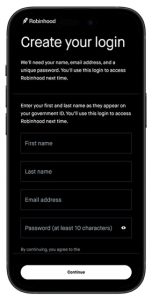
If you already have a Robinhood brokerage account, you can skip straight to funding it. New users can sign up directly in the app or online, providing their name, date of birth, Social Security number, and address to verify identity. You’ll need an individual investing account specifically. Robinhood doesn’t currently support event contract trading through joint or custodial accounts.
Fund Your Account
Add money using ACH bank transfer, instant bank transfer, a debit card, or a crypto transfer. This is also the step where Robinhood’s standard sign-up bonus applies: a free stock worth $5 to $200 for opening and funding your account. As covered earlier in this review, that stock bonus can’t be used to fund or trade event contracts specifically, so treat it as a nice extra rather than trading capital.
Apply for a Robinhood Derivatives Account
Search for “Prediction markets” in the app and open any event’s detail page. Selecting “Yes” or “No” on a contract kicks off the onboarding flow for a Robinhood Derivatives account, a separate approval layered on top of your regular brokerage account. Approval is typically fast, but if you’re rejected multiple times, or you disable event contract trading and later try to turn it back on, a 30-day waiting period can apply before you’re allowed to reapply.
Place Your First Trade
Once you’re approved, browse any category from sports to climate to crypto, pick a contract, and choose “Yes” or “No” based on how you think the event will play out. Review the price, which reflects the market’s implied probability, and confirm. From there, you can hold the position until it settles or sell early if the price moves in your favor.
How to Place a Trade on Robinhood Prediction Markets
Placing a trade on Robinhood follows the same basic shape as any event contract platform: find a market, pick “Yes” or “No,” and confirm. Open a contract’s event detail page, choose whether you want to trade in dollars or in contracts, and Robinhood walks you through the rest. Review the order details and swipe up to submit. From there, you can hold the position to settlement or close it early if the price has moved.
Order Types and Combos
Robinhood gives traders more control here than a lot of competitors. Immediate-or-cancel orders fill right away at the current price or don’t fill at all, while good-til-date orders let you set your own limit price and leave it open until 3 a.m. ET the next day. Dollar-based orders are always immediate-or-cancel and calculate the contract quantity for you based on the amount you enter, and some markets support fractional contracts down to two decimal places.
For sports fans who want something closer to a parlay, Robinhood supports combo orders on select events, including preset combinations and custom combos with up to 10 legs on football and basketball markets. Combos fill or cancel as a single unit. If Robinhood can’t get a quote from the exchange for every leg, or there isn’t a willing counterparty, the whole trade fails rather than partially filling.
Robinhood Trading Fees and Pricing
Contracts trade between $0.01 and $0.99, and that price is the market’s live estimate of the odds. Robinhood’s commission isn’t a flat per-contract charge. It’s calculated with a formula that scales with how close the price sits to a coin flip: commission equals 10% (or 5% with a $5-per-month Robinhood Gold subscription) multiplied by the contract price, multiplied by one minus that price, multiplied by the number of contracts.
In practice, that means the fee is smallest when a contract is priced near the extremes, close to $0.01 or $0.99, where the market is confident about the outcome, and highest in the middle of the range, around $0.50, where the outcome is closest to a toss-up. For example, buying 100 contracts at $0.90 each costs about $0.45 in commission with Gold, or $0.90 without it, on top of whatever the clearing exchange charges. Robinhood caps its own commission at $0.01 per contract regardless of price, and the exchange fee, when it applies, tops out at the same amount. Both fees apply whether you’re opening or closing a position, and both show up on your annual statement.
What Markets Can You Trade on Robinhood Prediction Markets?
Robinhood covers more ground than almost anything else in this space, spreading across 13 separate categories rather than leaning on sports and politics the way most competitors do. Here’s a quick look at every category and a real example pulled straight from the app.
| Category | Example Markets |
|---|---|
| 🏈 Sports | NFL, college football, NBA, college basketball, MLB, soccer, tennis, golf, and MMA; recently expanded into player performance props for football and prepackaged game combos |
| 🗳️ Politics | State and local races (mayoral contests, primary advancement) alongside federal contests |
| 📈 Economics | Fed rate decisions, monthly CPI prints, jobs reports, and GDP growth |
| 💹 Financial | Major indexes like the Nasdaq and S&P, plus company-level milestones |
| ₿ Crypto | Bitcoin price thresholds and other time-based price milestones |
| 🌦️ Climate | Daily high temperature thresholds and monthly rainfall totals across major cities; over 100 active contracts at any given time |
| 🌾 Commodities | Agricultural and energy prices, including natural gas and soybeans |
| 🥇 Metals | Gold, platinum, and palladium price thresholds |
| 🤖 Technology | AI progress, regulatory approvals, and space missions |
| 🎓 Education | Tuition trends, institutional rankings, and education policy outcomes |
| 🎬 Entertainment | Awards shows (Oscars, Grammys, Golden Globes) and pop culture voting outcomes |
| 🏇 Racing | Motorsports and horse racing outcomes |
| 🎮 Esports | Match winners across League of Legends, Counter-Strike 2, Valorant, Dota 2, and Call of Duty |
That’s a lot of ground to cover, so rather than walk through all 13 with equal weight, here’s a closer look at the categories where Robinhood actually stands out.
Sports
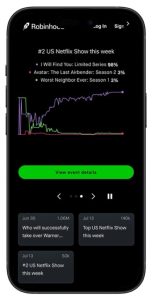
Sports remain Robinhood’s most heavily traded category, running across the NFL, college football, the NBA, college basketball, MLB, soccer, tennis, golf, and MMA. Robinhood recently expanded into player performance props for professional football, a level of granularity it didn’t offer a year ago, along with prepackaged combos for individual games. It’s a sign the company is leaning harder into sports rather than treating it as a side category.
Climate
This is the category that separates Robinhood from most of its competition. With well over 100 active climate contracts running at any given time, questions like whether a city’s daily high temperature clears a set mark, or whether a specific location sees more than an inch of rain in a given month, run in parallel across dozens of cities. It’s a genuinely deep category that most prediction market platforms treat as an afterthought.
Crypto
Crypto contracts lean on price thresholds and time-based milestones, like whether Bitcoin closes above a set price by a given date. Given that Robinhood already runs a full crypto trading business alongside stocks and options, this is one of the more natural extensions of the platform rather than a bolted-on category.
Esports
Esports contracts cover match winners across League of Legends, Counter-Strike 2, Valorant, Dota 2, and Call of Duty, tracking real organizations like Vitality, Natus Vincere, and FlyQuest through individual matches and tournament brackets. It’s a category most sportsbook-branded competitors skip entirely, and one that plays well to Robinhood’s younger, digitally native user base.
Beyond those four, Robinhood rounds out its lineup with Politics (state and local races alongside federal contests), Economics (Fed rate decisions, CPI prints, jobs reports, and GDP growth), Financial (major indexes and company-level milestones), Commodities (natural gas and soybeans, among others), Metals (gold, platinum, and palladium price thresholds), Technology (AI progress, regulatory approvals, and space missions), Education (tuition trends, rankings, and policy outcomes), Entertainment (awards shows and pop culture voting outcomes), and Racing. It’s a genuinely wide net, even if some of these categories carry far fewer active contracts than sports, crypto, or climate.
Robinhood Prediction Markets App and Platform Review
Unlike DraftKings Predicts, which runs as its own standalone app, Robinhood Prediction Markets lives inside the same app used for stocks, options, and crypto. There’s no separate download and no separate login. It sits inside the existing Investing tab, one search away from anything else you’re already doing in the app.
Because it’s tucked into an app that already handles far more established financial products, Prediction Markets can feel like a secondary feature rather than the main event. It’s still a product finding its footing, not the reason most people opened Robinhood in the first place.
Web and Mobile Experience
Trading is mobile only. The iOS and Android apps handle the full experience, but the desktop website only lets you view markets, not place a trade, and Robinhood Legend, the company’s dedicated desktop platform for stocks and options, doesn’t support event contracts at all. If you’re used to running your whole portfolio from a multi-monitor desktop setup, Prediction Markets is going to feel like the one exception where you have to reach for your phone.
Key Features for Traders
Where Robinhood pulls ahead of DraftKings Predicts is order flexibility. Beyond immediate or cancel orders at the current market price, you can place good til date limit orders and set your own price, something several sportsbook style competitors skip entirely. Robinhood also supports combo orders, including custom builds with up to 10 legs on football and basketball markets.
What’s still missing is depth. There’s no visible order book, no published trading volume, and no price history chart on most markets, so gauging a market’s liquidity before committing real money comes down to a gut check rather than actual data. For a platform built on top of one of the more sophisticated finance apps around, that gap stands out.
Current Promos at Robinhood Prediction Markets
As of October 2026, Robinhood isn’t running a limited-time promotion built specifically for Prediction Markets, the kind of spend-and-get offer you’ll see on some other platforms. What you’re left with is the same account-level stock bonus and referral program covered earlier in this review, plus one indirect perk worth knowing about: a Robinhood Gold subscription cuts your trading commission in half, from 10% down to 5% of the probability-weighted formula, for $5 a month. It’s not free money and it’s not tied to signing up, but if you plan to trade contracts regularly, it’s the closest thing to an ongoing discount Robinhood currently offers.
Prediction markets are still a newer, fast-moving corner of Robinhood’s business, so that could change. It’s worth checking the Promotions or Rewards section of the app periodically, since new offers tied to specific events or trading activity aren’t always advertised anywhere else. We’ll update this section if Robinhood launches anything Predictions-specific.
Robinhood Prediction Markets Payment Methods: Deposits and Withdrawals
Funding a Robinhood account is straightforward, with four ways to get money in, though getting money back out isn’t quite as fee-free as it is on some competing platforms. The table below breaks down the timing and cost for each option.
| Method | Deposit Fee | Deposit Time | Withdrawal Fee | Withdrawal Time |
|---|---|---|---|---|
| 🏦 ACH Bank Transfer | $0 | Up to 5 business days | $0 | 1 to 5 business days |
| ⚡ Instant Bank Transfer | $0 | Instant | $0 | Instant |
| 💳 Debit Card (Visa/Mastercard) | $1.95 temporary authorization on linking (refunded); no ongoing deposit fee | About 30 minutes | 1.75% ($1 to $150 range) | Within 24 hours |
| ₿ Crypto Transfer | Network fees may apply | Varies by network | Network fees may apply | Varies by network |
Funding Your Account
You can deposit using ACH bank transfer, instant bank transfer, a debit card (Visa or Mastercard only, no credit cards or prepaid cards accepted), or a crypto transfer. Instant bank transfer posts immediately, debit card deposits typically clear in about 30 minutes, and standard ACH transfers can take up to 5 business days. One quirk worth knowing about: linking a debit card triggers a temporary $1.95 authorization charge, which gets refunded, but it can catch new users off guard if they see it hit their statement without expecting it.
Withdrawals and Hold Periods
Withdrawals aren’t free across the board the way they are on some competing platforms. Instant bank transfer withdrawals arrive immediately and ACH withdrawals take 1 to 5 business days, both with no fee attached. Debit card withdrawals land faster, within 24 hours, but Robinhood charges a 1.75% fee for the convenience, ranging from $1 to $150 depending on the amount. If minimizing fees matters more to you than speed, ACH is the better default for cashing out.
Robinhood Prediction Markets vs. The Competition
Robinhood isn’t the only place to trade event contracts, and it isn’t really trying to be a dedicated prediction market app in the first place. FanDuel Predicts leans on a sports-first, mainstream app experience built through its partnership with CME Group. Polymarket offers the deepest market variety and the most active, crypto-native trading feel of the group. Kalshi runs one of the broadest slates of regulated contracts in the country, and not coincidentally, it’s one of the exchanges Robinhood itself routes trades through. Crypto.com folds prediction markets into a wider crypto and finance ecosystem, while OG, its sister platform, takes a more compliance-first, peer-to-peer approach with a milestone-based bonus structure. DraftKings Predicts brings the most brand recognition of the bunch, leaning on its sportsbook crossover and combo-style contracts to pull in existing bettors.
The comparison looks a little different here than it does for most of these platforms, since Robinhood isn’t asking you to adopt a new app or learn a new interface in the first place. Its edge is convenience: if you already have a brokerage account, Prediction Markets is a tap away. Where Robinhood tends to lose ground is depth, since order book visibility, price history, and community features all take a back seat to keeping the experience simple. Below, we’ll compare Robinhood with FanDuel Predicts, Polymarket, Kalshi, Crypto.com, OG, and DraftKings Predicts so you can see where each platform actually has the edge.

Robinhood Prediction Markets vs. FanDuel Predicts
FanDuel Predicts is FanDuel’s dedicated prediction market app, launched through a partnership with CME Group and expanded in mid-2026 with a second contract source via Crypto.com’s OG Prediction Markets. That gives it two distinct pools of event contracts to draw from rather than relying on a single exchange partner, a move timed in part to line up with 2026 World Cup entertainment and combination contracts.
The app covers sports, politics, and financial markets, structured the same way as most event contract platforms: buy “Yes” or “No” on an outcome, and the price reflects the market’s implied probability. FanDuel Predicts is available to trade in all 50 states, though sports specific contracts are limited to states where FanDuel doesn’t already run a licensed sportsbook, a familiar carve out among sportsbook-linked prediction platforms.
New users get a $25 trading bonus for signing up. FanDuel Predicts keeps that trading balance walled off from any FanDuel Sportsbook or Casino wallet, so funds don’t move between products even when you’re logged into all three with the same account.
Get $100 in Predicts Bonus When You Trade $1 for 5 Days
Make Predictions on Real World Events Right in Your Phone
Trade on Sports to Culture, Financials, Crypto and More
Get $100 in Predicts Bonus When You Trade $1 for 5 Days
Make Predictions on Real World Events Right in Your Phone
Trade on Sports to Culture, Financials, Crypto and More
FanDuel Predicts Pros
- Visible Order Book | FanDuel Predicts shows live bid and ask prices along with trading volume, giving traders a real read on how liquid a market is before committing.
- Two Exchange Partners | With contracts sourced through both CME Group and Crypto.com's OG Prediction Markets, FanDuel Predicts pulls from a broader pool of available markets than platforms tied to a single exchange.
FanDuel Predicts Cons
- Sports Contracts Depend on Your State | FanDuel restricts sports event contracts in states where it already runs a licensed sportsbook, so availability isn't as simple as "all 50 states."
- Narrow Deposit Options | Funding an account is limited mostly to debit card and ACH transfer, without the broader payment menu some competitors offer.

Robinhood Prediction Markets vs. Polymarket
Polymarket built its reputation as one of the largest prediction markets in the world before it was even legal for most US traders to use directly. That changed when Polymarket US, a CFTC regulated Designated Contract Market, began onboarding US users in December 2025, and the platform has been expanding its domestic footprint since. Today it covers politics, sports, crypto, finance, culture, and breaking news, with prices that move in real time as people trade rather than sitting fixed until something changes.
Funding an account leans crypto first. Deposits run through USDC, with on-ramps like Coinbase and MoonPay available depending on your account and location, so traders used to a debit card or bank transfer will have a bit of a learning curve just getting money in the door. That same learning curve carries over to the markets themselves. Each one sets its own resolution rules and settlement source, and reading those carefully before buying a position matters more here than on platforms with a simpler, more standardized rulebook.
New users who sign up with promo code GTODAY can deposit $20 and receive a $50 trading bonus.
Deposit $10, Get a $25 Trading Bonus
Live Trade with the Biggest Payouts at the Largest Prediction Market in the World
Deposit $10, Get a $25 Trading Bonus
Live Trade with the Biggest Payouts at the Largest Prediction Market in the World
Polymarket Pros
- Broadest Market Variety | Politics, sports, crypto, finance, culture, and breaking news all sit under one roof, giving traders more ground to cover than most single-focus platforms.
- Live, Trader-Driven Pricing | Prices move continuously based on actual trading activity rather than updating on a fixed schedule, giving Polymarket a genuine exchange feel.
Polymarket Cons
- Crypto-First Funding | Deposits run primarily through USDC and crypto on-ramps, an extra step for traders who'd rather fund an account with a debit card or bank transfer.
- Steeper Learning Curve | Resolution rules and settlement sources vary from market to market, so new traders need to do more homework before placing a position.
Robinhood Prediction Markets vs. DraftKings Predicts
DraftKings Predicts is DraftKings’ entry into event contract trading, running on DKeX, an exchange the company self-certified with the CFTC after acquiring Railbird, a prediction market exchange, to get into the category in the first place. It launched in December 2025 and covers sports, politics, crypto, the stock market, commodities, culture, and business and economics.

Robinhood Prediction Markets vs. Kalshi
Kalshi was the first CFTC-licensed event contract exchange in the country, and it’s still the backbone a lot of the industry runs on. Robinhood and Coinbase both route a portion of their event contract trades through Kalshi’s exchange rather than building their own, which says something about how established its infrastructure has become. Kalshi covers one of the broadest category lists available, spanning politics, economics, sports, culture, weather, and more.

Robinhood Prediction Markets vs. Crypto.com
Crypto.com Predictions lives inside the main Crypto.com app, right alongside the crypto trading, cards, and other financial products the company is best known for. Event contracts run through Crypto.com | Derivatives North America (CDNA), the CFTC-regulated entity that also supplies contracts to other partners in this space, including Underdog and, more recently, FanDuel Predicts.
Coverage spans sports, politics, and financial markets, with one notable exclusive: an entertainment tie-in with Hollywood.com that powers dedicated markets for the Oscars, the Grammys, and other awards shows and premieres. Funding an account benefits from the same infrastructure Crypto.com already runs for its core exchange, including instant bank transfers and card deposits, along with SOC 2 compliance and cold storage backing the security side.
New users can currently earn up to 1 BTC in CRO Rewards by completing a simple task in the app after signing up, with no promo code required.
Complete a Task in the Crypto.com App to Unlock up to 1 Bitcoin Worth of CRO Rewards
America’s All-In-One Trading Platform
Manage Your Crypto, Stocks, Predictions & Card Spend Seamlessly
Complete a Task in the Crypto.com App to Unlock up to 1 Bitcoin Worth of CRO Rewards
America’s All-In-One Trading Platform
Manage Your Crypto, Stocks, Predictions & Card Spend Seamlessly
Crypto.com Pros
- Awards Show Markets You Won't Find Elsewhere | The Hollywood.com partnership gives Crypto.com dedicated entertainment contracts, like the Oscars and Grammys, that most competitors don't offer at all.
- Mature Funding Infrastructure | Deposits benefit from the same instant bank transfer and card rails Crypto.com already runs for its core exchange, rather than a bolted-on payment system.
Crypto.com Cons
- Buried Inside a Larger App | Predictions sits as one feature inside Crypto.com's much broader crypto and finance app, which can make it feel secondary compared to platforms built around event contracts specifically.
- Fee Structure Takes Getting Used To | Between exchange fees and Crypto.com's own commission layer, understanding the true cost of a trade takes more homework than a flat per-contract fee would.

Robinhood Prediction Markets vs. OG
OG is Crypto.com’s standalone prediction market app, built and regulated separately from its sister platform, Crypto.com Predictions, as its own Designated Contract Market through Crypto.com Derivatives North America. Rather than living inside a broader crypto exchange, OG is built purely around event contract trading, covering sports, politics, economics, crypto, and culture.
OG leans harder into sports than its sister platform does, building out game winners, player props, and season-long outcomes alongside the standard politics and economics contracts. It’s a newer entrant, having launched in February 2026, and that relative youth shows up in thinner liquidity on some markets compared to more established competitors.
New users can earn up to $100 in bonuses by signing up, completing identity verification, making a deposit of at least $10, and hitting qualifying trading milestones within the promo window. It’s a compliance-first structure rather than an instant credit, so unlocking the full value takes some follow-through.
Huge Range of CFTC-Approved Markets (Sports, Tech, and More)
Compete with Others & Climb the Leaderboards
No User Limiting on Trades
Huge Range of CFTC-Approved Markets (Sports, Tech, and More)
Compete with Others & Climb the Leaderboards
No User Limiting on Trades
OG Pros
- Built Specifically for Event Contracts | OG runs as its own dedicated app rather than a feature bolted onto a broader crypto exchange, giving it a more focused trading experience than its sister platform.
- Deep Sports Market Design | Beyond standard game outcomes, OG builds out player props and season-long markets, giving sports-minded traders more to dig into than most compliance-first platforms.
OG Cons
- Bonus Takes Real Follow-Through | The $100 welcome offer unlocks through verification, a deposit, and trading milestones rather than landing all at once, so casual sign-ups won't see the full value.
- Thinner Liquidity as a Newer Platform | Some OG markets carry less trading volume than more established competitors, which can affect pricing and how easily you can exit a position.
Robinhood Prediction Markets Customer Support
Robinhood routes Prediction Markets support through the same Help Center it uses across every other product, so there’s no dedicated line specifically for event contracts. Live chat is available 24/7 and starts with a chatbot, escalating to a human agent for anything the bot can’t resolve.
If you’d rather talk to someone, phone support runs weekdays from 7am to 9pm ET, though it works on a callback model rather than a direct dial-in line. You request a call rather than reaching an agent immediately. Email support is also available, with a response time of around 24 hours for most inquiries.
| Support Channel | Details |
|---|---|
| 💬 Live Chat | Available 24/7; starts with a chatbot, escalates to a human agent for unresolved issues |
| 📞 Phone Support | Weekdays, 7am to 9pm ET; callback request model, not direct-dial |
| 📩 Email Support | About 24-hour response time for most inquiries |
| 📚 Help Center | Self-serve articles on accounts, funding, and event contracts, shared across all Robinhood products |
Robinhood Prediction Markets Pros and Cons
After going through Robinhood’s Prediction Markets hub end to end, from account setup to placing contracts across a dozen categories, a few things stand out clearly, for better and worse. Here’s the honest breakdown.
Robinhood Predicts Pros
- One Tap Away From an Account You Already Have | If you already use Robinhood for stocks, options, or crypto, Prediction Markets sits right inside the same app, with no new account, download, or login required.
- The Widest Category Spread We've Reviewed | Robinhood spans 13 categories, including unusual ones like climate, metals, education, and esports, well beyond the sports-and-politics core most competitors lean on.
- Real Order Flexibility | Beyond simple market orders, Robinhood supports good-til-date limit orders and custom combo trades with up to 10 legs, giving traders more control than several sportsbook-style competitors offer.
Robinhood Predicts Cons
- No Bonus Built for Prediction Markets | The only sign-up incentive is a stock bonus tied to opening a general brokerage account, and it explicitly can't be used to fund or trade event contracts.
- Trading Is Mobile-Only | You can view markets on the web, but placing a trade requires the phone app, and Robinhood Legend doesn't support event contracts at all.
- No Order Book or Price History | Despite sitting inside one of the more sophisticated finance apps around, Robinhood doesn't show live bids, asks, or historical pricing, making it hard to judge a market's liquidity before you trade.
Responsible Trading and Where to Get Help
Trading event contracts carries real financial risk, the same as any other form of wagering, even though Robinhood frames it as investing rather than betting. Robinhood builds in a few tools to help you keep trading within your means, and outside resources are available too if you ever need more support.
- Trading Breaks: A voluntary cooling-off period that suspends your ability to trade event contracts for a set stretch, such as 72 hours or longer, if you need to step back.
- Position Limits: Caps on how many contracts you can hold in a single event, which help prevent overexposure to one outcome.
- Self-Exclusion: Voluntarily lock yourself out of Prediction Markets trading if you feel it’s becoming a problem.
- Account-Level Controls: Because Prediction Markets shares your core Robinhood account, the standard account security and activity oversight tools already built into Robinhood carry over here too.
If you or someone you know is struggling with gambling or trading behavior, help is available. Call 1-800-GAMBLER, or visit our responsible gambling page for more resources.
Robinhood Prediction Markets Review: Final Verdict
Robinhood Prediction Markets is a strong pick if convenience matters more to you than depth, especially if you’re already trading stocks, options, or crypto on the platform. It’s not the deepest exchange out there. Traders who want a visible order book, desktop trading, or a bonus built specifically for event contracts will likely find more of what they’re after at Kalshi or a sportsbook-linked competitor. But for someone who wants the widest possible spread of categories without leaving an app they already trust, Robinhood delivers.
- 🔀 One tap from an account you already have: No new app, login, or identity verification required if you’re already a Robinhood user.
- 🌍 The widest category spread we’ve reviewed: 13 categories spanning sports to climate to esports, well beyond the sports-and-politics core most competitors lean on.
- 🏈 Sports contracts nearly everywhere: Only Maryland and Nevada carve-outs, since Robinhood isn’t competing against a sportsbook of its own.
- 🧮 Real order control: Good-til-date limit orders and 10-leg custom combos give traders more flexibility than several sportsbook-style rivals offer.
- 🏛️ Backed by real regulatory structure: Robinhood Derivatives, LLC is CFTC-regulated and routes contracts through established, independently regulated exchanges.
Other Robinhood Products
Robinhood Prediction Markets is just one corner of a much larger financial app. If event contracts aren’t quite your speed, or you’re curious what else Robinhood offers, here’s a quick look at its other major products.
- Robinhood Investing: The company’s original commission-free brokerage, covering stocks, ETFs, and options trading.
- Robinhood Crypto: A separate crypto trading arm supporting Bitcoin, Ethereum, and dozens of other cryptocurrencies.
- Robinhood Gold: A $5-per-month subscription that adds perks like a reduced Prediction Markets commission, higher interest on uninvested cash, and other premium account features.
- Robinhood Legend: A dedicated desktop platform built for active stock and options traders, with advanced charting tools that Prediction Markets doesn’t support.
Robinhood Predicts FAQs
Yes. Event contracts are offered through Robinhood Derivatives, LLC, a registered futures commission merchant and NFA member regulated by the CFTC. It’s the same federal framework used across the prediction market industry, not something unique to Robinhood.
No promo code is needed. Robinhood’s standard account bonus, a free stock worth $5 to $200, applies automatically once you open and fund a brokerage account, though it’s tied to the account itself rather than to Prediction Markets specifically.
You need the app. The Robinhood website lets you view markets, but placing a trade is mobile only, and Robinhood Legend, the company’s desktop platform for stocks and options, doesn’t support event contracts at all.
Contracts are priced between $0.01 and $0.99, so there’s no large minimum deposit required specifically for Prediction Markets. You’ll just want enough funded in your account to cover the contract price plus Robinhood’s commission.
Yes. Beyond your standard Robinhood brokerage account, you’ll need to separately apply for and be approved for a Robinhood Derivatives account before placing your first trade. Approval is usually quick, though repeated rejections can trigger a 30-day waiting period before you can reapply.
Maryland residents can’t trade event contracts at all, and Nevada residents can’t open new sports event contracts as of December 1, 2025. Additional restrictions can apply on a contract-by-contract basis, so it’s worth checking the app for your specific state.
Robinhood uses a probability-weighted commission: 10% (or 5% with Robinhood Gold) multiplied by the contract price, multiplied by one minus that price, multiplied by the number of contracts. Fees are lowest near the extremes and highest around a 50/50 contract, capped at $0.01 per contract.
No. The free stock bonus you get for opening and funding a Robinhood account, along with the matching referral bonus, is tied to your core brokerage account and can’t be used to open or fund event contract trades.
Withdrawals run through the same options as any Robinhood account: ACH transfer (1 to 5 business days, no fee), instant transfer (instant, no fee), or debit card (within 24 hours, with a 1.75% fee ranging from $1 to $150).
It depends on how often you trade. Robinhood Gold costs $5 a month and cuts your Prediction Markets commission rate in half, from 10% down to 5%. For occasional traders, the subscription may cost more than it saves, but frequent traders could come out ahead.

