
Politics Prediction Markets & Election Odds | October 2026


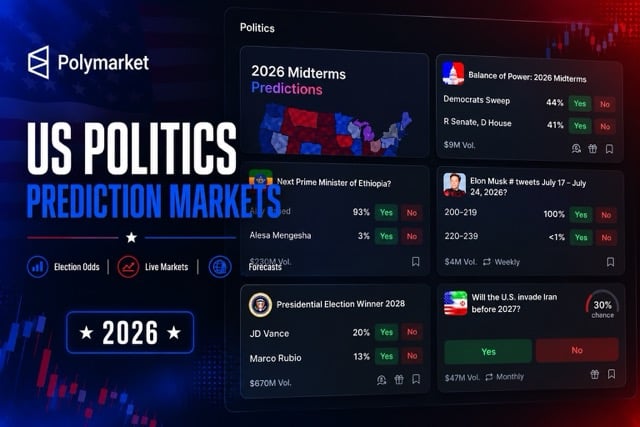
Political prediction markets let you trade on real-world outcomes, from control of Congress to presidential elections, with contract prices reflecting the market’s live view of the odds. These markets operate under CFTC oversight, a regulated, legal way to trade on political outcomes in the US, since traditional sportsbooks cannot offer such contracts.
What are political prediction markets?
Political prediction markets are regulated platforms where traders buy and sell contracts tied to real-world political outcomes, like which party controls the Senate or who wins the next presidential race. Each contract’s price reflects the market’s current view of the odds, moving in real time as new information comes in.
Every contract trades between 0¢ and $1, and that price is the market’s implied probability. If a contract on a candidate winning trades at 62¢, the market is pricing that outcome at roughly 62%. If the outcome resolves “yes,” the contract settles at $1. If it resolves “no,” it settles at $0.
You’ll find many prediction market platforms cover elections, legislation, and other political events. Unlike with traditional sports wagering, there’s no fixed-odds line set by a bookmaker. Prices move continuously as traders react to news, polling, and each other’s positions, which is why prediction markets are increasingly used as a real-time gauge of political sentiment, not just a place to trade on it. Traders sometimes call these political futures, since a contract’s price constantly updates to reflect the market’s best guess at the future outcome.
Is trading on political outcomes legal in the US?
Yes. Trading on political outcomes is legal in the US, just not through traditional sports betting sites. Platforms offer CFTC-regulated event contracts, which fall under federal derivatives law rather than state gambling law, making political event contracts a legal, federally regulated way to trade on elections nationwide.
Sportsbooks are licensed and regulated on a state-by-state basis, and most state gambling laws simply don’t address elections or other political outcomes at all. That’s a big part of why sportsbook apps can’t list a market on who wins a Senate seat. For the most part, prediction markets sidestep that state-by-state system entirely. Many operate through CFTC-regulated exchange structures, meaning their political contracts are treated as financial derivatives rather than gambling products, and the federal framework allows political event contracts to trade nationwide rather than state by state.
A growing number of states have pushed back on election and political prediction markets, specifically, not just sports-related event contracts. Minnesota, Kentucky, and Tennessee have all passed legislation this year aimed at restricting or banning prediction market platforms, and federal regulators have sued several states to block enforcement of those restrictions, arguing CFTC oversight preempts state gambling law.
Courts have generally sided with the federal view so far, but the fight is ongoing and unresolved. That makes availability genuinely state-dependent and worth double-checking before you fund an account, since the legal landscape here is shifting faster than most other regulated gaming categories.
What political markets can you trade?
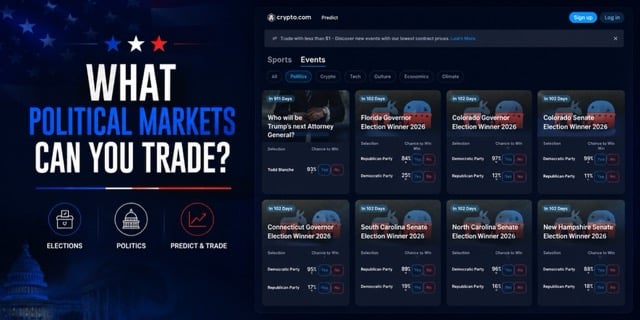
Congressional control markets are the most heavily traded political category, covering which party holds the majorities in the House and Senate, as well as individual toss-up races in key districts. Contracts also exist on leadership fights inside each chamber, giving traders a way to react to primary results, retirements, and shifting district maps well before a general election settles anything.
PredictIt is an example of a platform that only focuses on political markets. That said, its market lineup has been limited since a long-running dispute with the CFTC, so it’s worth checking current availability there before relying on it. Global politics markets extend the same model beyond US borders, covering foreign election outcomes, coalition government formations, and international policy decisions. Both Polymarket and Crypto.com sometimes offer markets on other countries’ elections.
| Market Category | Example Contracts | Where to Trade |
|---|---|---|
| 🏛️ Congress Control | House majority, Senate majority, Speaker of the House | FanDuel Predicts, Polymarket, OG, Crypto.com, DraftKings Predictions |
| 📜 Legislation & Nominations | Bill passage, Cabinet confirmations, agency rulings | Polymarket, OG |
| ⚖️ Supreme Court | Vacancy timing, confirmation outcomes | Polymarket |
| 🌍 Global Politics | Foreign elections, coalition governments, international policy | Polymarket, Crypto.com, DraftKings Predictions |
Prediction markets aren’t limited to politics, of course. If you’re also interested in sports or financial event contracts, we’ve reviewed several platforms built around those categories instead, including Underdog, ProphetX, NinjaTrader, and Interactive Brokers. And if you’d rather trade the forecast than the polls, our guide to weather prediction markets covers daily temperature, hurricane, and climate contracts.
Prediction market odds vs. polls: which is more accurate?
Polls and prediction markets measure different things. A poll captures a snapshot of how a sample of voters is saying they’ll vote, filtered through modeling assumptions such as turnout and likely-voter screens. A prediction market captures how traders price the outcome in real time using their own money, and it updates continuously as new information, such as early voting data or late-breaking news, comes in, rather than waiting for the next survey cycle.
The 2024 US presidential election became a widely cited example of this gap. In the final days before the election, several major prediction markets priced one candidate’s win probability notably higher than polling averages suggested, and the eventual result aligned with the market pricing rather than the polling consensus. That outcome fueled a broader conversation about whether markets can pick up on shifts, like late movement among undecided voters, faster than traditional polling models.
That doesn’t make prediction markets infallible. Markets can be thinner and more volatile in smaller races, and pricing can be skewed by a handful of large traders when liquidity is low. Still, the growing accessibility of these markets, including through mainstream platforms like Robinhood, has made real-time, capital-backed pricing available to a much wider audience than in past election cycles. We treat that pricing as a useful, real-time complement to polling, not a replacement for it.
Political trading strategy basics
Political markets move on a different rhythm than sports or financial contracts, so a few basics matter before you commit real money.
- Watch the calendar, not just the polls. Price often reacts to scheduled events, like debates, hearings, or filing deadlines, before public polling catches up, so knowing what’s coming next matters as much as today’s number.
- Size positions for thin liquidity. Many political contracts, especially outside the biggest races, trade in smaller volumes, so a single large order can move the price. Treat position size as a risk decision, not just a conviction call.
- Diversify across contract types. Spreading trades across different races, chambers, and market categories reduces how much a single unexpected outcome can affect your overall position.
None of this guarantees a profitable trade, but it’s the same discipline that applies to any market with moving prices. When a large order does move a thin Polymarket contract, our breakdown of Hashdive’s wallet analytics shows how to check whether the trader behind it has a record worth following.
Best political prediction market sites
Political event contracts aren’t limited to niche exchanges. Regulated platforms like Polymarket, Crypto.com, OG, and DraftKings Predictions all give traders a way to take a position on political outcomes, ranging from a dedicated politics-first exchange to a sportsbook-adjacent app that added political markets alongside its existing sports and finance offerings. Here’s what each platform actually offers traders specifically interested in politics.

Polymarket
Polymarket has grown into one of the largest prediction markets available to US traders, built around a live, continuously priced exchange rather than a fixed-odds format. Political event contracts are among its deepest categories, alongside sports, crypto, and culture, making it a natural stop for traders whose main interest is political outcomes.
On the political side, Polymarket covers a wide range of categories beyond just the next presidential race, including control of Congress, individual toss-up seats, and cabinet or legislative outcomes. It also extends into international elections and broader geopolitical event contracts, giving traders exposure to political markets well beyond US borders.
Because pricing updates continuously as traders buy and sell, Polymarket tends to feel more like a live market than a static prediction page, which suits traders who want to react to breaking political news as it happens rather than wait for the next data point.
New users can currently claim Polymarket’s welcome offer using promo code GTODAY. Deposit $10 and receive a $25 trading bonus, giving new traders extra room to explore political markets and other categories from the start.
Deposit $10, Get a $25 Trading Bonus
Live Trade with the Biggest Payouts at the Largest Prediction Market in the World
Deposit $10, Get a $25 Trading Bonus
Live Trade with the Biggest Payouts at the Largest Prediction Market in the World
Polymarket Pros
- Deep political category range | Polymarket covers far more than the presidential race, with active markets on Congress control, individual races, and international elections and geopolitical events.
- Continuous, live-feeling pricing | Prices update in real time as traders act, which makes it easier to react to breaking political developments rather than waiting on a slower-moving market.
Polymarket Shortcomings
- Limited state availability | Polymarket isn't live in every state yet, so traders should confirm eligibility in their state before creating an account, especially if political markets are the main draw.
- Bonus comes as trading credit, not cash | The $50 welcome offer is trading credit rather than a cash deposit, so it's worth reading the terms before assuming it behaves the same as regular account funds.

Crypto.com
Crypto.com Predictions is the event-contract trading product built into the broader Crypto.com app, giving users a way to trade on real-world outcomes without leaving a platform many already use for crypto. Contracts are fully CFTC-regulated, covering categories that include politics, sports, finance, and culture.
On the political side, Crypto.com’s contracts extend beyond a single presidential race into US elections, legislative outcomes, and global political events, reflecting the platform’s broader push into international markets. Around major political moments, Crypto.com has also run seasonal contests with leaderboards and prize pools for traders who correctly call outcomes, adding a competitive layer on top of standard trading.
Crypto.com Predictions also connects to the wider Crypto.com ecosystem. Traders who stake CRO for higher-tier cards can unlock additional account benefits across the app, so the value here builds the more you’re already using Crypto.com for other things, rather than existing as a fully standalone prediction product.
Instead of a simple deposit-match bonus, new users can currently claim Crypto.com’s sign-up offer to earn CRO Rewards, worth up to 1 BTC, by completing a short in-app task after signing up.
Complete a Task in the Crypto.com App to Unlock up to 1 Bitcoin Worth of CRO Rewards
America’s All-In-One Trading Platform
Manage Your Crypto, Stocks, Predictions & Card Spend Seamlessly
Complete a Task in the Crypto.com App to Unlock up to 1 Bitcoin Worth of CRO Rewards
America’s All-In-One Trading Platform
Manage Your Crypto, Stocks, Predictions & Card Spend Seamlessly
Crypto.com Pros
- Global political reach | Crypto.com's political contracts extend beyond domestic races into international elections and broader geopolitical events, useful for traders whose interest isn't limited to US politics.
- Election-season contests | Around major political moments, leaderboard-style contests with prize pools add a competitive layer beyond standard buy-and-sell trading.
Crypto.com Shortcomings
- Rewards favor existing Crypto.com users | The sign-up incentive is tied to the broader Crypto.com and CRO ecosystem, so traders who only want prediction markets may get less value than traders already active elsewhere in the app.
- No standalone welcome bonus | Unlike a simple deposit-match offer, there's no flat cash-style trading bonus specifically for Predictions, so new traders shouldn't expect an immediate bonus the way they might on other platforms.

OG
OG is the standalone prediction market app built by Crypto.com, running on the same CFTC-regulated exchange infrastructure as Crypto.com’s own trading products, but operating as a separate platform. Launched in 2026, OG covers event contracts across sports, finance, culture, and politics.
OG’s political contracts sit alongside a much larger sports catalog, covering categories like election outcomes, cabinet and appointment decisions, and broader policy questions. It isn’t built as a politics-first exchange, as some competitors are, but political markets are a consistent part of its lineup rather than an afterthought.
The platform is designed to feel more guided than some larger exchanges, with a simpler market menu and social features like leaderboards layered on top of standard trading. As with other regulated event-contract platforms, traders can sell a position before an outcome is determined rather than waiting until it is resolved.
New users can currently claim OG’s welcome offer, worth up to $100 in rewards. It’s milestone-based rather than automatic, requiring sign-up, identity verification, a qualifying deposit, and completion of qualifying trades within the promotion window.
Huge Range of CFTC-Approved Markets (Sports, Tech, and More)
Compete with Others & Climb the Leaderboards
No User Limiting on Trades
Huge Range of CFTC-Approved Markets (Sports, Tech, and More)
Compete with Others & Climb the Leaderboards
No User Limiting on Trades
OG Pros
- Guided, beginner-friendly structure | A simpler market menu and social features like leaderboards make OG approachable for traders newer to political event contracts specifically.
- Flexible position management | Traders can sell a political contract before the outcome is decided rather than only being able to hold it to resolution.
OG Shortcomings
- Sports-first catalog | OG's core market lineup leans heavily toward sports, so political coverage is comparatively narrower than its sports offering.
- Multi-step bonus | The welcome offer requires verification, a deposit, and qualifying trades within the promo window, so the full $100 isn't available immediately at sign-up.
DraftKings Predictions
DraftKings Predictions is DraftKings’ standalone prediction market app, running on its own CFTC-regulated exchange rather than the state-by-state licensing that governs its sportsbook. The platform’s roots are in sports, but its event-contract lineup has grown to include politics, economics, crypto, and pop culture.
Political contracts on DraftKings Predictions cover presidential and congressional races, primaries, gubernatorial races, and party control of Congress, as well as individual candidate matchups. Because political outcomes often take months or years to resolve, these markets tend to remain open much longer than a typical sports contract, which suits traders comfortable holding positions over extended periods.
The app carries over DraftKings’ familiar sportsbook-style interface, making it an easy entry point for existing DraftKings users moving into event-contract trading. That simplicity comes with fewer advanced tools than some competitors, though. There’s no full order book or limit-order functionality, so traders have less control over entry price than on more exchange-style platforms.
New users can currently claim a welcome offer worth Prediction Dollars after placing a first qualifying trade, credited as non-withdrawable trading credit rather than cash.
Get $200 in Bonuses Paid Over 21 Days
DraftKings is Now Available Nationwide
Browse Markets like Sports, Crypto, Tech & More
Get $200 in Bonuses Paid Over 21 Days
DraftKings is Now Available Nationwide
Browse Markets like Sports, Crypto, Tech & More
DK Predicts Pros
- Long-running political contracts | Presidential, congressional, and gubernatorial markets stay open well past a typical sports contract's window, suiting traders with longer-term political views.
- Easy entry for existing DraftKings users | The familiar sportsbook-style interface makes political event-contract trading approachable for anyone already using DraftKings' other products.
DK Predicts Shortcomings
- Thinner trading tools | No limit orders or full order book means less control over entry price on political contracts than on more exchange-style platforms.
- Political depth still developing | Political markets are real and active, but the category still trails more established, politics-first exchanges in overall variety.
How to trade on politics and elections
Trading on political outcomes follows a similar process across most regulated prediction markets, whether you want to trade on the presidential election, congressional control, or a single state race. Here's how to get started.
Choose a regulated platform
Start with a CFTC-regulated prediction market that lists political contracts, such as the platforms covered above. Confirm political markets are available in your state before signing up.
Create and verify your account
Sign up with your basic details, then complete identity verification. Most platforms require this before you can fund an account or open a position.
Fund your account
Add money using one of the platform’s accepted payment methods. Some platforms also offer a welcome bonus for new traders tied to your first funded trade.
Find a political market
Browse political contracts by category, such as presidential election odds, congressional control, or an individual race, and review the contract price and settlement rules before trading.
Enter your trade
Decide whether you think the outcome will happen and buy the “Yes” contract, or buy “No” if you don’t. Enter your trade amount, confirm the order, and then track your position as the price moves.
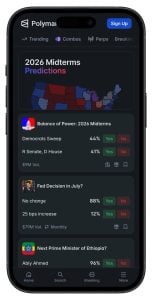
2026 midterm election odds and predictions
The 2026 midterms give prediction markets two headline questions to price: which party controls the House, and which party controls the Senate. As of mid-October 2026, Democrats are strongly favored on Polymarket, with markets pricing roughly a 65% chance of a Democratic Senate and nearly a 90% chance of a Democratic House, a sharp swing from earlier this year, when Senate control looked closer to a toss-up.
Traders can take a position on either chamber independently, and contract prices adjust continuously as primaries, retirements, and district-level developments shift the picture, rather than waiting for the next scheduled poll. Because the midterm picture keeps shifting right up to election day, these markets remain among the most actively traded political contracts on any platform that lists them. For current House and Senate prices, the latest polls, and a breakdown of every key Senate race, see our race-by-race 2026 midterm odds.
Some platforms offer a single contract on which party wins a chamber majority, while others let you trade individual district or state races and build your own view of the full picture. That means midterm trading can range from one straightforward position on House control to dozens of smaller contracts across competitive districts. For traders who want a broader view, some contracts also price margin-of-control outcomes, such as how large a majority a party ultimately secures, rather than a simple yes-or-no on which party wins.
Governor and other state-level races are also active trading categories, particularly in states seen as competitive, and these races tend to draw more attention as election day approaches. Not every governorship is up for election in the same cycle, though, so the number of active state-level contracts can vary significantly from one midterm to the next. It’s worth checking which governor races are actually on the ballot in 2026 before assuming a particular state is in play.
As with any political contract, prices here reflect the market’s current view rather than a guaranteed outcome, so it’s worth checking a platform’s market page for the latest pricing on House, Senate, and governor races before trading, especially as new markets open as election day approaches. If the same race trades at different prices on Polymarket and Kalshi, our guide to prediction market arbitrage explains when that gap is worth acting on and when fees or different settlement rules erase it.
2026 Midterm Election Odds: Where the House and Senate Markets Stand
With Election Day on Tuesday, Nov. 3, the midterms are the political market traders are watching most closely. Two contracts drive most of the action: which party wins the House, and which party wins the Senate. As of Oct. 19, Polymarket gave Democrats a 91% chance of winning the House and a 65% chance of taking the Senate. Kalshi sat close behind at 90% and 63%. The Senate is the tighter call. Republicans hold a 53-47 majority, so Democrats need a net gain of four seats. Polling averages in Iowa, Maine, Kansas, Ohio, and Texas all sit within about three points. Our live House and Senate midterm predictions page tracks every key race, the newest polls, and where markets and polls disagree.
2028 Presidential election odds
Presidential prediction markets open years before the actual election, and 2028 contracts are already trading even though neither party has chosen a nominee. That gives traders a way to price the race in stages, long before the field is set.
Right now, more than two years before the 2028 presidential election, the field remains wide open. On both FanDuel Predicts and Polymarket, JD Vance leads at around 21-22%. Vance is followed by both Jon Ossoff and Alexandria Ocasio-Cortez at 12-13%, Marco Rubio in the 9-11% range, and Gavin Newsom at around 7-9%.
Early activity tends to split into two layers. Nomination contracts ask which candidate wins a specific party’s nomination, and these usually see the most trading activity while the field is still forming. General election contracts ask which party, or which specific matchup, wins the presidency overall, and those tend to firm up once each party’s nominee is closer to settled.
Because the field can still change substantially, from candidates entering or exiting the race to shifts in early polling and fundraising, prices on 2028 contracts can move sharply on a single piece of news. That makes this one of the more volatile political categories to trade this far from the actual election, and it’s worth treating early pricing as a snapshot of current sentiment rather than a settled outcome.
As with the House and Senate midterm markets, it’s worth checking a platform’s own market page for current presidential contract pricing before trading, since positions can shift quickly as the field develops.
Where to track live politics odds
Looking for real-time movement instead of a static snapshot? Polymarket’s politics page shows live pricing across House, Senate, and presidential contracts, continuously updating as traders react to breaking political news. We don’t run our own live odds feed on this page, so it’s a straightforward place to check current pricing between our scheduled updates here. Bookmark it if you want to watch a specific race move in real time. For a wider set of tracking and analytics tools that go beyond a single platform’s page, see our roundup of the best prediction market tools.
Political Prediction Markets FAQ
Yes. CFTC-regulated platforms like Kalshi and Polymarket let US traders take a position on election outcomes through federally regulated event contracts, separate from state sports betting laws. Sportsbooks can’t offer this kind of contract, since political outcomes fall under federal derivatives oversight rather than state gaming regulation.
Political prediction markets are regulated platforms where traders buy and sell contracts tied to political outcomes, like which party controls Congress or who wins a presidential race. Contract prices move continuously and reflect the market’s current view of the odds, settling at $1 if the outcome happens or $0 if it doesn’t.
Several CFTC-regulated platforms offer political contracts, including Polymarket, Crypto.com, OG, and DraftKings Predictions, each with a different market lineup and depth of political coverage. Check state availability and each platform’s political category before creating an account, since both access and market depth can vary by platform.
Election odds on prediction markets work through contract pricing rather than fixed odds. A contract priced at 62 cents reflects an implied probability of roughly 62% for that outcome. Prices update continuously as traders buy and sell, and a winning contract settles at $1 while a losing one settles at $0. New to terms like “implied probability” or “settlement”? Our glossary of election and trading terms has the full rundown.
They measure different things. Polls capture a sample of stated voter intent, while prediction markets reflect real-time, capital-backed pricing that updates continuously. In some past elections, market pricing has lined up more closely with the eventual result than polling averages did, though markets can also be thin or volatile in smaller races.
Yes. Several regulated platforms list House and Senate control contracts for the 2026 midterms, along with individual district and governor race contracts on some platforms. Availability depends on the platform and your state, so check each platform’s current market list before trading, since new contracts often open as election day approaches.
Kalshi operates as a CFTC-regulated exchange with a broad political market lineup alongside sports, finance, and other categories. Polymarket also covers a wide range of political contracts, extending into international elections and geopolitical events. Both are regulated, so the better fit often comes down to market variety and trading experience rather than legitimacy.
A contract’s price is its implied probability. If a “Yes” contract trades at 40 cents, the market is pricing that outcome at roughly 40%. As new information comes in, the price moves up or down to reflect the market’s updated view, and a settled contract pays $1 for a correct outcome or $0 for an incorrect one.
In most cases, yes. Prediction market contracts can typically be sold before settlement if there’s a buyer at the current price, letting you lock in a gain or cut a loss without waiting for the outcome. Liquidity varies by market, so a thinly traded contract may be harder to exit quickly.
Sportsbooks are licensed state by state under gambling law, and most states don’t extend that framework to elections or political outcomes. Prediction markets operate under federal CFTC oversight instead, a separate regulatory framework that specifically allows political event contracts, regardless of individual state gambling licensing rules.
How we source and update this page
Pricing and market details referenced throughout this page are reviewed against each platform’s own listed markets on a regular basis rather than pulled from a live feed. What we have reported above reflects the most recent full review of this page’s odds references and operator details.
Political neutrality
GamingToday’s coverage of political prediction markets is strictly informational. We don’t endorse any candidate, party, or political outcome, and nothing on this page should be read as a prediction or recommendation about how any election will turn out. Contract pricing referenced here reflects trader activity on regulated exchanges, not editorial opinion.
About this page
This guide is part of GamingToday’s broader coverage of regulated real-money gaming, including online casinos, social casinos, and sweepstakes casinos.
Responsible trading and disclosures
Prediction markets involve real financial risk, and a correct prediction is never guaranteed. If trading stops feeling like a hobby, resources are available for help: call 1-800-GAMBLER or visit ncpgambling.org. You must be 18 or older to trade on the platforms covered here.
Affiliate disclosure: Some links on this page may earn GamingToday compensation at no additional cost to you. This doesn’t influence our editorial coverage or the accuracy of the information provided.

