
Pop Culture Prediction Markets: Entertainment Odds & Events | September 2026


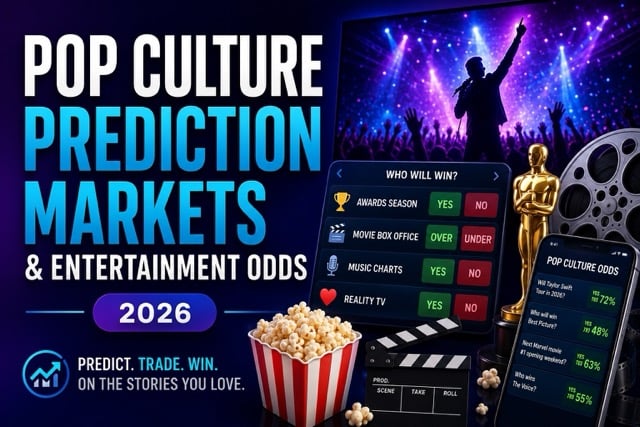 Pop culture prediction markets let you trade on entertainment outcomes, from award winners and movie box office to music charts, reality TV, and celebrity moments, with prices reflecting the market’s live odds. These CFTC-regulated markets, led by Polymarket, offer a legal way to trade on entertainment since sportsbooks can’t. This guide reflects market coverage as of September 2026.
Best Prediction Market Sites
Get $100 in Predicts Bonus When You Trade $1 for 5 Days
Make Predictions on Real World Events Right in Your Phone
Trade on Sports to Culture, Financials, Crypto and More
Get $100 in Predicts Bonus When You Trade $1 for 5 Days
Make Predictions on Real World Events Right in Your Phone
Trade on Sports to Culture, Financials, Crypto and More
Deposit $10, Get a $50 Trading Bonus
Live Trade with the Biggest Payouts at the Largest Prediction Market in the World
Use Bonus Code: GTODAY
Deposit $10, Get a $50 Trading Bonus
Live Trade with the Biggest Payouts at the Largest Prediction Market in the World
Use Bonus Code: GTODAY
America's #1 Sports Prediction Market
Same Sports Moments, Bigger Payouts
Choose from Straights, Player Props, Parlays & More
Use Exclusive Code: TODAY
America's #1 Sports Prediction Market
Same Sports Moments, Bigger Payouts
Choose from Straights, Player Props, Parlays & More
Use Exclusive Code: TODAY
Huge Range of CFTC-Approved Markets (Sports, Tech, and More)
Compete with Others & Climb the Leaderboards
No User Limiting on Trades
Huge Range of CFTC-Approved Markets (Sports, Tech, and More)
Compete with Others & Climb the Leaderboards
No User Limiting on Trades
Complete a Task in the Crypto.com App to Unlock up to 1 Bitcoin Worth of CRO Rewards
America’s All-In-One Trading Platform
Manage Your Crypto, Stocks, Predictions & Card Spend Seamlessly
Complete a Task in the Crypto.com App to Unlock up to 1 Bitcoin Worth of CRO Rewards
America’s All-In-One Trading Platform
Manage Your Crypto, Stocks, Predictions & Card Spend Seamlessly
Get $200 in Bonuses Paid Over 21 Days
DraftKings is Now Available Nationwide
Browse Markets like Sports, Crypto, Tech & More
Get $200 in Bonuses Paid Over 21 Days
DraftKings is Now Available Nationwide
Browse Markets like Sports, Crypto, Tech & More
What Are Pop Culture Prediction Markets?
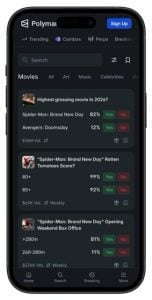
Pop culture prediction markets let you buy and sell contracts tied to entertainment outcomes, like who wins Best Picture or whether a song hits number one on the Billboard Hot 100, instead of placing a fixed-odds bet. Each contract’s price reflects the market’s implied probability of that outcome, and it settles at $1 if it happens or $0 if it doesn’t.
A contract trading at 70 cents means the market currently sees roughly a 70% chance of that outcome. Prediction markets like Polymarket run these contracts as a live exchange rather than a sportsbook line, so you’re trading against other users, not the house, and prices move continuously as trailers, reviews, chart data, and other news shift the odds.
That’s also the core difference from a sportsbook. A sportsbook sets the odds and takes your bet directly, with pricing built to favor the house over time. A prediction market works more like an exchange, so you can exit early by selling your position to another trader before the event resolves instead of waiting for the final result.
Can You Legally Bet on the Oscars (and Other Events) in the US?
Yes. Trading on entertainment outcomes is legal in the US, just not through a traditional sportsbook. Platforms such as Polymarket offer CFTC-regulated event contracts, which fall under federal derivatives law rather than state gambling law, making pop culture event contracts a legal, federally regulated way to trade on the Oscars, the Grammys, and other entertainment outcomes nationwide.
Sportsbooks are licensed and regulated state by state, and most state gambling laws simply don’t address award shows, box office results, or chart positions at all. That’s the main reason a sportsbook app can’t list a market on Best Picture. Prediction markets sidestep that state-by-state system entirely, treating entertainment contracts as financial derivatives rather than gambling products, which is what allows them to trade nationwide instead of state by state.
Access can still vary by platform. Polymarket operates through a CFTC-compliant US structure, though not every contract on the international version of the platform is available to US traders, so it’s worth confirming a specific market is open to you before funding an account.
A handful of states have pushed back specifically on sports-related event contracts, so it’s worth applying that same instinct here and checking a platform’s current state availability before trading. The same federal framework also covers political prediction markets, so if state-by-state rules are new to you, that guide walks through the same legal logic in more detail.
Best Pop Culture Prediction Market Sites
Entertainment event contracts aren’t limited to a single exchange. Polymarket, Kalshi, DraftKings Predictions, FanDuel Predicts, ProphetX, Crypto.com, and Novig all give traders a way to take a position on pop culture outcomes, though the depth of that coverage varies widely from a dedicated culture-market menu to a single category tucked inside a much larger sports or politics lineup.
Here’s what each platform actually offers traders interested in awards shows, movies, music, and celebrity markets specifically.

Polymarket
Polymarket runs the deepest pop culture market menu of any major prediction market, covering award shows, movies, music charts, reality TV, and celebrity mention markets alongside its politics and sports contracts. New users can use promo code GTODAY, deposit $10, and receive a $20 trading bonus after meeting the offer requirements.
Culture contracts here range from headline categories like Best Picture and Album of the Year down to narrower markets on box office totals, Rotten Tomatoes scores, and whether a specific line gets said on live television. Pricing works like a live order book rather than a static line, so a contract’s price moves continuously as reviews, trailers, chart data, and other news shift trader sentiment, rather than resetting on a fixed schedule.
Funding runs through USDC, a dollar-pegged cryptocurrency, rather than a bank transfer or card deposit. That’s an extra step for traders new to crypto wallets, though the platform’s onboarding walks new users through the conversion before their first trade.
Polymarket has moved toward a CFTC-compliant structure in the US as part of its return to the American market, a shift worth understanding if you’re weighing regulatory oversight against market depth when choosing where to trade pop culture outcomes specifically.
Deposit $10, Get a $50 Trading Bonus
Live Trade with the Biggest Payouts at the Largest Prediction Market in the World
Use Bonus Code: GTODAY
Deposit $10, Get a $50 Trading Bonus
Live Trade with the Biggest Payouts at the Largest Prediction Market in the World
Use Bonus Code: GTODAY
Pros
- Deepest Culture Market Menu | Coverage runs from headline award categories down to niche box office, chart, and mention markets, well beyond what most competitors list for entertainment.
- Live, Continuously Priced Contracts | Prices react in real time to reviews, chart movement, and breaking entertainment news instead of resetting on a fixed schedule.
Cons
- Crypto-Only Funding | Deposits run through USDC rather than a bank transfer or card, adding a step for traders unfamiliar with crypto wallets.
- Thinner Liquidity on Niche Markets | Narrower mention and chart-based contracts can trade thinner than headline award categories, so it's worth checking depth before trading them.

Kalshi
Kalshi runs one of the broadest event-contract menus in the industry, and its Culture category covers awards shows, movies, music, and television alongside the platform’s larger politics, sports, and economics offerings. As a CFTC-regulated exchange, Kalshi’s entertainment contracts fall under the same federal oversight as its election and Fed-rate markets rather than a state gambling license.
DraftKings Predictions
DraftKings Predictions runs event-contract trading through DKeX, DraftKings’ own CFTC-regulated exchange, separate from its state-licensed sportsbook. Culture contracts sit alongside the platform’s larger sports and politics menu, covering major awards shows and select entertainment outcomes rather than a dedicated, standalone culture category.
Award season is where DraftKings’ culture offering shows up most, with contracts on top categories at the Oscars, Grammys, and Emmys typically framed as simple Yes/No propositions. Outside of marquee awards, entertainment markets are limited, with little in the way of box office, chart-position, or celebrity mention contracts compared to platforms built around a deeper culture menu.
On the trading side, Predictions keeps things simple by design. There’s no visible order book or price history, and every trade executes at the current market price rather than a limit price you set yourself. That works fine for a trader who wants to take a quick position on Best Picture, but it offers less price control than an exchange-style platform.
Existing DraftKings Sportsbook, Casino, or DFS users can log into Predictions with the same credentials rather than creating a separate account, which makes it a low-friction way to try a culture contract for anyone already using DraftKings’ other products.
Get $200 in Bonuses Paid Over 21 Days
DraftKings is Now Available Nationwide
Browse Markets like Sports, Crypto, Tech & More
Get $200 in Bonuses Paid Over 21 Days
DraftKings is Now Available Nationwide
Browse Markets like Sports, Crypto, Tech & More
Pros
- Familiar Entry Point for DraftKings Users | Existing Sportsbook, Casino, or DFS customers can log into Predictions with the same account instead of signing up separately.
- Simple, Beginner-Friendly Pricing | Every trade fills at the current market price, so there's no order book or limit-order mechanics to learn before placing a culture contract.
Cons
- Culture Menu Isn't a Core Focus | Entertainment contracts lean heavily on major awards shows, with little coverage of box office, chart, or celebrity mention markets.
- No Price Control on Trades | Every trade executes at the current market price, since Predictions doesn't offer an order book or limit-order option.

FanDuel Predicts
FanDuel Predicts is FanDuel’s standalone prediction market app, running apart from FanDuel Sportsbook, and its category list runs from sports to culture, financials, and crypto. Entertainment contracts show up as a smaller slice of that lineup, built around straightforward Yes/No propositions rather than a deep, dedicated culture menu.
Culture coverage here leans toward the biggest, most mainstream moments, major awards shows and marquee entertainment news, rather than granular markets on box office totals, chart positions, or celebrity mentions. A trader looking for a narrow prop on a specific movie’s Rotten Tomatoes score is less likely to find it here than on a platform with a dedicated culture-first menu.
The trading experience favors simplicity over depth. Contracts show up as clear “Yes” or “No” propositions with a visible price and straightforward portfolio tracking, so a trader can see exactly what they hold without learning limit orders or order-book mechanics first.
FanDuel Predicts is available in all 50 states, though the specific culture contracts you’ll see can vary by location, so it’s worth checking the app’s current market list before assuming a particular award show or category is covered where you live.
Get $100 in Predicts Bonus When You Trade $1 for 5 Days
Make Predictions on Real World Events Right in Your Phone
Trade on Sports to Culture, Financials, Crypto and More
Get $100 in Predicts Bonus When You Trade $1 for 5 Days
Make Predictions on Real World Events Right in Your Phone
Trade on Sports to Culture, Financials, Crypto and More
Pros
- Culture Sits Inside a Familiar App | Traders already using FanDuel Predicts for sports or politics can add an entertainment position without creating a new account or learning a different platform.
- Low Barrier for Casual Entertainment Fans | A trader who just wants a quick take on an award show doesn't need to learn limit orders or exchange terminology to place a position.
Cons
- Culture Reads as an Afterthought | The app's design and market list clearly prioritize sports, so award-season and entertainment contracts can feel thinner than the platform's main offering.
- Coverage Depends on Location | The specific culture contracts available can shift from state to state, so it's worth checking the current list before assuming a category is live where you are.
ProphetX
ProphetX is built specifically for sports trading, and it doesn’t carry a pop culture or entertainment category. The platform’s entire menu, game outcomes, player props, parlays, and futures, stays inside sports, so there’s no Oscars, Grammys, or box office contract to trade here even as its sports lineup keeps expanding.
That focus is by design rather than an oversight. ProphetX has positioned itself as the sports-native alternative to broader exchanges like Polymarket and Kalshi, prioritizing deep liquidity and exchange-style pricing within sports rather than spreading across politics, culture, and other categories the way its larger competitors do.
If awards shows, music charts, or celebrity markets are what you’re after, ProphetX isn’t the platform for it. Traders who want both sports and culture contracts in one account are better served by Polymarket or Kalshi, both of which list entertainment alongside their sports menus.
America's #1 Sports Prediction Market
Same Sports Moments, Bigger Payouts
Choose from Straights, Player Props, Parlays & More
Use Exclusive Code: TODAY
America's #1 Sports Prediction Market
Same Sports Moments, Bigger Payouts
Choose from Straights, Player Props, Parlays & More
Use Exclusive Code: TODAY
Pros
- Deep, Focused Sports Liquidity | All of ProphetX's platform resources go toward sports markets, which can mean tighter pricing and more contract variety within that single category.
- Exchange-Style Pricing on What It Does List | Back-and-lay order matching gives sports traders more control over entry price than a fixed Yes/No contract, even without a culture menu to go with it.
Cons
- No Pop Culture Category at All | Awards shows, box office, music, and celebrity markets aren't available here, so this platform can't serve as a one-stop option for culture traders.
- Not a Fit for Multi-Category Traders | Anyone who wants sports and entertainment contracts in a single account will need to look elsewhere, since ProphetX has no plans to expand beyond sports.

Crypto.com
Crypto.com folds pop culture trading into the same app millions already use for its exchange, wallet, and card products, so a Best Picture contract sits a few taps away from a crypto trade rather than requiring a separate login. Culture is one of several categories here, alongside politics, sports, and finance, rather than the platform’s main draw.
Award season contracts make up most of the culture menu, covering major categories at shows like the Oscars, Grammys, and Emmys. Around those moments, Crypto.com has run leaderboard-style contests with prize pools for traders who call outcomes correctly, layering a competitive angle on top of standard buy-and-sell trading that’s worth checking for during a given awards cycle.
Funding works differently than most dedicated prediction market apps: you can deposit via bank transfer, debit or credit card, or crypto, rather than being locked into a single payment rail. That flexibility can make Crypto.com an easier on-ramp for a trader who doesn’t already hold crypto and doesn’t want to set one up just to trade an entertainment contract.
The tradeoff is depth. Culture is one category among several rather than the platform’s focus, so traders looking for granular box office, chart-position, or celebrity mention markets may find the menu thinner than a dedicated culture-first exchange offers. Account tier benefits also build the more you already use Crypto.com’s broader app, so existing users tend to get more out of the platform than newcomers who sign up just for entertainment contracts.
Complete a Task in the Crypto.com App to Unlock up to 1 Bitcoin Worth of CRO Rewards
America’s All-In-One Trading Platform
Manage Your Crypto, Stocks, Predictions & Card Spend Seamlessly
Complete a Task in the Crypto.com App to Unlock up to 1 Bitcoin Worth of CRO Rewards
America’s All-In-One Trading Platform
Manage Your Crypto, Stocks, Predictions & Card Spend Seamlessly
Pros
- Flexible Funding Options | Bank transfer, debit or credit card, and crypto are all accepted, making this an easier starting point than a crypto-only culture market for traders without a wallet already set up.
- Award-Season Leaderboard Contests | Prize-pool contests around major ceremonies add a competitive layer beyond simply holding a position on who wins.
Cons
- Culture Menu Stays Fairly Broad | Coverage centers on major awards shows, with less depth in box office, chart, or celebrity mention markets than a dedicated culture-first platform.
- Best Value for Existing Users | Account tier perks build the more you already use Crypto.com's wider app, so a trader signing up just for entertainment contracts gets less added benefit than a long-time user.

Novig
Novig is a sports-only prediction market, and as of September 2026 it doesn’t offer a pop culture or entertainment category. The entire menu, single-game outcomes, player props, parlays, and season futures, stays inside sports, so there’s no Oscars, Grammys, or box office contract available here.
Pop Culture Prediction Markets at a Glance
Reading through seven platforms at once is a lot to hold in your head, especially when culture coverage ranges from a deep, dedicated menu to no entertainment category at all. Here’s a side-by-side recap of the same seven platforms above, useful if you already have a favorite in mind and just want to confirm the details, or if you’re weighing two or three against each other before you commit.
Treat this table as a snapshot rather than the final word. Culture market depth, fees, and state availability shift as platforms adjust their offerings, so it’s worth confirming current terms directly on a platform before funding an account.
| Platform | Culture Market Depth | Fees | Min. Deposit | Age Requirement | US/State Access |
|---|---|---|---|---|---|
| 🔷 Polymarket | Deepest culture menu — awards, movies, music, TV, celebrity mention markets | Built into contract spread; no separate flat trading fee published | $10 to qualify for welcome bonus (funded via USDC) | 18+ | Approx. 48 states |
| 🏛️ Kalshi | Deep on major awards (Oscars, Grammys, Emmys); thinner outside marquee categories | Per-trade maker/taker fee; market orders cost more than limit orders | No set minimum; $100 traded unlocks welcome bonus | 18+ | Nationwide |
| 👑 DraftKings Predictions | Limited to major awards shows; little coverage beyond that | Built into market price; no visible order book or separate fee schedule | $5+ first qualifying trade to unlock bonus | 18+ | Nationwide |
| 🦆 FanDuel Predicts | Limited to mainstream awards shows and marquee entertainment moments | Built into contract price; no published flat fee | No stated minimum; bonus unlocks on sign-up | 18+ | All 50 states; specific culture contracts vary by state |
| ⚡ ProphetX | None — sports-only exchange, no culture category as of September 2026 | N/A for culture (sports-only exchange) | N/A | 18+ | All US states except Nevada (sports only) |
| 💳 Crypto.com | Moderate — mostly major awards shows alongside a broader event lineup | Built into spread; benefits vary by account tier | No stated minimum; bonus tied to in-app task completion | 18+ | Approx. 48 states plus DC |
| 🎯 Novig | None — sports-only exchange, no culture category as of September 2026 | N/A for culture (zero fees on sports contracts) | N/A | 18+ | All 50 states (sports only) |
What Pop Culture Markets Can You Trade?
Pop culture prediction markets break down into a handful of categories, and the specific contracts available vary by platform. Here’s what shows up most often.
Awards: Academy Awards odds cover categories like Best Picture, Best Actress, and Best Director, alongside Grammy odds, Emmy odds, Golden Globes, and BAFTAs. These tend to be the deepest, most heavily traded pop culture contracts, since a single ceremony creates dozens of individual category markets at once.
Movies: Beyond who wins an award, you can trade on a film’s Rotten Tomatoes score landing above or below a set threshold, opening-weekend box office predictions, and even runtime over/under contracts on a franchise’s next release.
Music: Billboard Hot 100 position markets let you trade on whether a song reaches number one, alongside Spotify streaming thresholds and whether an album crosses a specific first-week sales number. Polymarket carries some of the deepest music-category coverage among the platforms we’ve reviewed.
TV & reality: Reality TV odds, most visibly Survivor winner and elimination markets, let you trade on outcomes week to week rather than waiting for a season finale, closer in spirit to an in-play sports contract than a single fixed bet.
Celebrity & mention markets: The narrowest and often riskiest category, covering things like whether Taylor Swift announces a specific project, MrBeast hits a subscriber milestone, or a specific word gets said on Saturday Night Live. These contracts settle on a strict, sometimes ambiguous, definition of the event, so read the settlement rules closely before trading one.
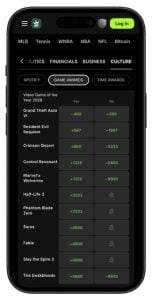
Which Culture Markets Are Actually Worth Trading?
Not every pop culture contract carries enough volume to trade well, and knowing where the money actually sits matters as much as picking the right outcome.
Major awards categories, especially Best Picture, Best Actor, Best Actress, and the top categories at the Grammys and Emmys, pull the heaviest volume of any pop culture market. Enough traders are watching these outcomes that prices tend to move smoothly and reflect real sentiment, and you can typically enter or exit a position without much slippage.
Move outside the marquee categories and liquidity drops off fast. A specific below-the-line Oscar category, a mid-tier Grammy field, or a niche box office threshold might only attract a handful of traders, which means a single large order can swing the price disproportionately. Treat thin markets as a signal to size positions smaller, not as an opportunity to find an overlooked edge.
Resolution risk is its own separate problem. A game has a final score, but a mention market asking whether a specific phrase gets said on live television can hinge on a judgment call about wording, timing, or context. Ties and near-ties on chart or ranking markets, like two songs landing in a virtual dead heat on a weekly chart, can also trigger ambiguous settlement depending on how the contract defines the outcome. Read a market’s settlement rules before trading it, not after a close result leaves you disputing how it resolved.
The takeaway isn’t to avoid thin or ambiguous markets entirely. Some of the best value shows up exactly where fewer traders are paying attention, but go in knowing liquidity and settlement risk are real costs, not just theoretical ones. Our collection of prediction market tools can help you spot mispriced culture contracts before the crowd catches on.
Entertainment Awards Calendar: What’s Tradable
Pop culture trading follows a predictable rhythm built around awards season, with a few major ceremonies anchoring the calendar and everything else, music charts, reality TV, box office, trading year-round in between.
Here’s when the major shows typically land and what tends to open up around them. Exact dates shift from year to year, so check our Prediction Market News section for the current schedule before assuming a date below still holds.
| Award Show | Typical Timing | What's Tradable |
|---|---|---|
| 🏆 Oscars (Academy Awards) | Nominations: January | Ceremony: March | Best Picture, acting, and directing categories; nomination morning itself often opens a burst of new markets |
| 🌍 Golden Globes | January | Film and TV categories together; often the first major precursor of awards season |
| 🎵 Grammys | February | Album, Record, and Song of the Year, plus genre-specific categories |
| 📺 Emmys | September | Outstanding Drama, Comedy, and lead/supporting acting categories; markets typically open weeks ahead of the ceremony |
| 🔁 Year-Round Markets | Ongoing | Billboard and Spotify chart movement, Survivor and other reality TV eliminations, and box office opening-weekend contracts |
How to Trade Pop Culture Markets
Once you understand how entertainment contracts work, actually placing a trade follows a similar process across most platforms. Here's how to go from picking a platform to closing out a position.
Choose Your Platform
Start with a platform that lists the awards shows, movies, music, or celebrity markets you want to trade. Confirm pop culture contracts are actually available in your state before creating an account, since coverage and access can vary by platform.
Verify and Fund Your Account
Sign up with your basic details and complete identity verification, a standard step across regulated platforms. Once verified, fund your account using one of the platform’s accepted payment methods, such as a bank transfer or credit card. Start with an amount you’re comfortable trading while you learn how the platform works.
Find a Pop Culture Market
Browse contracts by category, awards, movies, music, TV, or celebrity mentions, then review the exact terms of the outcome you’re considering. A Best Picture contract settles differently than a Rotten Tomatoes score threshold, so confirm exactly what triggers a payout before trading.
Read the Price as a Probability
Every contract’s price reflects the market’s implied probability of that outcome. A contract trading at 70 cents means the market currently sees roughly a 70% chance of that result. Our implied probability calculator breaks down how to convert a contract price into a percentage if you want to check the math yourself.
Buy Yes/No or Set a Limit
Decide whether you think the outcome will happen and buy the “Yes” contract, or buy “No” if you don’t. You can also choose how you enter that trade: a market order fills instantly at the current best price, while a limit order lets you name your own price and wait for another trader to match it.
Manage or Exit Your Position
Once you’re in a trade, you don’t have to wait for the ceremony or chart update to conclude. Most platforms let you sell your contract to another trader anytime before settlement, so you can lock in a gain or cut a loss as the price moves.
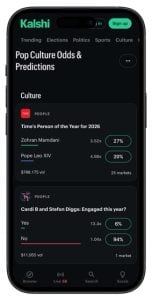
Are Prediction Markets Good at Predicting Culture?
The track record here is genuinely strong, though not perfect. Prediction markets have correctly called 19 of the last 24 major Oscar categories and 26 of the last 28 Golden Globe categories, favoring the eventual winner in the vast majority of cases well ahead of the ceremony itself. That accuracy comes from the same mechanism that makes markets useful elsewhere: thousands of traders pricing in industry buzz, guild wins, and critical consensus in real time, rather than a single outlet’s editorial pick.
That said, markets aren’t infallible, and the misses tend to cluster in predictable places. Upsets happen most often in the closer, more subjective categories, Best Actor or Best Actress races with two strong performances, rather than the more lopsided Best Picture front-runners. Thinner markets carry more risk too. A niche category or a lower-profile award with fewer traders can misprice an outcome simply because there isn’t enough volume to reflect real sentiment.
The practical takeaway: treat a heavily traded, lopsided market as a reasonably strong signal, and treat a close or thinly traded one as exactly that, close and thin, regardless of what the current price shows.
Prediction Market Pop Culture FAQs
Yes. CFTC-regulated platforms like Polymarket let US traders take a position on Oscars and other entertainment outcomes through federally regulated event contracts, separate from state sportsbook licensing. Sportsbooks can’t offer this kind of contract, since entertainment outcomes sit under federal derivatives oversight rather than state gambling law.
Pop culture prediction markets are regulated platforms where traders buy and sell contracts tied to entertainment outcomes, like who wins Best Picture or whether a song reaches number one. Contract prices move continuously and reflect the market’s current view of the odds, settling at $1 if the outcome happens or $0 if it doesn’t.
Several CFTC-regulated platforms list pop culture contracts, including Polymarket, Kalshi, Crypto.com, DraftKings Predictions, and FanDuel Predicts, each with a different depth of award show, movie, music, and celebrity coverage. Check state availability and a platform’s culture category specifically before creating an account, since both access and market depth vary.
Entertainment odds work through contract pricing rather than fixed odds. A contract priced at 70 cents reflects a roughly 70% implied probability of that outcome. Prices update continuously as traders buy and sell, and a winning contract settles at $1 while a losing one settles at $0.
Generally, yes. Markets have correctly called 19 of the last 24 major Oscar categories and 26 of the last 28 Golden Globe categories. Accuracy tends to be highest in heavily traded, lopsided categories, and lower in close races or thinly traded categories where fewer traders are pricing the outcome.
Yes. Several platforms list Grammy and Emmy category markets, along with Survivor and other reality TV winner and elimination contracts. Coverage varies by platform and by show, and reality TV markets in particular often update week to week rather than resolving in a single event.
Mention markets ask whether a specific word, phrase, or moment happens during a live event, like a name said during an awards speech. They resolve based on the contract’s exact wording, which can turn on a judgment call, so it’s worth reading the settlement rules before trading one. Unfamiliar with terms like “resolve” or “settlement rules”? Our prediction market glossary has the full A-Z.
Yes. Polymarket operates through a CFTC-compliant US structure and carries one of the deepest pop culture menus of any platform, covering awards, movies, music, and celebrity mention markets. Not every contract on Polymarket’s international site is available to US traders, so confirm a specific market is open to you first.
A contract’s price is its implied probability, so a rising price means the market sees the outcome as more likely. Most platforms let you sell your position to another trader before the event resolves, letting you lock in a gain or cut a loss rather than holding to settlement.
Polymarket carries the deeper pop culture menu, extending into movies, music, and celebrity mention markets alongside major awards shows. Kalshi’s culture coverage leans more heavily on major awards categories specifically, with less depth outside of marquee ceremonies. Both are CFTC-regulated, so the better fit often comes down to category depth.
Responsible Trading
Pop culture prediction markets are new enough that a lot of the usual safety habits don’t automatically carry over from a sportsbook or a casino account, and that gap is worth understanding before you fund one.
Why Entertainment Trading Can Feel Different Than It Looks
Watching a live awards show while holding an open position changes the experience of the broadcast itself. Categories announce one after another for hours, and a trader can add to, exit, or open a new position between every envelope, which keeps the same kind of continuous decision-making available that a single sports bet or casino spin doesn’t offer. The “trading” language around these products doesn’t change what that pattern can feel like in the moment: an event with no natural stopping point until the last category is read.
Mention and chart-based markets add a similar pull outside of awards season. A contract tied to a celebrity’s next move, a chart position, or a live TV moment can stay open and tradable for days or weeks, which means the position is never fully out of mind the way a settled bet would be.
Self-Exclusion Doesn’t Automatically Carry Over
If you’ve self-excluded from a sportsbook or casino, that block doesn’t automatically extend to a prediction market platform, since these operate under separate federal oversight rather than state gambling systems. A cross-platform option does exist: Kalshi has partnered with a compliance firm on a tool called SelfExclude, built to cover multiple prediction market platforms rather than just one account. Other platforms have reportedly begun integrating with it, but coverage isn’t universal, so don’t assume a self-exclusion request on one culture-trading app protects you on another. Ask directly what a platform’s exclusion tools actually cover.
Before You Trade
A few habits make a real difference here:
- Set your budget before the ceremony starts, not category by category as it airs. Decide what you’re comfortable trading in advance, when you’re not reacting to a result in real time.
- Pick your exit point ahead of time, for both a win and a loss. That’s a much easier call to make before the show starts than mid-broadcast.
- Treat “just one more mention market” as a signal to stop, not a strategy. These contracts can stay open for days, and that availability isn’t a sign you’re due for a win.
- Don’t let “trading” language talk you out of a red flag. Chasing a loss on a Best Picture contract is the same behavior as chasing one on a game, whatever you call it.
Get Help
If trading pop culture markets stops feeling like something you’re choosing to do, help is available: call 1-800-GAMBLER or visit our responsible gambling resources. You must be 18 or older to trade on the platforms covered on this page.
How We Source and Update This Page
Odds, bonus terms, and operator details on this page are checked against each platform’s own listings on a recurring basis rather than pulled from a live data feed. September 12, 2026 reflects the most recent full review of the pricing references and platform details above.
About This Page
This guide is one part of GamingToday’s broader coverage of regulated real-money gaming, alongside our reporting on online casinos, social casinos, and sweepstakes casinos.
Affiliate disclosure: Some links on this page may earn GamingToday a commission if you sign up through them, at no extra cost to you. That relationship has no bearing on how we evaluate or write about any platform covered here.

