
What Is Hashdive? Polymarket Smart Money Analytics Explained


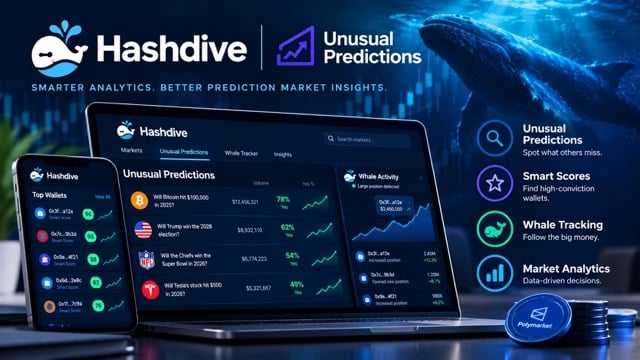 Hashdive made its name as a Polymarket analytics tool built around one idea: a Smart Score that grades every trader’s wallet. In 2026, the team joined Unusual Whales, and the product now runs as Unusual Predictions. This review explains what changed, what the tool actually does, what it costs and when a free alternative covers the same ground.
It’s one of the analytics platforms we track in our prediction market tools hub, and it’s built for traders who already use Polymarket and want a sharper read on who is moving the prediction markets they trade.
Hashdive at a Glance
Here’s the short version before we get into the details. Every entry reflects the product as it exists today under the Unusual Whales banner, not the original standalone site.
| Detail | Hashdive / Unusual Predictions |
|---|---|
| 🔄 Status | Rebranded as Unusual Predictions after joining Unusual Whales in January 2026 |
| 🏢 Owner | Unusual Whales |
| 📈 Platforms covered | Polymarket |
| 💲 Price | Included with paid Unusual Whales Retail plans, starting at $50 per month |
| 🚫 Executes trades | No, it’s a research tool only |
| 🔑 Wallet connection needed | No, you only look up public wallet addresses |
| 🎯 Best for | Active Polymarket traders who research wallets before following a position |
| ⭐ GamingToday verdict | Strong smart-money research, but now priced for committed traders, not casual ones |
What Is Hashdive?
Hashdive is a Polymarket analytics platform that scores traders’ wallets, flags possible insider activity and tracks whale positions using public blockchain data. It was always read-only, so it never placed a trade for you. Since joining Unusual Whales in 2026, its scoring engine powers a product called Unusual Predictions.
The concept works because Polymarket settles trades on the Polygon blockchain, which leaves every wallet’s trading history visible to anyone. That raw data is hard to read on its own. Hashdive, founded by data engineer Niko Kudriastev, turned it into rankings, charts and alerts that answer a simple question: is the money behind this price move smart or not?
Its core audience was active Polymarket traders. Copy traders used it to vet wallets before following them, researchers used it to spot unusual bets ahead of news, and market watchers used it to judge whether a sudden price swing had real conviction behind it. If you’re still getting comfortable with how event contracts work, our complete prediction markets guide covers the basics, and our prediction market glossary defines terms like smart money, whale and liquidity that come up throughout this review.
What Happened to Hashdive?
In January 2026, Hashdive announced it was joining Unusual Whales, the market data company best known for tracking unusual options flow and politicians’ stock trades, to build Unusual Predictions. Unusual Whales launched the product that same month and credited its partners at Hashdive for the data work behind its smart-money scoring.
The original Hashdive site stayed available through a transition window that ended June 8, 2026. Today, the Smart Score, insider flags and whale tracking live inside the Unusual Whales platform at unusualwhales.com/predictions, and access requires a paid membership.
So if you searched for Hashdive expecting the old free dashboard, Unusual Predictions is where that toolkit lives now. The scoring logic carried over, but the pricing, branding and login all changed.
Hashdive Features Explained
Hashdive’s toolkit covers five jobs: grading traders, screening markets, flagging suspicious bets, tracking big wallets and charting price action. Here’s how each one works and what it’s actually good for.
Smart Score: Rating Wallets From -100 to 100
The Smart Score is the feature that made Hashdive’s reputation. Each tracked wallet gets a rating from -100 to 100 based on its trading history, weighing how profitable, consistent and disciplined that history has been, along with how its open positions are performing. Under Unusual Predictions, the scoring also ranks traders by topic, so a wallet that crushes politics markets can stand out from one that only wins on crypto, with bet sizing and contrarian calls factored in.
The table below is our plain-English guide to reading the scale. It describes the general direction of the score, not official cutoffs published by the tool.
| Score Range | What It Suggests | How to Use It |
|---|---|---|
| 🟢 Near +100 | A long, consistent record of profitable, well-sized trades | Worth studying closely, but still check the specific market before acting |
| ⚪ Around 0 | A mixed or thin record with no clear edge | Treat activity from these wallets as noise |
| 🔴 Near -100 | A sustained pattern of losing or poorly sized trades | A useful reminder of positions not to copy |
Market Screener: Liquidity, Volume, Price Moves and Whale Activity
The screener filters Polymarket’s catalog by liquidity, trading volume, recent price moves, momentum and whale activity, which makes it easy to find where serious money is concentrating. That’s useful whether you trade sports prediction markets, follow politics and election markets, dabble in pop culture event markets or watch economy markets tied to Fed decisions and inflation data. Unusual Predictions also tags markets with labels such as Contrarian Whales, Momentum and Closing Soon, the last of which highlights markets resolving within about a week.
Insider Detection and Z-Score Flags
Insider detection looks for fresh or long-dormant wallets that suddenly place large, concentrated bets shortly before news breaks. A Z-score measures how far a bet sits from normal activity, expressed in standard deviations, so the bigger the outlier, the louder the flag. When Unusual Whales launched the product, it pointed to a new account whose concentrated bets on a Venezuela-related market reportedly grew from about $30,000 to more than $400,000.
A flag is not proof. Plenty of unusual bets come from traders with strong research, a big bankroll or plain luck. Treat an insider flag as a reason to look harder at a market, never as confirmation of what will happen.
Whale Tracker and Wallet Analyzer
Paste any public Polygon wallet address into the analyzer and you’ll see that wallet’s open positions, profit and loss history and Smart Score. The whale tracker does the same work at scale, surfacing the largest positions in a market and the track records of the accounts behind them. You never connect your own wallet to do any of this, because every number comes from public on-chain data.
Charts and AI Probability
For traders who think in technical terms, market charts include candlesticks with RSI, MACD and moving averages, plus a breakdown of how much volume came from whales. The original Hashdive dashboard also placed the crowd’s market price beside an AI-calculated probability, a quick way to spot markets where the model and the money disagree. Treat that AI number as a second opinion, not a forecast you can bank on.
How to Use Hashdive (Unusual Predictions) Step by Step
The workflow below takes you from a blank screen to a sized trade. It assumes you already have a paid Unusual Whales plan and a funded Polymarket account, since Unusual Predictions only handles the research side.
- Open Unusual Predictions. Log in to your Unusual Whales account and head to the predictions section at unusualwhales.com/predictions. Type the address yourself or use a saved bookmark rather than clicking links from social media.
- Screen the markets. Filter by volume, liquidity and whale activity to find markets where large, informed money is active, then shortlist two or three that fit categories you already understand.
- Check the Smart Score. Open the wallets driving activity in your shortlisted market and compare their scores, paying extra attention to how each one performs in that specific topic.
- Review open positions. Look at each wallet’s entry price, position size and recent results. A high-scoring wallet that bought at 30 cents tells you less about a market now trading at 60.
- Find the market on Polymarket. Locate the same contract on Polymarket, read its resolution rules carefully and check the current price and order book depth.
- Size the trade. Decide how much of your bankroll the trade deserves before you click buy. Our prediction market strategies guide walks through position sizing, hedging and the risks of copy trading.
Repeat the loop sparingly. The tool is most valuable as a filter that narrows your research, not as a feed of trades to mirror one after another.
Hashdive Pricing: Is It Free?
Not anymore. The original Hashdive ran on a freemium model: core market screens and wallet lookups cost nothing, while a Pro tier unlocked extras such as tracking up to 50 wallets at once. We couldn’t verify a published Pro price from that era, and that free tier went away with the standalone site.
Unusual Predictions is included with every paid Unusual Whales Retail plan rather than sold on its own. Here’s what those plans cost on the official Unusual Whales pricing page as of October 9, 2026:
| Plan | Billed Monthly | Billed Yearly |
|---|---|---|
| 🐋 Retail Basic | $50 per month | $42 per month ($504 per year) |
| 🐋 Retail Pro | $75 per month | $63 per month ($756 per year) |
| 🐋 Retail Max | $120 per month | $102 per month ($1,224 per year) |
A free Unusual Whales account exists, but it doesn’t list Unusual Predictions among its features. Check the pricing page before you subscribe, since plans and features can change. If you only need to run the numbers on a trade, our free betting tools and calculators handle odds conversions and payouts without a subscription.
Does Hashdive Work With Kalshi?
Not in any meaningful way. As of October 2026, Unusual Predictions covers Polymarket only. Some older directory listings describe the original Hashdive as offering Kalshi analytics too, but its signature features never translated to that exchange.
The reason is structural. Smart Scores, whale tracking and insider flags all depend on public wallet histories, and Polymarket’s on-chain settlement provides exactly that. Kalshi is a CFTC-regulated exchange that keeps trader accounts private, so there’s no public ledger of who bought what to analyze.
If Kalshi is your main platform, you’ll need Kalshi-focused analytics instead, and the alternatives section below includes options that cover it. Our Kalshi review also explains how the exchange’s markets and fees work.
Does Hashdive Have an API?
There’s no standalone Hashdive API to sign up for today. Unusual Whales sells API access separately from its dashboard plans, offers a one-week free trial and references prediction market data in its developer resources. Developers who only need raw market data can skip the middleman entirely, since both Polymarket and Kalshi publish their own public APIs for prices, order books and market listings. If you’re pulling both feeds to compare prices, our cross-platform arbitrage guide explains how to tell whether a gap between the two survives fees.
Check the Trade Before You Copy It
A whale’s trade only tells you what they paid. Before you follow, run your own numbers at today’s price, because the profit, the risk and the probability you need to be right all shift as the price climbs.
Here’s the math the calculator handles. Each winning contract pays $1, so your payout equals the number of shares you hold. Buy $100 of Yes at 40 cents and you own 250 shares. If Yes wins, you collect $250, a $150 profit before fees. If it loses, you lose the full $100.
Your break-even probability is your total cost divided by your payout. With no fees, that’s $100 divided by $250, or 40%. Add a $2 fee and it rises to 40.8%. Now imagine the wallet you’re copying bought at 30 cents: it needed to be right 30% of the time, while you need better than 40%. That gap is the hidden cost of arriving late.
Our implied probability calculator converts any price into a percentage, and the Kelly Criterion calculator suggests how much of your bankroll a trade deserves based on your edge.
Is Hashdive Safe and Legit?
Yes, Hashdive was a legitimate analytics tool, and its successor sits inside an established market data company. The bigger safety question is how you use it, since prediction market tools attract imitators and scammers who know traders have crypto wallets.
- Read-only by design | Unusual Predictions works from public blockchain data and a standard account login. It never needs your wallet connected to look anything up.
- Never share a seed phrase | No legitimate analytics tool will ask for your seed phrase or private key. Anyone who does is trying to drain your wallet.
- Never sign transactions for a research site | Approving a transaction or token allowance on a site that only shows data is a major red flag. Close the tab.
- Use the official domain | Go to unusualwhales.com directly or use a saved bookmark. Similarly named prediction market sites exist, and links in direct messages or replies are a common phishing route.
- Treat insider flags as signals, not facts | An unusual bet is a reason to research, not proof that someone knows the outcome. Following flags blindly is how traders take on outsized losses.
Finally, remember that a smart-money signal doesn’t reduce the risk of the trade itself. A contract that resolves against you pays nothing, no matter who else held it.
Hashdive Pros and Cons
Hashdive’s strengths are all about research speed and safety. Its weaknesses mostly come down to what changed in the move to Unusual Whales.
Pros
- Smart Score Cuts Research Time | A single rating condenses a wallet’s full trading history, so you can vet a trader in seconds instead of digging through transactions.
- Insider and Whale Signals in One Place | Anomaly flags, whale positions and topic rankings sit side by side, giving you context on a price move fast.
- No Wallet Connection Required | Everything runs on public data, so you never expose your own wallet to use it.
Cons
- No Longer Free | Access now requires a paid Unusual Whales plan starting at $50 per month, a steep jump from the old freemium model.
- Polymarket Only | Wallet-level analytics don’t work on Kalshi, so traders who split activity across exchanges get only half the picture.
- Signals Can Arrive Late | By the time a whale’s position shows up, the price has often moved, which shrinks the edge for anyone following.
Hashdive Alternatives Compared
Not every trader needs a $50 monthly subscription to follow smart money. Depending on what you actually want from a tool, a free option may cover most of the job. We grouped the main alternatives by what they do best.
| Tool | What It Does | Platforms | Price | Executes Trades |
|---|---|---|---|---|
| 🐋 Unusual Predictions | Hashdive’s successor: Smart Scores, insider flags and whale trades | Polymarket | Included with Unusual Whales Retail plans from $50 per month | No |
| 🏆 Polymarket leaderboard and activity tab | Built-in rankings of top traders plus a live feed of recent trades | Polymarket | Free | Trades happen on Polymarket itself |
| 🔎 Polywhaler | Whale tracker focused on large trades, with paper trading | Polymarket, Kalshi | Free; Pro $9 per month | No |
| 📊 Polymarket Analytics | Dashboards for traders, markets and open positions | Polymarket | Free; Premium $20 per month | No |
| 📉 Kalshinomics | Kalshi market analytics with Polymarket price comparisons | Kalshi | Free | No |
| 🖥️ Stand.trade | Cross-venue trading terminal with whale alerts | Polymarket, Kalshi | Free | Yes, with account access |
| 🤖 Rainmaker | AI-assisted terminal combining analytics, arbitrage and copy trading | Polymarket, Kalshi | Requires $RAIN token access | Yes, with account access |
Third-party prices were checked in October 2026 and can change, so confirm on each tool’s site before paying.
Pick Unusual Predictions if wallet scoring and insider flags are the core of your process. Start with Polymarket’s own leaderboard if you just want to see who’s winning, since it costs nothing. Try Polywhaler for basic whale alerts across both major exchanges, and Kalshinomics if Kalshi is your home base. Consider a terminal like Stand.trade or Rainmaker only if you want research and execution in one place, and only after reading exactly what account access each one requests.
Still deciding where to trade in the first place? Our Polymarket vs. Kalshi comparison breaks down fees, markets and availability side by side.
Our Verdict on Hashdive
Hashdive’s smart-money toolkit is still one of the sharpest ways to research Polymarket wallets, and Unusual Predictions keeps the features that mattered. What changed is the audience: at $50 or more per month, it now makes sense for committed traders rather than the curious.
- ✅ Use It If | You trade Polymarket regularly and want scored wallets and insider flags before you commit money.
- 🧮 Run the Numbers First | Copying a whale at a worse price raises the break-even probability you need to hit.
- 🆓 Start Free If | You’re new to prediction markets or only check smart money occasionally.
- 🔀 Look Elsewhere If | Kalshi is your main exchange, since wallet-level data doesn’t exist there.
- 🛡️ Stay Skeptical | Treat every flag and score as research, not a guarantee.
Hashdive FAQ
Hashdive joined Unusual Whales in January 2026 to build Unusual Predictions, which now carries Hashdive’s Smart Score, insider detection and whale tracking. The original Hashdive site stayed available through a transition window that ended June 8, 2026, and the toolkit now lives inside the Unusual Whales platform behind a paid membership.
Hashdive is used to research Polymarket traders and markets. It scores wallets on their trading history, flags unusual bets that may signal inside information, tracks whale positions and charts market activity. Traders use it to vet wallets before copying a position and to judge whether a price move has real conviction behind it.
A Smart Score rates a Polymarket wallet from -100 to 100 based on its trading history, weighing profitability, consistency and risk management. Scores near +100 point to a strong, sustained record, scores near zero suggest no clear edge, and scores near -100 reflect consistent losses. It’s a research shortcut, not a prediction.
Not anymore. The original Hashdive offered a free tier plus a paid Pro upgrade. Its successor, Unusual Predictions, is included only with paid Unusual Whales Retail plans, which start at $50 per month or $42 per month billed yearly, based on the official pricing page in October 2026.
Not in a meaningful way. Unusual Predictions covers Polymarket only. Its wallet scoring and whale tracking rely on public blockchain data, and Kalshi is a CFTC-regulated exchange that keeps trader accounts private, so there’s no public wallet history to analyze. Kalshi traders need Kalshi-focused analytics tools instead.
Yes, as long as you use it the way it was designed. It’s read-only and never needs your wallet connected. Never share a seed phrase or private key, never sign transactions for a research site, use the official unusualwhales.com domain and treat insider flags as signals rather than facts.
No. Hashdive and Unusual Predictions are research tools only. They show scores, flags, positions and charts, but you place every trade yourself on Polymarket. That also means the tool never needs trading permissions, account keys or a wallet connection to work.
Unusual Predictions is the direct successor. Polymarket’s own leaderboard and activity feed are free, Polywhaler tracks whales across Polymarket and Kalshi, Polymarket Analytics offers free dashboards, and Kalshinomics focuses on Kalshi. Terminals like Stand.trade and Rainmaker add trade execution, but they require account access.
This review is checked regularly against the live product and official pricing.
Responsible gambling: Trading prediction markets carries real financial risk, and no analytics tool guarantees a profit. If trading no longer feels like something you’re choosing to do, confidential help is available 24/7 by calling 1-800-GAMBLER. Visit our responsible gambling resources for tools including deposit limits and self-exclusion programs. You must be 18 or older, or the applicable minimum age in your state, to participate.

