
Economy Prediction Markets: Fed, Recession & Inflation Odds


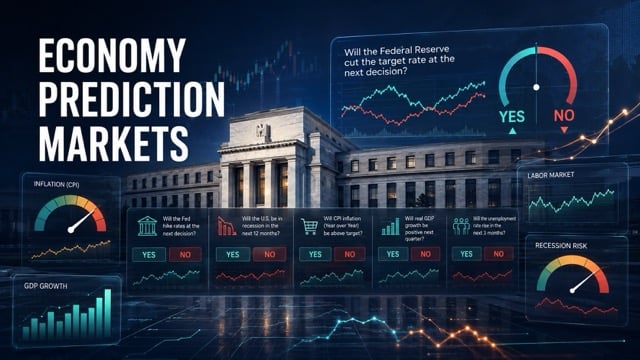
Economy prediction markets let you trade contracts on Fed rate decisions, recession odds, inflation prints, GDP growth, and jobs reports, with the price reflecting the market’s live probability of each outcome. Kalshi is the main regulated US venue for these contracts, alongside Polymarket. This guide covers current odds, how they compare to CME FedWatch, and where to trade.
This page is part of our broader prediction markets coverage, which also includes dedicated guides to sports, politics, and pop culture prediction markets.
This guide reflects prediction market pricing and economic data as of September 25, 2026. Because Fed odds, inflation prints, and recession probabilities shift with every data release, we revisit and update this page frequently.
Best Prediction Market Sites
Get $100 in Predicts Bonus When You Trade $1 for 5 Days
Make Predictions on Real World Events Right in Your Phone
Trade on Sports to Culture, Financials, Crypto and More
Get $100 in Predicts Bonus When You Trade $1 for 5 Days
Make Predictions on Real World Events Right in Your Phone
Trade on Sports to Culture, Financials, Crypto and More
Huge Range of CFTC-Approved Markets (Sports, Tech, and More)
Compete with Others & Climb the Leaderboards
No User Limiting on Trades
Huge Range of CFTC-Approved Markets (Sports, Tech, and More)
Compete with Others & Climb the Leaderboards
No User Limiting on Trades
Deposit $10, Get a $50 Trading Bonus
Live Trade with the Biggest Payouts at the Largest Prediction Market in the World
Deposit $10, Get a $50 Trading Bonus
Live Trade with the Biggest Payouts at the Largest Prediction Market in the World
America's #1 Sports Prediction Market
Same Sports Moments, Bigger Payouts
Choose from Straights, Player Props, Parlays & More
America's #1 Sports Prediction Market
Same Sports Moments, Bigger Payouts
Choose from Straights, Player Props, Parlays & More
Get $150 in Bonuses Paid Over 14 Days
DraftKings is Now Available Nationwide
Browse Markets like Sports, Crypto, Tech & More
Get $150 in Bonuses Paid Over 14 Days
DraftKings is Now Available Nationwide
Browse Markets like Sports, Crypto, Tech & More
Complete a Task in the Crypto.com App to Unlock up to 1 Bitcoin Worth of CRO Rewards
America’s All-In-One Trading Platform
Manage Your Crypto, Stocks, Predictions & Card Spend Seamlessly
Complete a Task in the Crypto.com App to Unlock up to 1 Bitcoin Worth of CRO Rewards
America’s All-In-One Trading Platform
Manage Your Crypto, Stocks, Predictions & Card Spend Seamlessly
Live Fed Rate Cut Odds
Snapshot as of August 6, 2026.
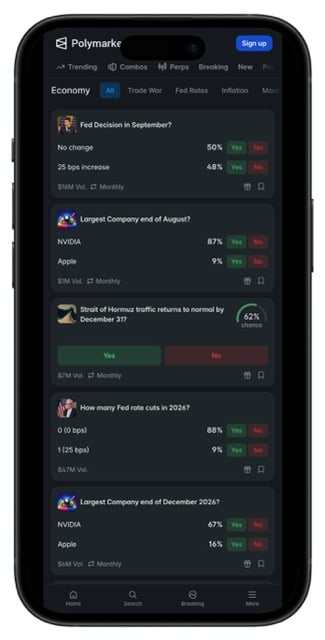
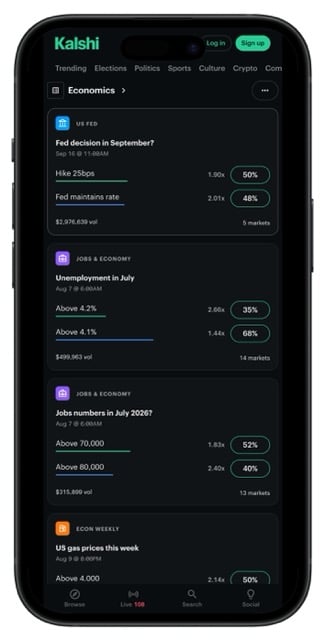
Prediction markets currently price the September 16 FOMC decision as close to a coin flip between holding and hiking: Kalshi and Polymarket both show roughly 53-55% odds the Fed holds its 3.50%-3.75% target range, with a 44-47% chance of a 25-basis-point hike and only a sliver of probability on a cut. That’s a notable shift from earlier in the year, when cuts were the dominant conversation. Prices move constantly as new data lands; treat this as a snapshot, not a live board, and check Kalshi or Polymarket directly before trading.
| FOMC Meeting | Kalshi | Polymarket | CME FedWatch |
|---|---|---|---|
| 📅 Sept. 15-16, 2026 | Hold, ~52-53% | Hold, ~54-55% | Hike, ~62% (as of Aug 4) |
| 📅 Oct. 27-28, 2026 | Not yet listed | Hold, ~69% | Not yet available |
| 📅 Dec. 8-9, 2026 | Not yet listed | Hold, ~59% | Not yet available |
The Fed already met five times in 2026 (Jan. 27-28, March 17-18, April 28-29, June 16-17, and July 28-29), holding rates steady each time and ending July with the target range at 3.50%-3.75%, a decision that came with three dissents in favor of a 25-basis-point hike. Three meetings remain.
What Are Economy Prediction Markets?
Economy prediction markets are contracts tied to a specific macroeconomic outcome, like whether the Fed cuts rates, whether GDP contracts for two straight quarters, or where a CPI report lands. Each contract trades between $0.01 and $0.99, and its price is the market’s real-time estimate of that outcome’s probability. A contract settles at $1 if the outcome happens and $0 if it doesn’t.
These work the same way as sports or political event contracts, just applied to economic data releases and policy decisions instead of games or elections. Kalshi, a CFTC-regulated exchange, lists the deepest US menu, covering FOMC decisions, CPI, GDP, jobs reports, and even gas prices, all settling against official government or Federal Reserve data rather than a private company’s estimate.
What makes economic contracts distinct is the calendar. Unlike a game that ends in a few hours, economic contracts resolve on fixed release dates, a CPI print, a jobs report, an FOMC statement, so prices can sit relatively stable for weeks and then move sharply the moment new data hits. That’s also what separates them from a sportsbook wager, which settles the moment a game ends rather than against a scheduled data release. See our full prediction markets vs. sportsbooks comparison for more on how the two differ.
Will the Fed Cut Rates? Fed Interest Rate Odds
Fed rate decisions are the single most heavily traded economic event on prediction markets, and right now the conversation isn’t really about cuts at all.
How Prediction Markets Price FOMC Decisions
Every FOMC meeting gets its own set of contracts: hold, cut 25bps, hike 25bps, and larger moves in both directions, each trading as its own yes/no market. The price is the probability. A contract on “Fed holds in September” trading at 54 cents means the market currently sees roughly a 54% chance the Fed leaves rates unchanged. These markets resolve against the official Federal Reserve statement at federalreserve.gov, typically within hours of the 2:00 p.m. ET announcement.
Prediction Markets vs. CME FedWatch
CME’s FedWatch tool, which derives probabilities from Fed funds futures prices, is the traditional benchmark macro desks have used for years. Prediction markets are increasingly diverging from it, and the gap itself has become a signal worth watching. Fed funds futures-implied odds of a September hike spiked to roughly 82% in late July as oil prices climbed, before easing to around 62% by early August, according to CME FedWatch data reported by CNBC. Kalshi and Polymarket, meanwhile, held closer to 45-47% hike odds through the same stretch. That spread matters: futures markets can be more exposed to hedging flows and thin trading around news, while Kalshi and Polymarket prices come from a broader, retail-inclusive order book. Following the Fed’s July 29 hold, several outlets, including Barron’s, cited Federal Reserve research showing Kalshi’s day-before FOMC forecasts have outperformed Fed funds futures historically.
The 2026 Rate Path
The Fed already met five times in 2026, Jan. 27-28, March 17-18, April 28-29, June 16-17, and July 28-29, holding rates steady each time and ending July with the target range at 3.50%-3.75%, a decision that came with three dissents in favor of a 25-basis-point hike, one of the more hawkish voting splits in recent Fed history. Three meetings remain in 2026: Sept. 15-16, Oct. 27-28, and Dec. 8-9. Polymarket’s “How many Fed rate cuts in 2026?” market currently prices an 88% chance of zero cuts for the full year, underscoring how far the conversation has shifted from where it started.
Recession Odds: Will There Be a Recession?
As of early August 2026, prediction markets see a recession this year as unlikely. Kalshi’s “Recession before 2027?” contract prices roughly a 7% chance of a recession, while Polymarket’s comparable market sits around 10%. Both platforms define a recession using the standard shorthand of two consecutive quarters of negative GDP growth.
That’s a sharp turnaround from where odds sat earlier in the year. Kalshi’s recession contract touched levels above 35% at points in the first half of 2026 before falling to 27.7% by early April and continuing to drift lower since, according to Kalshi’s own research desk.
What Moves Recession Odds
Recession odds on these markets are unusually reactive to a narrow set of inputs: oil and gas prices, geopolitical shocks, and a handful of third-party recession models. In the spring, a spike in oil prices tied to Middle East tensions pushed gas prices above $4 a gallon nationally for the first time since 2022, and odds moved with it, Kalshi’s recession contract fell 9.2 percentage points in a single weekend after de-escalation headlines, illustrating how fast these contracts can reprice on a single news cycle.
Third-party indicators get cited alongside the market price too. Moody’s AI-driven recession model has at times put downturn odds as high as 49%, well above what Kalshi or Polymarket were pricing at the same time, and the “Walmart Recession Signal,” an indicator built by comparing Walmart’s stock performance to a luxury-retail index, was flashing levels comparable to the 2008 financial crisis earlier this year even as prediction markets stayed comparatively calm.
That divergence is worth sitting with. Prediction markets aggregate trader sentiment in real time, but they aren’t a model, and a low recession price doesn’t mean a downturn is off the table, it means traders currently see it as more likely than not to be avoided.
Inflation and CPI Prediction Markets
Inflation contracts on Kalshi and Polymarket typically ask a simple threshold question: will a specific CPI report land above or below a set level. As of early August 2026, markets are confidently pricing July’s year-over-year CPI print as having landed above 3%, with Kalshi’s contract on that threshold trading near certainty. The more uncertain question is the month-over-month figure, where Kalshi’s contract for a 0.1% July reading was trading around 43%, reflecting real disagreement about the exact number even with the broader trend not in doubt.
Looking further out, the full-year picture is more contested. Polymarket’s “How high will inflation get in 2026?” market currently prices only about a 1-in-5 chance that inflation reaches 4.5% at any point this year, and a separate threshold market puts roughly a 39% probability on inflation reaching 5%. Together, that suggests traders see inflation as elevated and running persistently above the Fed’s 2% target, but not spiraling toward the kind of levels that would force more aggressive action.
Core CPI, which strips out food and energy, trades as its own contract too. These core prints matter more to the Fed’s actual rate decisions than the headline number, since food and energy prices move on factors, like the oil price swings covered in the recession section above, that monetary policy can’t directly control.
GDP, Growth and Jobs Markets
Beyond Fed decisions, recession odds, and inflation, prediction markets also price a wider set of economic indicators, from quarterly GDP growth to monthly jobs reports to weekly gas prices, giving traders a real-time read on the broader economy as new data lands.
GDP and Growth
The Atlanta Fed’s GDPNow model, a widely watched real-time growth tracker, put third-quarter 2026 GDP growth at 5.9% on August 4, a sharp upward revision from 5.0% just a day earlier, driven by stronger-than-expected consumer spending and trade data. Prediction markets don’t yet offer as deep a menu on quarterly GDP specifically as they do on Fed decisions, but the same logic applies: a contract asking whether GDP lands in a specific growth range prices the market’s probability of that bracket, updating as new data like the GDPNow tracker comes in.
Jobs Reports and Unemployment
The economy added 57,000 jobs in June 2026, with unemployment holding at 4.2%. Heading into the July report, due August 7, economists’ consensus estimates clustered around 85,000 to 95,000 jobs added with unemployment expected to hold steady at 4.2%. Kalshi’s jobs contracts for July were pricing near-certainty that payrolls would avoid a sharp negative surprise, with its threshold contract for job losses beyond -25,000 trading around 96%.
Gas Prices and Commodities
Gas prices get their own dedicated Kalshi contracts, tracked both nationally and by specific price thresholds. As of early August, Kalshi’s weekly gas price contract was pricing the national average around $3.86 a gallon, down from the roughly $4.30 forecast traders were pricing back in April during the spring oil price spike. Oil contracts on WTI crude trade even more granularly, with daily and monthly price-threshold markets that traders use to hedge or speculate on energy costs feeding into both inflation and recession odds elsewhere on this page.
Where to Trade Economic Markets: Platforms Compared
Kalshi carries the deepest US menu of economic contracts by a wide margin, but it isn’t the only regulated venue. Here’s how the main platforms compare on economic-market depth, fees, and access.
| Platform | Economic Market Depth | Funding | Best For |
|---|---|---|---|
| 🏛️ Kalshi | Thousands of active contracts across Fed decisions, CPI, GDP, jobs, gas & oil | Bank transfer, debit or credit card | Broadest economic menu and combo contracts |
| 🔷 Polymarket | Deep year-out and tail-outcome markets (e.g., full-year rate cut counts) | USDC only | Long-horizon and tail-risk economic bets |
| 💎 Gemini Predictions | FOMC rate-decision contracts; broader economic menu still developing | Gemini Exchange account | Traders already inside the Gemini ecosystem |
| 🎯 OG.com | Fed decisions, CPI, and employment data across 49 states plus DC | Multiple funding options | Combo/margin-style trading once certified |
Kalshi lists thousands of active economic contracts, more than any competitor, spanning Fed decisions, CPI, GDP, jobs data, and gas and oil prices, and accounts for the large majority of tracked trading volume in the category. Its combo contracts let traders pair a Fed rate decision with a secondary outcome, like the number of dissenting votes, in a single position. Read our full Kalshi review for current fees and sign-up details.
Polymarket runs the deepest year-out and tail-outcome economic markets, like full-year Fed rate cut counts, where a single contract can clear tens of millions in volume. Funding runs through USDC rather than a bank transfer. See our full Polymarket review for details.
Gemini Predictions, a CFTC-regulated market from Gemini Titan, added FOMC rate-decision contracts in late 2025 and is still building out its broader economic menu.
OG.com, regulated through Crypto.com Derivatives North America, covers Fed decisions, CPI, and employment data across 49 states plus DC, and has a margin-trading feature for event contracts pending CFTC certification, a first for the space if it clears.
Are Prediction Markets Better Than Economists at Forecasting?
Academic research generally says yes, with caveats. A widely cited Brookings Institution and NBER analysis by economists Erik Snowberg, Justin Wolfers, and Eric Zitzewitz found that prediction markets tend to produce more accurate forecasts than professional forecaster panels and polls, in part because prices update continuously as new information arrives rather than waiting for a scheduled survey. Their research found prediction markets typically post lower error scores than expert panels, which in turn outperform simple naive forecasts.
Real-world examples back this up. Following the Fed’s July 2026 decision to hold rates, several outlets, including Barron’s, cited Federal Reserve research showing Kalshi’s day-before FOMC forecasts had outperformed Fed funds futures, the market economists and Wall Street desks have relied on for decades, at predicting the outcome.
That edge isn’t universal or permanent. Prediction markets can still misprice tail events, especially in thinly traded contracts, and they reflect trader sentiment, not a structural economic model the way the Fed’s own dot plot does. The two are best read together: the dot plot shows where policymakers say they’re headed, and the market price shows where traders are actually betting they’ll end up, with the gap between them often the most useful signal of all.
How to Trade Economic Events
Trading an economic contract follows a similar process to any other prediction market trade, with one extra step: knowing exactly when the underlying data releases.
Pick a regulated platform
Kalshi carries the deepest economic menu; confirm whichever platform you choose lists the specific release you’re trading.
Find the market
Search by event, an FOMC meeting, a CPI print, a jobs report, and check the exact resolution criteria and release date before trading.
Read the price as a probability
A contract at 55 cents implies roughly a 55% chance of that outcome; compare it to your own read on the data before trading.
Trade and set your exit
Buy Yes or No at the market price or set a limit order, then decide whether you’re holding until the release or exiting early as the price moves.
Compare current fees and market menus in our platform reviews above before funding an account.
If you’re new to trading event contracts generally, our prediction market strategies guide covers bankroll management and core tactics that apply just as well to Fed, recession, and other economic contracts. Our prediction market tools roundup is also worth a look if you want dedicated calculators for sizing positions around Fed decisions and CPI releases.
This isn’t investment advice. Economic event contracts carry real financial risk, and no strategy or platform guarantees a specific data release turns out the way the market is pricing it.
Economy Prediction Markets FAQ
Unlikely, based on current pricing. As of early August 2026, Kalshi and Polymarket both price the September 16 FOMC meeting as roughly a toss-up between holding rates and hiking 25 basis points, with only a sliver of probability on a cut. Odds shift with every economic data release, so confirm current pricing before trading.
Economy prediction markets are contracts tied to macroeconomic outcomes, like Fed rate decisions, recession odds, or CPI prints, with the price reflecting the market’s real-time probability estimate. Contracts settle at $1 if the outcome happens and $0 if it doesn’t, the same structure used for sports or political event contracts.
As of early August 2026, Kalshi prices roughly a 7% chance of a US recession before 2027, and Polymarket’s comparable market sits near 10%. Both are down sharply from earlier in the year, when odds touched above 35% amid oil price spikes and geopolitical tension. These numbers move quickly with new data.
CME FedWatch derives odds from Fed funds futures prices, while Kalshi and Polymarket prices come from a broader, retail-inclusive order book. The two have diverged meaningfully in 2026: FedWatch-implied hike odds spiked to roughly 82% in late July before easing to about 62%, while Kalshi and Polymarket held closer to 45-47% through the same stretch. Not sure what an “order book” is? Our glossary of prediction market terms explains it and dozens of other terms you’ll see on economy markets.
Generally, yes. Academic research from Brookings and NBER economists has found prediction markets tend to outperform professional forecaster panels, partly because prices update continuously rather than waiting for a scheduled survey. That edge isn’t absolute, and thinly traded contracts can still misprice tail events, but the historical track record favors markets over static forecasts.
Kalshi carries the deepest US menu of economic contracts, covering Fed decisions, CPI, GDP, jobs data, and gas and oil prices under direct CFTC oversight. Polymarket, Gemini Predictions, and OG.com also list economic contracts, though with narrower menus. Compare current fees and market depth before choosing a platform.
Most economic contracts resolve against the official government or Federal Reserve data release, an FOMC statement, a BLS jobs report, a CPI print, rather than media reporting or analyst commentary. Resolution typically happens within hours of the official release, with payouts processed shortly after.
Neither, exactly. Platforms structure and regulate these contracts as financial derivatives under CFTC oversight, not as bets or securities. Functionally, you’re taking a position on a real-world data outcome and risking real money either way, so treat it with the same discipline you’d bring to any form of trading, not as investment advice.
Not with certainty, no. They aggregate real-time trader sentiment into a single probability, which has proven more responsive to new information than most forecasting models, but a low recession price reflects what traders currently believe is likely, not a guarantee. Treat it as an informed, constantly updating estimate.
This guide is reviewed regularly to reflect current prediction market pricing and economic data. Last updated: September 2026.
Not investment advice: Economic event contracts are not investments, and nothing on this page is financial, investment, or trading advice. Prices reflect trader sentiment, not a guaranteed forecast, and economic data can move markets sharply and without warning.
Responsible gambling: Trading economic event contracts carries real financial risk. If trading no longer feels like something you’re choosing to do, confidential help is available 24/7 by calling 1-800-GAMBLER. Visit our responsible gambling resources for tools including deposit limits and self-exclusion programs. You must be 18 or older, or the applicable minimum age in your state, to participate.
Affiliate disclosure: Some links on this page may earn GamingToday compensation, at no additional cost to you. This doesn’t influence our reviews, ratings, or recommendations for prediction market platforms.

