
Prediction Markets vs. Sports Betting: What’s the Difference?


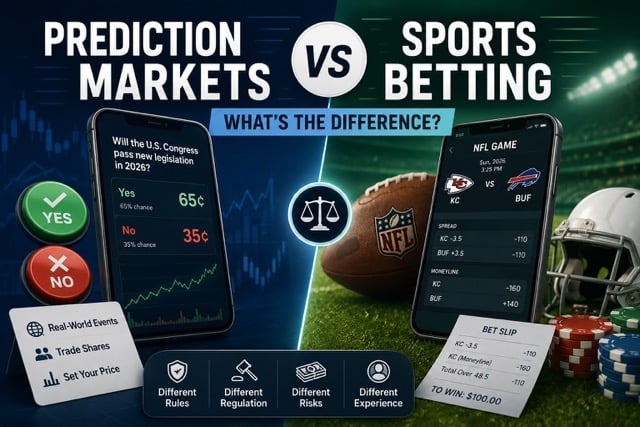
Prediction markets and sports betting both let you put money on how an event turns out, but they work in fundamentally different ways. Sportsbooks set the odds and build in a profit margin called the vig. Prediction markets are peer-to-peer, traders buy and sell contracts tied to an event’s outcome, with the price set by the market itself rather than a bookmaker.
That distinction matters more than ever right now. More bettors than ever are weighing whether to lay down a traditional bet or trade a contract on those exact games, so it’s worth understanding exactly how the two actually compare. Is that gambling? It depends on how the platform is built, as we explain below.
This guide reflects prediction market and sports betting rules current as of September 2026, and we revisit it as regulations shift.
Prediction Markets vs Sports Betting: Quick Answer
Prediction markets let you trade contracts against other users, with prices reflecting the market’s odds of an outcome. Sports betting means wagering against a bookmaker’s fixed odds, which include a built-in margin called the vig. The core difference: peer-to-peer pricing versus a house that sets and profits from the line.
The table below lays out the practical differences at a glance: who you’re trading against, how pricing works, how odds convert to a probability, when you can exit a position, what you can trade, and how each is regulated and taxed. Neither format is inherently better; the right choice depends on whether you value no-vig pricing and broader event coverage or the multiproduct convenience of a traditional sportsbook. We break down these key differences section by section below, including whether prediction markets on sports count as gambling.
| Attribute | Prediction Markets | Sportsbooks |
|---|---|---|
| 🤝 Who You Trade Against | Other traders, peer-to-peer | The sportsbook itself |
| 💰 Pricing Structure | ~1-2% fee, no vig | Vig built into every line |
| 📊 Odds vs. Probability | Price directly reflects probability | Odds imply probability, skewed by vig |
| 🚪 Exit Options | Sell your contract anytime | Locked in, cash-out varies |
| 🎯 Product Range | Sports, politics, economics, pop culture | Game lines and player props |
| ⚖️ Regulation | Federal oversight via the CFTC | State-by-state gaming licenses |
| 🧾 Tax Treatment | Event-contract tax treatment | Gambling winnings, W-2G reporting |
How They Work: Peer-to-Peer vs Betting Against the House
The clearest way to understand the difference is to look at who takes the other side of your position. Prediction markets are peer-to-peer, sportsbooks are not.
Prediction Markets: Trading Contracts With Other People
On a prediction market, you’re buying and selling event contracts, not placing a bet with a bookmaker. Each contract represents a specific outcome and trades on an order book, the same way a stock does, with the price moving toward $1 as an outcome looks more likely and toward $0 as it looks less likely. At resolution, contracts on the correct outcome pay $1 and the rest expire at $0. Because those prices come from other traders buying and selling rather than a bookmaker’s line, the market sets its own odds in real time. If you still have questions, be sure to check out our complete prediction markets guide.
Sportsbooks: Betting Against the House
A sportsbook works differently. The book sets the odds on every game or prop, and when you place a wager, you’re betting against the house, not another bettor. Your payout comes from the sportsbook itself, priced to build in a margin regardless of the outcome. The odds move based on how the book manages its own risk, factoring in injury news, sharp action and public betting patterns, but you’re never trading directly with the people on the other side of the line. That fixed, house-set structure is what makes the vig possible, which we cover next.
Pricing: No-Vig Contracts vs the Vig
Pricing is where the two formats diverge the most, and it’s the single biggest reason bettors compare them at all. Sportsbooks build a margin, commonly called the vig or juice, into every line. Prediction markets don’t add a hidden margin to the price at all; instead, they charge a small, transparent trading fee on top of a price that reflects the market’s actual view of the odds.
Here’s how that plays out on the same $100 wager. At a typical -110 sportsbook line, you’d need to risk $110 to win $100, since -110 odds imply a 52.4% chance of winning. Both sides of that same matchup priced at -110 add up to roughly 104.8% implied probability. That extra 4.8%, often rounded to about a 4.5% hold, is the vig at work. On a prediction market, that same matchup might trade at 50 cents a contract, a no-vig price reflecting a true 50/50 probability with nothing extra baked in. Buying $100 worth of contracts at 50 cents gets you 200 contracts, worth $200 if that outcome occurs, and the platform’s cut comes as a disclosed 1-2% trading fee rather than a skewed price.
How to Read the Price as a Probability (60¢ = 60%)
Prediction-market prices are built to be read directly as probabilities. A contract trading at 60 cents means the market currently thinks that outcome has about a 60% chance of happening; a price of 25 cents implies roughly a 25% chance. As new information comes in and traders buy or sell, the price adjusts in real time to reflect the updated consensus. That’s a more direct read than sportsbook odds, where you first have to convert -150 or +130 into an implied probability before you can compare it to anything.
DraftKings and FanDuel: When Your Sportsbook Also Runs a Prediction Market
The line between these two formats got a lot blurrier once the biggest names in sports betting launched prediction markets of their own. DraftKings Predictions and FanDuel Predicts, which FanDuel built with CME Group, both debuted in December 2025. Both operate under CFTC oversight instead of state gaming licenses, which is why they’re available in many states where DraftKings Sportsbook and FanDuel Sportsbook can’t legally operate.
Sharing a brand name doesn’t make the products interchangeable. DraftKings keeps Predictions in a separate app with its own wallet, and it doesn’t offer Predictions in states where its sportsbook is licensed, so most customers will only ever have access to one of the two. FanDuel Predicts is available nationwide, though its sports contracts are limited to 18 states, with non-sports markets like economics and pop culture offered everywhere else.
What’s the Difference Between Trades and Bets on DraftKings?
If you’ve come across both “bets” and “trades” in DraftKings’ products, the two terms describe completely different transactions:
- Bets (DraftKings Sportsbook): You wager against DraftKings at odds the book sets, with the vig built into every line. Your bet settles when the event ends unless you accept a cash-out offer along the way.
- Trades (DraftKings Predictions): You buy Yes or No contracts from other users at prices between $0.01 and $0.99, and DraftKings charges a per-contract fee rather than a vig. Winning contracts settle at $1, and you can sell your position at the current market price before the event is over.
The rules behind them differ just as much. Sportsbook bets fall under each state’s gaming regulator, while trades run through DKeX, DraftKings’ own CFTC-regulated exchange. That’s also why the age requirements don’t match: DraftKings Predictions is open to users 18 and older in most of its markets, while online sportsbooks require bettors to be 21 or older in nearly every state. For a closer look at each platform, see our DraftKings Predictions review and our FanDuel Predicts review.

 Are Prediction Markets Gambling?
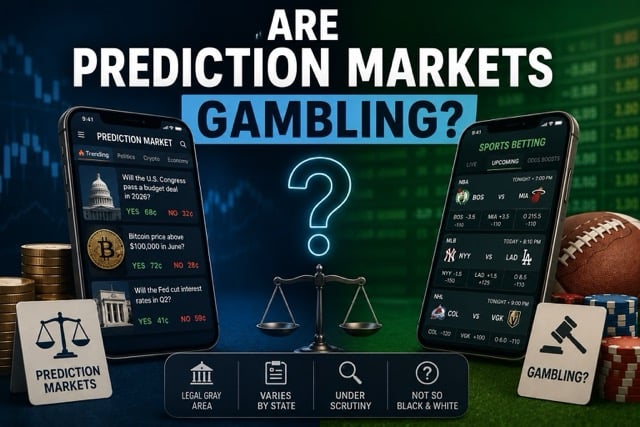
Whether prediction markets count as gambling depends on who you ask, how gambling is defined, and increasingly, which federal court covers your state. The two biggest platforms, Polymarket and Kalshi, were designed as financial products from the start. Each operates a designated contract market supervised by the CFTC, a status Polymarket’s US exchange secured in late 2025, which places their contracts alongside futures and other derivatives rather than wagers. Neither platform carries a gaming license from any state, and neither describes what it sells as a bet.
Supporters describe prediction markets as information markets. A contract’s price captures the combined judgment of everyone trading it, much the way share prices track what investors collectively expect, instead of one bookmaker’s view of who should win. Critics argue that when the contract is tied to a football game, calling it an information market starts to sound more like branding than a real difference.
That argument is hardest to make for markets on elections, inflation data, or corporate earnings, since nobody would confuse those with a sportsbook menu. Sports are a different story. A contract on whether the Chiefs win Sunday and a moneyline wager on that exact game leave the holder in essentially the same position: you’re right or you’re wrong, and money changes hands accordingly.
Courts are now split on how much that resemblance matters. The Third Circuit sided with Kalshi, finding that federal law preempts state gaming rules for CFTC-registered markets. On August 28, 2026, the Ninth Circuit reached the opposite conclusion, ruling that sports event contracts aren’t swaps under federal commodities law and that states can regulate them as gambling. New Jersey has since asked the US Supreme Court to settle the question.
Where does that leave you? On paper, prediction markets are designed and supervised as financial instruments. Functionally, a sports contract can feel almost identical to a bet, and depending on where you live, a court or state regulator may now treat it as one. The practical answer comes down to the platform, the type of contract, and your state.
Legality: Federal Oversight vs State Gaming Licenses
Prediction markets and sportsbooks report to completely different regulators, and that’s why prediction markets can reach players in states where sports betting is still illegal. Platforms such as Polymarket US and Kalshi operate as designated contract markets registered with the Commodity Futures Trading Commission (CFTC). Federal registration allows them to offer contracts across the country without a separate state license. Sportsbooks need the opposite: a gaming license in every state where they take bets, so a sportsbook approved in New Jersey still can’t take action from a customer in Texas, where legal sports betting doesn’t exist.
The Legal Fight Over Sports Contracts
That federal-versus-state divide has turned sports event contracts into the most contested part of the industry. Roughly 20 states are now in litigation with prediction market platforms, arguing that trading on a game’s result is no different from a sports bet and belongs under state gambling law. The biggest developments so far:
- A circuit split: The Third Circuit ruled in Kalshi’s favor, while the Ninth Circuit ruled against it on August 28, 2026, holding that states can regulate sports event contracts as gambling.
- A Supreme Court request: New Jersey petitioned the US Supreme Court in early September 2026 to resolve the split.
- A state closing its doors: Nevada is now effectively off-limits for sports event contracts following the Ninth Circuit decision.
- Federal rulemaking: The CFTC proposed changes in June 2026 to how it defines “gaming” for event contracts, and 44 states jointly challenged the agency’s authority during the comment period.
Until the Supreme Court or Congress steps in, your access to sports contracts depends on both the platform and your state, and that picture can change quickly. It’s a very different situation from sports betting’s straightforward legal-or-illegal map. Our prediction market news page tracks the latest rulings as they happen.
Taxes on Winnings: Sportsbooks vs Prediction Markets
Taxes differ between the two formats as well. Sportsbook payouts count as gambling income for tax purposes, and books issue a W-2G on larger wins. Starting with the 2026 tax year, you can only deduct 90% of your gambling losses, and only if you itemize. A House committee advanced a bill in September 2026 to restore the full deduction, but it hasn’t become law.
Prediction markets sit in a gray area. The IRS hasn’t issued formal guidance on event contracts, so tax professionals currently treat gains as capital gains, gambling income, or in some cases other categories, and platforms like Kalshi and Robinhood don’t issue a comprehensive 1099 covering every event contract trade. That leaves much of the recordkeeping up to you. This isn’t tax advice, so if you trade or bet meaningful amounts on either format, talk to a tax professional about how your activity should be reported.
Product Range: What You Can Trade
Sportsbooks keep their entire product built around live games: point spreads, moneylines, totals and a growing menu of player and game props, all tied to an actual sporting event you can watch. That focus keeps the product simple, but it also means your options end wherever the sports calendar does.
Prediction markets cast a much wider net. You can trade sports contracts covering the same games a sportsbook offers, then pivot to political contracts on elections, legislation and policy outcomes, plus markets on economic data like inflation reports and Fed decisions, and even pop-culture questions like award-show winners or entertainment headlines. If an outcome is verifiable and enough people want to trade it, a prediction market can usually build a contract around it, well beyond anything a sportsbook’s license lets it touch.
There’s a third format worth knowing about, too: daily fantasy sports (DFS). DFS apps like PrizePicks and Underdog have you pick player-prop outcomes for a fixed, pre-set payout rather than trading a live-priced contract — no market price, no selling early. Several of these apps, including PrizePicks, Underdog, and DraftKings, now bolt a prediction-market feature onto their existing DFS product, which is exactly where things get confusing. If you’re weighing a DFS app’s prediction tab against a dedicated exchange, our full prediction markets vs DFS breakdown covers the structural differences in more depth.
| Market Category | Prediction Markets | Sportsbooks |
|---|---|---|
| 🏈 Sports (Games & Props) | Game outcomes, MVP races, win totals | Game lines, player props, futures |
| 🗳️ Politics & Elections | Presidential races, congressional control, primaries | Not offered by regulated books |
| 📈 Economics & Fed Decisions | Fed rate decisions, inflation prints, jobs data | Not offered by regulated books |
| 🎬 Entertainment & Pop Culture | Award-show winners, box office results | Not offered by regulated books |
| 🌪️ Weather & Climate Events | Hurricane paths, temperature records, snowfall totals | Not offered by regulated books |
| ₿ Crypto & Finance Benchmarks | Bitcoin price levels, rate-cut odds | Not offered by regulated books |
Which Is Better for You?
There’s no universally right answer here, the better fit depends on what you’re actually optimizing for.
Prediction markets tend to suit traders who want no-vig pricing, value the ability to shop for a better price as the market moves, and like having access to markets well beyond sports, politics, economics and entertainment, all under one platform. If you’re comfortable doing your own research and thinking in terms of probability rather than odds, our prediction market strategies guide is a good next stop, and our prediction market tools breakdown covers the calculators and trackers that make that research easier.
Sportsbooks tend to suit bettors who want the convenience of live, in-play wagering across a wide slate of games, plus the promos, bonus structures and polished mobile experience that come with an established book. That maturity matters: these books have processed millions of wagers, refined their apps for years and built customer support and dispute processes that newer prediction market platforms are still developing. If that sounds more like you, our roundup of the best sports betting apps is the better starting point.
Plenty of bettors end up using both, prediction markets for the pricing edge and breadth, sportsbooks for the in-play action and familiarity, rather than treating it as an either-or choice.
Ready to Trade? See Our Top Prediction Markets
Compare GamingToday’s top-rated prediction market platforms to find the best fit before you place your first trade.
Get $100 in Predicts Bonus When You Trade $1 for 5 Days
Make Predictions on Real World Events Right in Your Phone
Trade on Sports to Culture, Financials, Crypto and More
Get $100 in Predicts Bonus When You Trade $1 for 5 Days
Make Predictions on Real World Events Right in Your Phone
Trade on Sports to Culture, Financials, Crypto and More
Huge Range of CFTC-Approved Markets (Sports, Tech, and More)
Compete with Others & Climb the Leaderboards
No User Limiting on Trades
Huge Range of CFTC-Approved Markets (Sports, Tech, and More)
Compete with Others & Climb the Leaderboards
No User Limiting on Trades
Deposit $10, Get a $50 Trading Bonus
Live Trade with the Biggest Payouts at the Largest Prediction Market in the World
Deposit $10, Get a $50 Trading Bonus
Live Trade with the Biggest Payouts at the Largest Prediction Market in the World
America's #1 Sports Prediction Market
Same Sports Moments, Bigger Payouts
Choose from Straights, Player Props, Parlays & More
America's #1 Sports Prediction Market
Same Sports Moments, Bigger Payouts
Choose from Straights, Player Props, Parlays & More
Get $150 in Bonuses Paid Over 14 Days
DraftKings is Now Available Nationwide
Browse Markets like Sports, Crypto, Tech & More
Get $150 in Bonuses Paid Over 14 Days
DraftKings is Now Available Nationwide
Browse Markets like Sports, Crypto, Tech & More
Complete a Task in the Crypto.com App to Unlock up to 1 Bitcoin Worth of CRO Rewards
America’s All-In-One Trading Platform
Manage Your Crypto, Stocks, Predictions & Card Spend Seamlessly
Complete a Task in the Crypto.com App to Unlock up to 1 Bitcoin Worth of CRO Rewards
America’s All-In-One Trading Platform
Manage Your Crypto, Stocks, Predictions & Card Spend Seamlessly
Ready to Bet? See Our Top Sportsbooks
Compare GamingToday’s top-rated sportsbooks to find the best welcome offer and betting experience for you.
Up to $1,500 in Bonus Bets if Your First Bet Doesn't Win*
*Bonus Bets Expire in 7 Days. One New Customer Offer Only. Add’l terms. 21+. Gambling Problem? Call 1-800-GAMBLER or 1-800-MY-RESET
Up to $1,500 in Bonus Bets if Your First Bet Doesn't Win*
*Bonus Bets Expire in 7 Days. One New Customer Offer Only. Add’l terms. 21+. Gambling Problem? Call 1-800-GAMBLER or 1-800-MY-RESET
Get $250 in Bonus Bets When You Wager $5 for 5 Days ($50 Bonus Bets Per Day)
Available on Desktop, Android & iOS
Easy Deposits, Fast Withdrawals
Get $250 in Bonus Bets When You Wager $5 for 5 Days ($50 Bonus Bets Per Day)
Available on Desktop, Android & iOS
Easy Deposits, Fast Withdrawals
Get a 100% Bet Match up to $100 in FanCash for 10 Days
Earn FanCash & Spend it on Team Swag or More Bets
Daily Odds & Profit Boosts on Select Games
Get a 100% Bet Match up to $100 in FanCash for 10 Days
Earn FanCash & Spend it on Team Swag or More Bets
Daily Odds & Profit Boosts on Select Games
Spend $5+ Get $150 in Bonus Bets Over 14 Days
Plus Get up to $1,000 Deposit Bonus
Bet on All Your Favorite Sports With America's Top-Rated Sportsbook
Spend $5+ Get $150 in Bonus Bets Over 14 Days
Plus Get up to $1,000 Deposit Bonus
Bet on All Your Favorite Sports With America's Top-Rated Sportsbook
Bet $10 Get $200 in Bonus Bets Win or Lose
30% Extra on Same Game Parlay Profit
T&Cs Apply. Gambling Problem? Call 1-800-GAMBLER or 1-800-MY-RESET (AZ, CO, IL, IN, KS, KY, LA, MD, MI, MO, NC, NJ, OH, PA, TN, VA, WV) or 1-800-BETS OFF (IA). 21+ only. Please gamble responsibly. Must be present in AZ/CO/IA/IL/IN/KS/KY/LA(select parishes) /MD/MI/MO/NC/NJ/OH/PA/TN/VA/WV.
Bet $10 Get $200 in Bonus Bets Win or Lose
30% Extra on Same Game Parlay Profit
T&Cs Apply. Gambling Problem? Call 1-800-GAMBLER or 1-800-MY-RESET (AZ, CO, IL, IN, KS, KY, LA, MD, MI, MO, NC, NJ, OH, PA, TN, VA, WV) or 1-800-BETS OFF (IA). 21+ only. Please gamble responsibly. Must be present in AZ/CO/IA/IL/IN/KS/KY/LA(select parishes) /MD/MI/MO/NC/NJ/OH/PA/TN/VA/WV.
Polymarket vs DraftKings and FanDuel: A Quick Comparison
Polymarket and traditional sportsbooks like DraftKings and FanDuel both let you take a position on a game’s outcome, but the similarities mostly end there. DraftKings and FanDuel are licensed sportsbooks with fixed odds set by the book, built-in vig, and access limited to states where each holds a gaming license. Polymarket is a peer-to-peer prediction market with no-vig pricing and no state-by-state licensing wall, though its sports contracts sit in the same legally contested space discussed above.
For sports specifically, DraftKings and FanDuel offer deeper same-game parlay tools, live in-play betting and established promo programs that Polymarket doesn’t match. Polymarket’s edge is pricing and breadth, plus access to non-sports markets neither sportsbook offers at all.
| Attribute | Polymarket | DraftKings | FanDuel |
|---|---|---|---|
| 🤝 Who You Trade Against | Other traders, peer-to-peer | The sportsbook itself | The sportsbook itself |
| 💰 Pricing Structure | ~1-2% fee, no vig | Vig built into every line | Vig built into every line |
| 📊 Odds vs. Probability | Price directly reflects probability | Odds imply probability, skewed by vig | Odds imply probability, skewed by vig |
| 🚪 Exit Options | Sell your contract anytime | Locked in, cash-out varies | Locked in, cash-out varies |
| 🎯 Product Range | Sports, politics, economics, pop culture | Game lines and player props | Game lines and player props |
| ⚖️ Regulation | Decentralized, no state licensing | State-by-state gaming licenses | State-by-state gaming licenses |
| 🧾 Tax Treatment | Event-contract tax treatment | Gambling winnings, W-2G reporting | Gambling winnings, W-2G reporting |
Final Verdict: Prediction Markets or Sportsbooks?
Neither format beats the other outright, they’re built for different things, and the right pick comes down to what you actually value when you put money on an outcome. Prediction markets win on pricing and breadth, sportsbooks win on convenience and maturity, and plenty of bettors end up using both rather than picking a side.
- 💰 No-Vig Pricing Favors Prediction Markets | A typical -110 sportsbook line bakes in roughly a 4.5% hold, while platforms like Polymarket and Kalshi charge a disclosed 1-2% trading fee instead of skewing the price itself, a real structural edge for anyone comparing the two purely on cost.
- 🎯 Sportsbooks Still Win on Convenience | Live in-play wagering, same-game parlays, and years of refined mobile apps and promo programs give DraftKings and FanDuel a maturity that newer prediction market platforms are still building toward.
- 🌐 Prediction Markets Cast a Wider Net | Beyond sports, prediction markets let you trade on elections, Fed decisions, and pop culture, entire categories no state-licensed sportsbook is allowed to touch.
- ⚖️ Regulation Splits Along Federal and State Lines | Prediction markets answer to the CFTC and can operate nationwide without a state license, while sportsbooks need a license in every state they operate in, which is exactly why sports-related event contracts remain the most legally contested corner of the industry.
- 🧾 The Gambling Question Still Isn’t Fully Settled | Structurally, prediction markets are regulated as financial products rather than bets, but for a sports contract specifically, the practical experience can feel close enough to a wager that regulators and courts are still sorting out where the line actually falls.
If you value no-vig pricing and want access to markets beyond sports, prediction markets like Polymarket and Kalshi are the better fit. If live in-play betting, deep promo offers, and an established mobile experience matter more to you, a sportsbook like DraftKings or FanDuel is still the more polished product. Most serious bettors don’t have to choose just one, using each format for what it does best.
How We Rate and Review Prediction Markets and Sportsbooks
This comparison, and every operator we link to from it, goes through the same evaluation regardless of which format it falls under: we verify the actual regulatory structure, price out real examples rather than relying on marketing claims, and hold prediction market platforms and sportsbooks to the same standard even though they operate under different rules.
- Pricing and Fee Transparency | We calculate the real cost of a bet or trade, the vig on a sportsbook line, the disclosed fee on a prediction market contract, rather than taking either platform’s framing of “no-vig” or “fair odds” at face value.
- Regulatory Verification | We confirm a sportsbook’s state gaming license or a prediction market’s CFTC registration directly, since the two operate under entirely different oversight structures that aren’t interchangeable.
- Product Range Accuracy | We check what markets or bet types a platform actually offers today, not what it’s announced or plans to launch, since prediction markets and sportsbooks differ enormously in category breadth.
- Tax and Legal Clarity | We research how winnings are actually treated and reported for each format, and we’re upfront when guidance is genuinely unsettled, like sports-related event contracts, rather than presenting an unresolved legal question as settled fact.
- Live and In-Play Experience | We test how each format handles a position once an event is already underway, since a sportsbook’s dedicated live-betting menu and a prediction market’s continuously updating price serve that need very differently.
- Responsible Play Resources | We confirm that deposit limits, cool-off periods, and self-exclusion tools are genuinely available and easy to find on both prediction market platforms and sportsbooks alike.
A lower headline cost or a broader market menu only tells part of the story. What actually shapes our recommendations is whether the regulatory structure, the real pricing, and the player protections hold up on both sides of this comparison. See our full how we rate and review online gambling sites guide for the complete methodology.
Trade and Bet Responsibly
Whether you’re trading prediction-market contracts or placing sportsbook wagers, only ever risk money you can afford to lose. Both formats carry real financial risk, and no strategy, platform or pricing edge guarantees a profit.
Licensed sportsbooks and prediction market platforms offer tools like deposit limits, wagering limits, cool-off periods and self-exclusion programs. Use them if you notice yourself chasing losses, trading past your comfort level, or spending more time or money than you intended. You must be 21 or older, or the applicable minimum age in your state, to participate in either format. Visit our responsible gaming guide for more tools and resources.
If gambling or trading no longer feels fun, or feels out of your control, confidential support is available 24/7 by calling 1-800-GAMBLER.
FAQs
It depends on the platform and the outcome. Prediction markets are structured and regulated as financial products rather than bets, and that holds up clearly for markets on elections or economic data. For sports specifically, the financial experience can feel close enough to a wager that the honest answer depends on structure, intent and where you live.
Prediction markets are peer-to-peer, meaning you’re trading contracts against other users at prices that move with supply and demand. Sports betting means wagering against a sportsbook’s fixed odds, which build in a margin called the vig. That structural difference carries through pricing, regulation, product range and even how winnings get taxed.
Often, yes, in terms of pricing efficiency. A typical -110 sportsbook line carries roughly a 4.5% hold built into the odds, while prediction markets usually charge a smaller, disclosed trading fee of around 1-2% instead of baking a margin into the price itself. That structural difference tends to favor prediction markets on pure pricing.
In many cases, yes. Platforms regulated under the CFTC operate under federal oversight, which lets them offer contracts nationwide without a state-by-state gaming license, unlike sportsbooks. That said, sports-related prediction contracts specifically face ongoing legal challenges in several states, so availability for that category can still vary by state and platform.
The vig is baked into a sportsbook’s odds, so you never see it as a separate charge, both sides of a matchup typically add up to more than 100% implied probability. A prediction-market fee is usually a small, disclosed percentage charged on top of a price that already reflects a true 50/50 probability. For a deeper breakdown of terms like “implied probability” and “vig,” check our full glossary of prediction market terms.
Potentially, yes, though the exact treatment depends on the platform and the IRS hasn’t issued dedicated guidance for every prediction-market structure. Sports betting winnings are reported as gambling income, with a W-2G issued for larger wins. This isn’t tax advice, a tax professional can tell you exactly how your specific activity should be reported.
Somewhat, but it works differently. Prediction-market prices update continuously as traders buy and sell, so you can exit or add to a position mid-event, but that’s different from a sportsbook’s dedicated live-betting menu with constantly refreshed lines and bet types built specifically for in-game wagering.
Structurally, no, Polymarket operates as a decentralized prediction market rather than a licensed sportsbook, and it doesn’t hold a state gambling license. Functionally, when the contract is tied to a sports outcome, the experience can feel close to a wager, which is why the broader legal question hasn’t fully settled.

