
Prediction Markets vs. Daily Fantasy Sports: What’s the Difference?


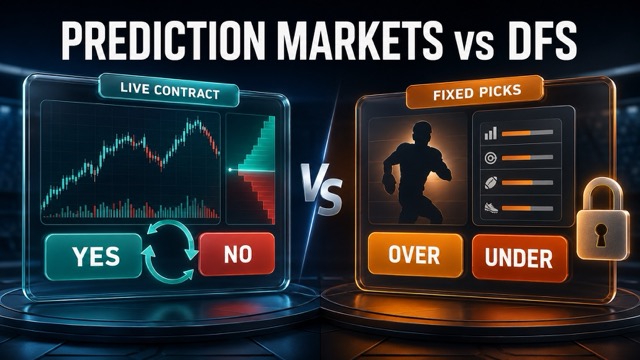
Daily fantasy sports locks you into a set lineup or player-prop picks the moment you submit, with a payout that’s fixed no matter how the rest of the slate plays out. A prediction market works on a different model: you buy a live-priced “Yes” or “No” contract, and you can sell it back anytime before the event ends if the price swings your way. The two used to be worlds apart, but the line has blurred fast, with PrizePicks, Underdog, and DraftKings now running DFS contests and prediction-market contracts side by side, often on the exact same slate of games.
Baseball gives both products plenty to work with all season, especially down the stretch as division and wild-card races tighten. Tight standings battles and marquee rivalry series alike draw heavy trading and lineup-building activity, with moneyline, win-total, and player-prop contracts to trade on Polymarket, or lineups to build on PrizePicks and Underdog, before the first pitch each night.
Football adds another layer once the NFL season kicks off, with a full slate of games every week from the opening Sunday through the playoffs. Expect both DFS lineups and prediction-market contracts on game winners, win totals, and award races to stay active all season long.
Where to Trade These Contracts
These operators carry the deepest baseball and NFL market menus, each with its own sign-up offer for new traders.
Get $100 in Predicts Bonus When You Trade $1 for 5 Days
Make Predictions on Real World Events Right in Your Phone
Trade on Sports to Culture, Financials, Crypto and More
Get $100 in Predicts Bonus When You Trade $1 for 5 Days
Make Predictions on Real World Events Right in Your Phone
Trade on Sports to Culture, Financials, Crypto and More
Huge Range of CFTC-Approved Markets (Sports, Tech, and More)
Compete with Others & Climb the Leaderboards
No User Limiting on Trades
Huge Range of CFTC-Approved Markets (Sports, Tech, and More)
Compete with Others & Climb the Leaderboards
No User Limiting on Trades
Deposit $10, Get a $50 Trading Bonus
Live Trade with the Biggest Payouts at the Largest Prediction Market in the World
Deposit $10, Get a $50 Trading Bonus
Live Trade with the Biggest Payouts at the Largest Prediction Market in the World
America's #1 Sports Prediction Market
Same Sports Moments, Bigger Payouts
Choose from Straights, Player Props, Parlays & More
America's #1 Sports Prediction Market
Same Sports Moments, Bigger Payouts
Choose from Straights, Player Props, Parlays & More
Get $150 in Bonuses Paid Over 14 Days
DraftKings is Now Available Nationwide
Browse Markets like Sports, Crypto, Tech & More
Get $150 in Bonuses Paid Over 14 Days
DraftKings is Now Available Nationwide
Browse Markets like Sports, Crypto, Tech & More
Complete a Task in the Crypto.com App to Unlock up to 1 Bitcoin Worth of CRO Rewards
America’s All-In-One Trading Platform
Manage Your Crypto, Stocks, Predictions & Card Spend Seamlessly
Complete a Task in the Crypto.com App to Unlock up to 1 Bitcoin Worth of CRO Rewards
America’s All-In-One Trading Platform
Manage Your Crypto, Stocks, Predictions & Card Spend Seamlessly
Prediction markets vs DFS: the key difference
The difference between prediction markets and daily fantasy sports is how the price and the payout work. In a prediction market, you buy a contract on a real-world outcome at a live market price, and that price moves as new information arrives — you can sell early for a profit or loss. In DFS, you build a lineup or pick a set of player props against a fixed contest structure, and your payout is locked in once the contest starts; there’s no market price and no exit.
That distinction matters more than it sounds. A prediction market contract behaves like a tradable financial instrument: it has a bid, an ask, and a settlement date, and its price reflects the market’s real-time read on the odds. A DFS pick’em entry behaves more like a parlay slip — you commit your picks, the contest locks, and you wait for the final box score. This is also the root of the prediction markets vs sportsbooks debate: both DFS and sportsbooks offer fixed, locked-in wagers, while prediction markets trade more like an exchange.
It’s also why regulators treat the two differently (more on that below): prediction markets are regulated as derivatives by the CFTC, while DFS pick’em contests fall under a patchwork of state fantasy-sports and gambling laws.
Prediction markets vs daily fantasy sports: side-by-side
The table below lines up the two formats feature by feature. The short version: a prediction market is a live, tradable event contract; DFS is a fixed contest with a locked-in payout.
| Feature | Prediction Market | Daily Fantasy Sports |
|---|---|---|
| 🎯 What you do | Buy or sell "Yes"/"No" event contracts | Build a lineup or pick player-prop projections |
| 💲 Pricing | Live market price, moves with new information | Fixed contest rules and payout table set upfront |
| 🚪 Exit before the end | Yes — sell your contract anytime before settlement | No — your entry locks once the contest starts |
| 🌐 Range of markets | Any event with a knowable outcome: sports, politics, economy, pop culture | Player and team performance only |
| ⚖️ Regulation | CFTC-regulated event contracts (federal) | State-by-state DFS/fantasy-sports law; pick'em format contested in several states |
| 🔢 Minimum age | 18+ on platforms like Kalshi (as of September 2026) | Varies by state — commonly 18, but 19 or 21 in some states |
| 📍 Availability | Most states; a few app-specific exclusions | Varies widely; pick'em-style contests restricted in a growing number of states |
| 🔀 Who offers both | Kalshi, Polymarket | PrizePicks (via Kalshi), Underdog (via Underdog Predict), DraftKings (via DraftKings Predictions) |
One row worth double-checking before you sign up anywhere: regulation and minimum age. Prediction markets like Kalshi and Polymarket are regulated as derivatives exchanges and generally set the minimum age at 18, while DFS platforms set their own age minimums (often 18, but 19 or 21 in some states) under state fantasy-sports law. Both change by state, and both are worth confirming directly in-app.
The “range” row is where prediction markets pull ahead on sheer breadth. Where DFS is built around player and team performance, prediction markets cover any event with a knowable outcome — sports, politics, economic data like Fed decisions and CPI, and even pop-culture events like award shows and reality TV outcomes. That breadth is also why the “who offers both” row exists at all: DFS operators looking to expand beyond player props found it easier to add prediction contracts than to build new fantasy formats from scratch.
None of this is static. New markets get added, states change their rules, and platforms adjust their age minimums and product mix throughout the year — the numbers above are a snapshot, not a permanent reference.
What is daily fantasy sports?
Daily fantasy sports (DFS) lets you build a roster of real athletes for a single day or week’s slate of games, scored on their real statistical performance. The two main formats are salary-cap contests, where you draft a lineup under a fixed budget and compete against other entrants for a prize pool, and pick’em contests, where you pick whether individual players will go “over” or “under” a projected stat line and get paid out on a fixed multiplier based on how many picks you get right.
PrizePicks and Underdog built their businesses on the pick’em format; DraftKings and FanDuel offer both formats, with salary-cap contests as their original product. All four now sit alongside sportsbook and prediction-market products in the same apps — see our social sportsbooks hub for how DFS compares to social and sweepstakes betting apps, and our NFL DFS and betting apps guide for a rundown of what’s live for football season.
What is a prediction market?
A prediction market is a marketplace where traders exchange contracts tied to the outcome of a real-world event, such as “Will the Fed cut rates in September?” or “Will [Team] win the Super Bowl?” rather than placing a single fixed-odds bet. Each contract settles at $1 if the outcome happens and $0 if it doesn’t, and the live price in between, say 62 cents, reflects the market’s collective estimate of the odds. Traders can buy, sell, or hold that contract right up until the event resolves.
That trading mechanic is also what separates prediction markets from sportsbooks, a distinction worth understanding on its own; see our full breakdown of prediction markets vs sportsbooks. For the fundamentals, including how contracts are priced, who regulates them, and how to get started, our prediction markets guide covers the full picture.
Wait — DFS apps now offer prediction markets too
If you’ve had a DFS app on your phone for a while, you may have noticed a new tab appear sometime in 2026: prediction markets, built right into the product you already use for pick’em contests. This isn’t a rebrand — it’s three different companies solving the same regulatory problem in three different ways.
PrizePicks partnered with Kalshi rather than build its own exchange. Through its FCM subsidiary, PrizePicks now offers Team Picks (contracts on game winners, matchups, and season-long outcomes) and Culture Picks (award shows, entertainment, and political events) as federally regulated event contracts sitting alongside its original DFS pick’em product.
Underdog went the opposite direction and built Underdog Predict, its own in-house exchange, after acquiring the Aristotle Exchange’s contract-market and clearing licenses in 2026. That makes Underdog the first DFS-turned-prediction company to hold the full license stack — futures commission merchant, designated contract market, and derivatives clearing organization — instead of routing trades through a partner.
DraftKings Predictions and FanDuel took a lighter-touch approach, operating as CFTC-registered introducing brokers that connect customers to regulated exchanges rather than running the market themselves. Both frame their prediction-market products as a “familiar,” DFS-and-sportsbook-adjacent experience rather than a full trading interface.
| Company | Original DFS Product | Prediction-Market Product | How It's Structured |
|---|---|---|---|
| 🏈 PrizePicks | Pick'em contests | Team Picks & Culture Picks | Partnered with Kalshi via an FCM subsidiary — doesn't run its own exchange |
| 🐶 Underdog | Pick'em contests | Underdog Predict | Built its own exchange after acquiring Aristotle Exchange's DCM/DCO licenses |
| 👑 DraftKings | Salary-cap & pick'em DFS | DraftKings Predictions | CFTC-registered introducing broker — routes trades to regulated exchanges |
| 💙 FanDuel | Salary-cap & pick'em DFS | FanDuel Predictions | Introducing-broker model, similar to DraftKings |
Why now? DFS pick’em contests have come under sustained pressure — New York ruled in 2023 that pick’em-style, fixed-odds picks against a “line” function like prop bets rather than skill-based fantasy, and several other states (including Arizona, Colorado, Idaho, Louisiana, Montana, Nevada, and Washington) have restricted or blocked the format outright. Prediction markets offer these companies a federal path around that patchwork: courts have so far found (in at least the Third Circuit, covering New Jersey, Pennsylvania, and Delaware) that CFTC-regulated event contracts preempt conflicting state gambling law — though that question is still being litigated elsewhere, including a pending New York lawsuit against Kalshi. More on that below.
Is PrizePicks gambling? Is DFS legal?
General information as of September 2026, not legal advice — this area is changing quickly, so confirm current rules for your state directly with the platform.
Is PrizePicks gambling? It depends who you ask. PrizePicks and other DFS pick’em operators argue their contests are skill-based fantasy sports, protected under the same state carve-outs that cover traditional salary-cap DFS. Several state regulators disagree: New York’s Gaming Commission ruled in 2023 that pick’em-style, fixed-multiplier picks against a projected stat line function like proposition bets rather than skill-based contests, regardless of the skill involved in choosing them — a structural argument, not a skill-vs-luck one. That reasoning has since been echoed, in varying forms, by regulators in Arizona, Colorado, Idaho, Louisiana, Montana, Nevada, and Washington.
Is PrizePicks legal in my state? PrizePicks says its DFS pick’em product carries all required licenses in most states, but the list of restricted states has grown and changes often — check current availability in the app rather than relying on a fixed list. Its newer Team Picks and Culture Picks, run through Kalshi as federal event contracts, follow a separate legal framework and a different state footprint.
Is daily fantasy sports gambling? Traditional salary-cap DFS — draft a full roster, compete against other players for a prize pool — has generally avoided gambling classification because outcomes depend on relative skill across a multi-player field. Pick’em contests are the harder case, because they pay out on a fixed schedule against the house rather than against other players, which is closer to how sportsbooks and, now, prediction markets are structured and regulated.
That’s exactly the wrinkle that’s reshaping this space: a divided Third Circuit ruled in April 2026 that CFTC-regulated sports event contracts fall under exclusive federal jurisdiction in at least New Jersey, Pennsylvania, and Delaware — a very different legal foundation than state DFS law. New York has taken the opposite position, suing Kalshi directly in July 2026 and calling its event contracts an illegal gambling operation. Nothing here is nationally settled — treat any specific state claim as a snapshot, not a guarantee.
| Product / Entity | Current Status | Note |
|---|---|---|
| 🎯 PrizePicks pick'em (DFS) | Governed by state DFS/fantasy-sports law | Restricted or blocked in a growing list of states; check current availability in-app |
| 🔄 PrizePicks Team Picks & Culture Picks | Regulated as CFTC event contracts (via Kalshi) | Separate legal framework and state footprint from pick'em DFS |
| ⚖️ Kalshi sports event contracts (NJ, PA, DE) | Protected by a federal injunction (Third Circuit, April 2026) | Ruling's reach is limited to those states — not nationwide |
| 🗽 Kalshi in New York | Being sued directly by the state (filed July 2026) | NY alleges an illegal gambling operation — the opposite legal theory from the Third Circuit ruling |
| 📋 DFS pick'em contests generally | Restricted or blocked in several states, including NY, AZ, CO, ID, LA, MT, NV, and WA | States' rationale: fixed-multiplier picks against a projected line function like prop bets, regardless of skill |
Kalshi vs PrizePicks: which should you use?
There’s no universal answer here — it depends on what you’re actually trying to do, how many apps you’re willing to juggle, and how much control you want over exiting a position early.
Use a DFS app’s prediction feature if you’re already a PrizePicks, Underdog, or DraftKings user and want everything in one app. You get a simpler interface tuned for casual use, the same login and balance you already have, and enough market coverage for the biggest games and events without needing a second account.
Use a pure exchange like Kalshi or Polymarket if you want the full range of markets — not just sports and pop culture but politics, economic data, and niche events — plus deeper liquidity, tighter spreads, and exchange-style order types (limit orders, early exits, automated selling) that DFS-app front-ends generally don’t expose. If you’re coming from DFS specifically and want a broader, prediction-only platform, Kalshi is the most common PrizePicks alternative people land on.
In practice, a lot of traders end up doing both: the DFS app’s prediction tab for quick, familiar picks on the games they’re already watching, and a direct exchange account for anything bigger or more market-specific. Once you’ve picked a starting point, our prediction market strategies guide covers how to actually manage risk and size positions once you’re trading, not just picking sides, and our prediction market trading tools comparison rounds up the trackers and scanners that make managing more than one account easier.
Fees, payouts, and taxes
DFS pick’em payouts are fixed multipliers set before the contest locks — pick two players correctly and you might get a set 3x return; pick five and it jumps to a bigger, pre-published number. What you see at entry is what you get if your picks hit, no matter what happens to the odds in between. Prediction market payouts work differently: your return is the gap between the price you paid for your contract and either the price you sold it at, or its final $1-or-$0 settlement value. Fees on exchanges like Kalshi typically show up as a small spread or per-trade fee rather than a flat entry fee. Terms like “spread” and “settlement” are covered in more detail in our prediction market terms glossary.
Tax note — general information, not tax advice. This is one of the more meaningful practical differences between the two. DFS and sportsbook winnings are almost always taxed as ordinary gambling income, and a 2026 federal law change capped gambling-loss deductions at 90% of your winnings — so losses no longer fully offset wins for tax purposes. Prediction market contracts on CFTC-regulated exchanges have a stronger case for capital-gains treatment (some qualify for Section 1256’s 60/40 long/short-term split), though the IRS hasn’t issued prediction-market-specific guidance yet, and how a given platform’s contracts get classified can vary. Talk to a tax professional about your specific situation before assuming either treatment applies.
FAQs
Prediction markets let you buy or sell a live-priced “Yes”/”No” contract on a real-world outcome and exit anytime before it settles. Daily fantasy sports locks you into a fixed lineup or set of player-prop picks with a payout schedule set in advance — no live pricing, no early exit, and no trading once the contest starts.
It depends who’s asking. PrizePicks calls its pick’em contests skill-based fantasy sports. Several state regulators, starting with New York in 2023, have ruled that fixed-multiplier picks against a projected stat line function like proposition bets regardless of skill involved. There’s no single national answer, and the legal picture is still shifting state by state.
PrizePicks says its DFS pick’em product operates with required licenses in most states, but a growing list of states restrict or block the format, and that list changes often. Its newer Team Picks and Culture Picks (run through Kalshi as federal event contracts) follow a separate legal framework and a different state footprint — check current availability in-app.
Traditional salary-cap DFS, where you draft a full roster and compete against other players for a shared prize pool, has generally avoided gambling classification. Pick’em contests are the harder case: they pay out on a fixed schedule against the house rather than against other players, which several regulators say functions more like sports betting.
Yes. PrizePicks partnered with Kalshi to add Team Picks (contracts on game winners, matchups, and season outcomes) and Culture Picks (entertainment, awards, and political events) as federally regulated event contracts, sitting alongside — not replacing — its original DFS pick’em product.
Neither is objectively “better” — they serve different needs. PrizePicks bundles a simplified prediction feature into an app you may already use for DFS. Kalshi is a dedicated exchange with a much wider range of markets, deeper liquidity, and exchange-style order tools. Casual, familiar experience versus full trading control.
Yes, especially if you want more than sports and pop-culture picks. Kalshi covers politics, economic data, and other event categories PrizePicks’ Culture Picks only partially touches, plus the ability to exit a position early instead of holding it to settlement — a real advantage over PrizePicks’ fixed-payout structure.
On some platforms, yes. Kalshi and PrizePicks’ Team Picks offer contracts tied to player and team performance that function similarly to a prop bet, but priced and traded like an event contract rather than a fixed-odds wager. Coverage varies by sport and by platform, so check current markets before assuming a specific prop is listed.
Not necessarily, and this is general information, not tax advice. DFS and sportsbook winnings are typically taxed as ordinary gambling income, now subject to a 2026 cap limiting loss deductions to 90% of winnings. Prediction market contracts on regulated exchanges have a stronger case for capital-gains treatment, though the IRS hasn’t issued specific guidance — confirm your situation with a tax professional.
Bottom Line: Prediction Markets vs. DFS
Both formats let you turn an opinion into money, but the mechanics underneath are different enough that picking the wrong one for what you actually want can be frustrating.
- 🎯 The same instinct, two different structures. A DFS pick locks in a stat line and site odds before you play, while a prediction-market contract prices your view in real time and lets you buy in or step away before the outcome lands.
- 💰 Payouts don’t work the same way. DFS sets your return the moment you submit a lineup or pick. A prediction market contract settles based on where the price sits when you exit, or where it lands at $0 or $1 if you hold to the end.
- ⚖️ Regulation splits along different lines. DFS answers to state fantasy-sports law state by state, while prediction markets lean on federal CFTC oversight, oversight that’s still being tested in court as states like New York push back.
- 🔄 The categories keep bleeding into each other. Familiar DFS names are adding prediction-market-style contracts of their own, so the line between the two keeps getting blurrier.
- 🔎 Our take. Stick with a DFS app if you already use one and want your picks and profile in one place. Move to a dedicated exchange if you want a wider range of markets, real liquidity, and the option to exit a position early.
How We Rate and Review Prediction Markets and DFS
This guide leans on a handful of specific claims: that prediction markets run under federal CFTC oversight while DFS is governed by a patchwork of state rules, that one state is actively suing Kalshi, and that DFS payouts lock in before a contest starts while prediction market returns move with live pricing. We checked every one of those claims ourselves rather than repeating them as settled fact.
- Regulatory Status Verification | We confirmed the named prediction markets’ actual CFTC registration and looked into pending legal challenges, like New York’s suit against Kalshi, rather than treating federal oversight as settled everywhere.
- DFS Skill-Classification Check | We tracked how regulators and courts are actually treating fixed-multiplier picks state by state, since a skill-game label in one state doesn’t guarantee the same treatment next door.
- Payout Mechanics Confirmation | We verified that DFS payouts really do lock in before a contest begins, and that prediction market settlement really does hinge on live pricing rather than a preset number.
- Platform Overlap Tracking | When a DFS app rolls out its own prediction-market contracts, or the reverse, we test that new feature directly instead of assuming it behaves like the rest of the platform.
- Fee and Structure Comparison | We stack up entry costs, spreads, and payout structures across the named platforms on both sides rather than leaning on marketing language about better odds or no fees.
A comparison like this only holds up if every claim in it survives a second look, not simply the ones that sound most dramatic. We hold this guide to the same bar as every review on the site, covered fully in how we rate and review online gambling sites.
This page compares product formats and general legal trends as of September 2026 and is for informational purposes only — it is not legal, financial, or tax advice. Laws around daily fantasy sports and prediction markets vary by state, are actively being litigated, and can change without notice. Confirm current legality and availability directly with each platform before you play or trade.
Gambling problem? Call or text 1-800-GAMBLER, or visit our responsible gaming resources for support and tools to help you stay in control.
GamingToday may earn an affiliate commission from operators linked on this page. This does not affect our reviews or the objectivity of our reporting.

