
Prediction Markets Explained: A Complete Guide to Trading Event Contracts in 2026


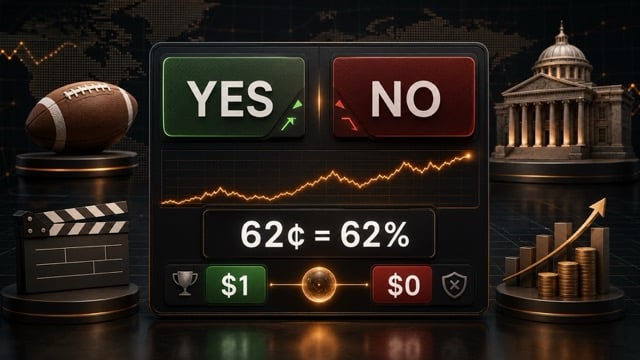
Prediction markets let you buy and sell contracts tied to a real-world event’s outcome, from who wins the Super Bowl to who controls Congress to almost anything with a defined outcome, with the price reflecting the market’s live estimate of how likely that outcome is. You can trade on regulated platforms such as FanDuel Predicts, Polymarket, and Kalshi for sports, politics, entertainment, and economic outcomes. This guide covers how the contracts work, where to trade them, and the rules for prediction markets in 2026.
We also cover platform availability, available markets, and the latest regulatory information as of September 2026. Because the status of sports contracts, state legal challenges, and platform offerings continues to shift, we revisit and update this page regularly.
What Is a Prediction Market?
A prediction market is a regulated online exchange where traders buy and sell contracts tied to the outcome of a real-world event, such as an election or a game. Each contract trades between $0.01 and $0.99, and its price reflects the market’s real-time estimate of the probability of that outcome.
Prices move as traders react to news, polling, injuries, or any other information that changes how likely an outcome looks. A contract trading at 70 cents implies the market sees roughly a 70% chance of that outcome; if it happens, the contract settles at $1, and if it doesn’t, it settles at $0.
That structure is why prediction markets are sometimes called “event contracts” rather than bets. Platforms like Kalshi and Polymarket structure and regulate these contracts as financial instruments, with Kalshi operating under Commodity Futures Trading Commission (CFTC) oversight, the same federal framework that governs other exchange-traded derivatives. That’s different from a sportsbook, which sets its own odds and takes the other side of your wager directly.
You can trade prediction markets on far more than sports. Politics, economic data like Fed decisions and inflation reports, award shows, and even weather events all trade as contracts on major platforms, which is the main reason people who’d never call themselves “bettors” still use these platforms.
How Do Prediction Markets Work?
Once you understand the basic definition, the mechanics come down to three things: what you’re actually trading, how to read the price, and what happens when the event ends.
Event Contracts and the Yes/No Structure
Every prediction market trade centers on an event contract, a single yes-or-no proposition about a specific outcome, like “Will the Fed cut rates in September?” or “Will Warren win the primary?” You buy the “Yes” side if you think it’ll happen, or the “No” side if you don’t think it will. Unlike a sportsbook line that covers a whole game, each contract is its own market with its own price, so a single event, an election, for instance, can have dozens of separate contracts trading at once: one for each candidate, one for turnout, one for margin of victory, and so on.
Price as Implied Probability
Here’s the part that trips up people used to sportsbook odds: the contract price is the probability. Prices trade between $0.01 and $0.99, and the number you see is roughly the market’s estimate of the probability that the outcome will occur.
Worked example: say a contract on “Team A wins the championship” is trading at 62 cents. That means the market currently prices Team A’s championship odds at about 62%. If you buy one contract for 62 cents and Team A wins, your contract settles at $1, a 38-cent profit. If Team A loses, the contract settles at $0, and you lose your 62-cent stake. Unlike a fixed sportsbook line, that 62-cent price can move throughout the day, and even during the event itself, as new information changes what traders think.
How Markets Settle
Every contract has a resolution date and a clear rule for what determines a Yes or a No, spelled out before the market opens. Once the underlying event is determined, usually verified against an agreed-upon source such as an official election result or a league’s box score, the market settles automatically: winning contracts pay $1 each, and losing contracts pay $0. You don’t have to hold a contract until settlement, though. Because prices update continuously, you can sell your position to another trader at any point before resolution, locking in a gain or cutting a loss instead of waiting for the outcome.
| Attribute | Prediction Markets | Sportsbooks | Stock Market |
|---|---|---|---|
| 🤝 Who You Trade Against | Other traders, peer-to-peer | The sportsbook itself | Other investors, via an exchange |
| 💰 Pricing Structure | ~1-2% trading fee, no vig | Vig built into every line | Brokerage commission or spread, no vig |
| 📊 Price Reflects | Probability of a specific outcome (0-100%) | Odds imply probability, skewed by the vig | A company's perceived value and future earnings |
| 🚪 Exit Options | Sell your contract anytime before resolution | Locked in once placed; cash-out varies by book | Sell your shares anytime the market is open |
| ⏳ Time Horizon | Resolves on a fixed event date | Ends when the game or event ends | Can hold indefinitely; no forced resolution |
| ⚖️ Regulation | Federal oversight via the CFTC | State-by-state gaming licenses | SEC and FINRA |
| 🧾 Tax Treatment | Event-contract tax treatment | Gambling winnings, W-2G reporting | Capital gains/losses |
What Can You Trade on Prediction Markets?
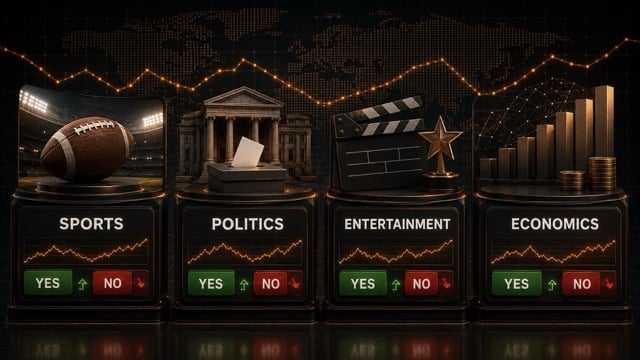
Prediction markets cover a lot more ground than a typical sportsbook or fantasy app. Here’s a look at the four biggest categories, and where to go for a deeper dive on each.
Sports
Sports contracts let you trade on game outcomes, win totals, and player and team props the same way you’d trade a stock, buying and selling as the price moves instead of locking in a fixed line. Kalshi, Polymarket, ProphetX, and several sports-first platforms all list active sports markets. See our full sports prediction markets guide for platform-by-platform breakdowns and live market snapshots.
Politics & Elections
Political contracts price everything from presidential races and control of Congress to individual primaries, with Kalshi and Polymarket as the two largest venues in this category. Prices here often move faster than public polling, since traders react to news in real time. Our politics prediction markets guide covers current odds on the 2026 midterms and beyond.
Pop Culture & Entertainment
Award shows, box office results, reality TV outcomes, and other entertainment headlines all trade as contracts too, letting fans put a number on things like who wins Best Picture or who gets eliminated next. Check out our pop culture prediction markets guide for the categories and platforms that cover entertainment odds.
Economics & Crypto
Beyond sports and politics, you can trade Federal Reserve rate decisions, inflation prints, jobs reports, and crypto price levels, contracts that look and function more like the derivatives traded on regulated exchanges than anything you’d find at a sportsbook. Check our economy prediction markets guide for current Fed, recession, and inflation odds.
Because sports and fantasy-style contracts sit closest to traditional betting, they draw the most side-by-side comparisons. See how prediction markets stack up against sportsbooks, daily fantasy sports, and pick’em-style apps if you’re deciding which format fits you best.
Where to Trade: Top Prediction Market Platforms
Dozens of platforms now offer event contracts, but a handful account for most of the trading volume and the broadest menus of markets. Here’s a brief look at some of the biggest, with links to our full reviews for the details on fees, sign-up bonuses, and state availability.
| Platform | Regulation | What You Can Trade | Best For | Promo Code (Click to Join) |
|---|---|---|---|---|
| 🎯 FanDuel Predicts | CFTC-regulated event contracts, available nationwide; sports contracts limited to 18 states | Sports (where available), entertainment, politics | Existing FanDuel sportsbook or DFS users looking to try prediction markets | Click to claim promo |
| 🎱 OG.com | CFTC-registered Futures Commission Merchant, contracts cleared through Nadex and Crypto.com Derivatives North America | Sports, crypto, forex and stock indices, commodities, politics, economics and culture | Traders who want exposure to commodities and forex alongside the usual sports, politics and crypto contracts | Click to claim promo |
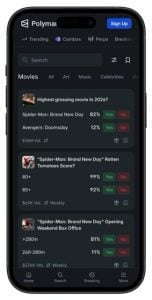
| 🔷 Polymarket | CFTC-compliant structure for US market | Politics, current events, sports, crypto | Traders who want the largest global market and deepest liquidity | GTODAY |
| 🔮 ProphetX | Dual CFTC-registered — Designated Contract Market (DCM) and Derivatives Clearing Organization (DCO) | Sports outcomes and props | Sports-focused traders who want a peer-to-peer exchange with parlay-style combo contracts | TODAY |
| 🐶 Underdog Predict | Full CFTC license stack (Designated Contract Market, Derivatives Clearing Organization and Futures Commission Merchant), operated through Underdog's own exchange | Sports-focused contracts, plus culture and other categories | Existing Underdog Fantasy users who want to trade on sports outcomes without leaving the app | GTODAYPM |
| 📊 DraftKings Predictions | CFTC-registered Introducing Broker and NFA member, event contracts connected to CME Group with additional exchanges planned | Sports and finance at launch (available in 38 states), with entertainment and culture categories planned | Existing DraftKings sportsbook or DFS users looking to try event contracts, including in states without legal sports betting | Click to claim promo |
| 💳 Crypto.com | Multiple licenses (multi-jurisdiction) | Sports, politics, crypto, finance | Traders who want bank/card funding instead of crypto-only deposits | Click to claim promo |
| 💡 Fanatics Markets | CFTC-registered Futures Commission Merchant and NFA member, contracts delivered through Crypto.com Derivatives North America under Nadex rules | Sports (football, baseball, basketball, tennis, soccer, hockey, golf, MMA, esports, motorsports, chess, sailing), crypto, politics, economics and culture | Existing Fanatics Sportsbook or FanCash users who want prediction markets in the same ecosystem | Click to claim promo |
| 🏛️ Kalshi | CFTC-regulated Designated Contract Market | Sports, politics, economics, entertainment | Traders who want the broadest, most established regulated menu | N/A |
| 📱 Robinhood Prediction Markets | Offered inside Robinhood's regulated brokerage app | Sports, politics, economics, climate, and more (12+ categories) | Existing Robinhood users who want to try contracts without a new account | N/A |
FanDuel Predicts runs CFTC-regulated event contracts nationwide, though sports contracts specifically are only live in states where the FanDuel Sportsbook is not already available. Read our FanDuel Predicts review for details and a deeper look at how it stacks up.
OG.com runs a CFTC-regulated exchange spanning sports, crypto, forex, commodities, and politics, making it one of the broadest multi-asset prediction markets available to US traders. Read our OG.com review for a full breakdown of its markets and fees.
Polymarket is the largest prediction market exchange globally by trading volume, historically strongest in politics and current events, and now runs a CFTC-approved exchange for US traders following a November 2025 regulatory nod. A separate bid to open its original global platform to US traders remains pending. See our Polymarket review for sign-up details and a look at its order-book style pricing.
ProphetX is a sports-native prediction market registered with the CFTC as both a designated contract market and a derivatives clearing organization, built around peer-to-peer pricing instead of a house-set line. Read our full ProphetX review for a walkthrough of its RFQ parlay mechanism and current market menu.
Underdog Predict runs on the fantasy operator's own fully licensed CFTC exchange, focused primarily on sports outcomes for its existing fantasy and sportsbook user base. See our Underdog Predict review for a closer look at its markets and how it fits alongside Underdog's other products.
DraftKings Predictions runs on DKeX, DraftKings' own CFTC-regulated exchange, with event contracts on sports, politics, crypto, and economics available in 38 states. Read our DraftKings Predictions review for state availability and a full features breakdown.
Crypto.com folds event-contract trading into its broader exchange, wallet, and card app, with multiple funding options, including bank transfer and card, rather than crypto-only deposits. Read our complete Crypto.com review.
Fanatics Markets offers a sports-first prediction market interface with contracts on sports, politics, economics, and culture, cleared through Crypto.com Derivatives North America. Read our complete Fanatics Markets review for fees, banking options, and current promo details.
Kalshi is the largest CFTC-regulated prediction market built specifically as a designated contract market, with contracts spanning sports, politics, economics, and more, all under direct federal oversight. Check out our Kalshi review for current promo details and a walkthrough of the platform.
Robinhood Prediction Markets puts event contracts inside the same app millions of traders already use for stocks and crypto, offering more than a dozen prediction market categories rather than a standalone product. It’s a low-friction way to try a contract or two if you already have a Robinhood account. See our Robinhood review for more.
Before funding any account, compare current bonuses, fees, and market menus using our prediction market platform comparison tools, and check platform-specific reviews for state-by-state availability.
How to Get Started (for Beginners)
Once you understand how contracts are priced, actually placing your first trade follows a similar process across most platforms.
Pick a regulated platform
Choose a platform that lists the market categories you’re interested in and confirm it’s available in your state before signing up.
Verify and fund your account
Complete identity verification, a standard step on regulated platforms, then fund your account by bank transfer, card, or crypto, depending on what the platform accepts.
Find a market
Browse contracts by category, whether that’s a specific game, a race, or an economic release, and read the exact resolution criteria before trading.
Read the price as a probability
A contract trading at 40 cents implies roughly a 40% chance of that outcome. Use that number, not just your gut feeling, to judge whether a trade looks like good value.
Place or exit your trade
Buy “Yes” or “No” at the current market price, or set a limit order at your own price. You can sell your position to another trader anytime before the event settles instead of waiting for the final result.
Final tips
Start with an amount you’re comfortable trading while you learn how a given platform’s order types and fees work. Compare current promos, minimum deposits, and market menus in our platform reviews above if you’re ready to pick one and get started. Once you’ve got the basics down, our prediction market strategies guide covers value trading, arbitrage, and bankroll sizing in more depth, and our overview of prediction market tools covers the calculators and trackers worth adding once you’re actively trading.
Are Prediction Markets Accurate?
Prediction markets rely on what’s often called the “wisdom of crowds”: because prices move only when someone is willing to put money behind their view, backing a bad prediction costs the trader money, while backing a good one earns it. That financial incentive, in theory, pulls the price toward the most accurate available estimate faster than a poll or a pundit’s opinion, since it’s constantly updated by people with a direct stake in getting it right.
The 2024 US presidential election became a widely cited test case. In the final days before the vote, several major prediction markets priced one candidate’s win probability notably higher than most public polling averages, and that pricing lined up more closely with the eventual result than the polling did. Supporters point to that gap as evidence that markets aggregate real-time information, including local betting patterns and sentiment, that traditional polling can miss.
That track record doesn’t make markets infallible. Thinner markets, meaning fewer active traders and less money changing hands, can be swayed by a handful of large trades, and prices can lag or overreact to breaking news just like any other market. Treat prediction market odds as a well-informed, continuously updated estimate, not a guaranteed outcome.
Are Prediction Markets Legal in the US?
Yes, generally. Platforms like Kalshi and Polymarket offer event contracts under federal oversight from the Commodity Futures Trading Commission (CFTC), not as state-licensed sportsbooks. That federal structure is what allows a single platform to offer contracts nationwide rather than applying for a gaming license in each state.
CFTC Regulation and Event Contracts
Kalshi registers as a CFTC-regulated designated contract market, the same type of regulation that governs other exchange-traded derivatives. That means its contracts, across politics, economics, and sports, answer to a federal derivatives regulator rather than a state gaming commission. Polymarket has moved toward a similar CFTC-compliant structure as part of its return to the US market. Supporters describe this framework as treating contracts as financial instruments rather than wagers, since prices aggregate collective judgment as other markets do.
State Restrictions and the Ongoing Debate
Sports-related contracts specifically have drawn the most pushback. More than a dozen states have sued, investigated, or otherwise challenged sports event contracts since early 2025, arguing that a contract on who wins a game functions like a sports bet and should fall under state gambling law rather than federal commodities rules. Courts have split: some have paused state enforcement pending appeal, while others have sided with the state and blocked sports contracts outright.
As of September 2026, no single court ruling or regulator decision has settled the question nationwide, and it’s changing on a near-weekly basis. Political, economic, and entertainment contracts haven’t faced the same level of legal challenge as sports contracts specifically. Confirm current availability directly on a platform before funding an account, and don’t treat any state-by-state list as permanent.
Risks and Responsible Trading
Prediction markets carry real financial risk, and no platform, price, or strategy guarantees a profit. A losing contract settles at $0, meaning you can lose your entire stake on that trade, the same as any wager.
It’s worth being clear-eyed about what you’re doing, too. Even though platforms frame these as financial exchanges rather than betting products, the underlying experience, putting money on an uncertain outcome and waiting to see if you were right, functions the same way for your finances and your habits, whether you call it “trading” or “betting.” Some clinicians who treat gambling disorders have reported seeing the same patterns in prediction market traders that they see in sportsbook customers.
If you’ve self-excluded from a sportsbook, that exclusion does not automatically carry over to prediction market platforms, since they’re regulated separately from state gambling systems. Set a budget before you start, decide your exit point in advance, and treat “one more trade” as a warning sign rather than a strategy.
If trading stops feeling like something you’re choosing to do, confidential help is available 24/7 by calling 1-800-GAMBLER. Visit our responsible gambling resources for tools such as deposit limits and self-exclusion programs. You must be 18 or older, or the applicable minimum age in your state, to participate.
Key Terms Glossary
A handful of terms come up constantly on prediction market platforms, and knowing them makes reading any market page a lot faster. The table below covers the essentials.
| Term | Definition |
|---|---|
| 📄 Event Contract | A single yes-or-no financial contract tied to a specific real-world outcome, paying $1 if it resolves "Yes" and $0 if it resolves "No." |
| 📖 Order Book | The live list of buy and sell orders waiting to be matched at a given price, the same mechanism that prices stocks on an exchange. |
| ✅ Resolution | The point at which a market's outcome is verified and confirmed, triggering final payouts to contract holders. |
| 🔀 YES/NO Contract | The two sides of every event contract; buying "Yes" pays off if the event happens, buying "No" pays off if it doesn't. |
| 🛠️ Maker/Taker | A "maker" posts a new order at a chosen price and waits for a match; a "taker" accepts an order already sitting in the book. Platforms often charge different fees for each. |
| 💧 Liquidity | How much money and how many active orders are in a market. Highly liquid markets are easier to enter and exit at a fair price; thin markets can be harder to trade without moving the price. |
| 🎯 Implied Probability | The percentage chance an outcome is priced to occur, read directly from the contract's price (a 45-cent contract implies roughly 45%). |
Most of these concepts carry over from stock and options trading, which is part of why prediction markets can feel more like a brokerage app than a sportsbook once you’re comfortable with the vocabulary. For definitions beyond this list, including terms specific to individual platforms, visit our full betting and trading glossary.
FAQs
A prediction market is an exchange where you buy and sell contracts tied to whether something will happen, like an election result or a game outcome. Each contract trades between $0.01 and $0.99, and the price reflects the market’s estimate of the probability of that outcome. Correct contracts pay $1; incorrect ones pay $0.
You buy a “Yes” or “No” contract on a specific outcome at whatever price the market is currently offering. That price is the implied probability of the outcome happening. If you’re right when the event resolves, your contract pays $1; if you’re wrong, it pays $0. You can also sell your position before resolution.
Yes, generally. Platforms like Kalshi operate under CFTC oversight as federally regulated exchanges, letting them offer contracts nationwide. Sports-related contracts specifically face ongoing legal challenges in several states, so availability for that category can vary. Confirm the current state of availability directly on the platform before funding an account.
A sportsbook sets fixed odds and takes your bet directly, building a profit margin called the vig into the line. A prediction market is peer-to-peer: you trade against other users, prices move with supply and demand, and you can exit your position before the event ends instead of waiting for the final result.
It depends on how you define it. Platforms structure and regulate event contracts as financial instruments rather than bets, which holds up clearly for markets on elections or economic data. For sports contracts specifically, the experience can feel close enough to a wager that regulators and courts are still working through the distinction.
A contract’s price is meant to be read directly as a probability. A contract trading at 30 cents implies the market sees roughly a 30% chance of that outcome happening. As traders buy and sell based on new information, the price adjusts in real time to reflect the updated consensus.
Kalshi is the largest CFTC-regulated prediction market covering sports, politics, and economics under direct federal oversight. Polymarket, Robinhood Prediction Markets, and Crypto.com also list event contracts across similar categories. Availability, fees, and market menus vary by platform, so compare a few before funding an account.
Often, yes, though not always. Prices aggregate the judgment of everyone trading, which can move faster and more accurately than polling in fast-moving situations like the 2024 election. But thinner markets with fewer active traders can be swayed by a handful of large trades, so treat any price as an estimate, not a guarantee.
Yes. A contract that resolves against your position pays $0, meaning you lose whatever you paid for it. Prediction markets carry the same real financial risk as any form of trading or betting, and no platform, strategy, or pricing edge guarantees a profit.
Likely yes, though exact treatment can vary by platform, and the IRS hasn’t issued dedicated guidance covering every prediction-market structure. This isn’t tax advice; if you’re trading meaningful amounts, a tax professional can tell you exactly how your specific activity should be reported.
This guide is reviewed regularly to reflect current platform terms, fees, and regulatory status. Last updated: September 2026.
Responsible gambling: Prediction market trading carries real financial risk. If trading no longer feels like something you’re choosing to do, confidential help is available 24/7 by calling 1-800-GAMBLER. Visit our responsible gambling resources for tools, including deposit limits and self-exclusion programs. You must be 18 or older, or the applicable minimum age in your state, to participate.
Affiliate disclosure: Some links on this page may earn GamingToday compensation, at no additional cost to you. This doesn’t influence our reviews, ratings, or recommendations for prediction market platforms.

