
Sports Prediction Markets: How to Trade and Bet on Sports | September 2026


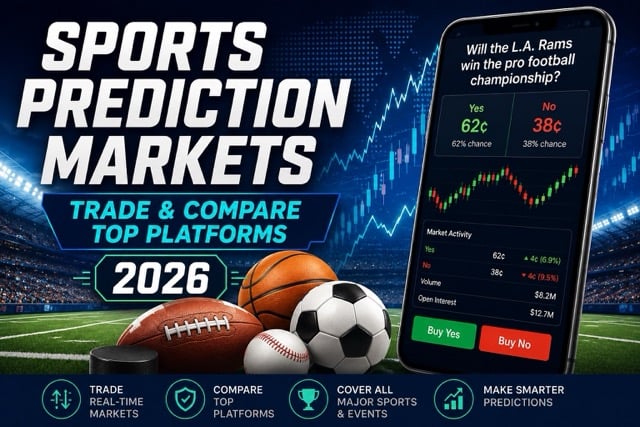
Sports prediction markets let you trade contracts on game outcomes instead of placing a fixed bet against a bookmaker. Prices move with the market rather than a set line, more like a stock than a spread. Kalshi is the main regulated US venue for this, and sports contracts are legal nationwide under federal oversight, with a few state exceptions.
This guide reflects platform availability, fees, and market access as of September 2026, and we revisit it regularly as sports contracts, state rules, and new platforms continue to shift.
What Are Sports Prediction Markets?
Sports prediction markets let you buy and sell contracts tied to a specific game outcome, like which team wins or covers, instead of placing a fixed-odds bet. Each contract’s price reflects the market’s implied probability of that outcome, and it settles at $1 if the outcome occurs, or $0 if it doesn’t.
These are called event contracts, and each one represents a single yes-or-no proposition, such as “Will the Chiefs win?” or “Will the total go over 47.5?” Contracts trade between $0.01 and $0.99 while the outcome is undecided, and that price moves in real time as traders react to injuries, line movement elsewhere, and game action. A contract trading at $0.65 means the market currently sees a 65% chance of that outcome. Our implied probability calculator breaks down how to convert a contract price into a percentage if you want to check the math yourself.
The other core difference is who is on the other side of your trade. A sportsbook sets the line and takes your bet directly, with the odds built to favor the house over time. A prediction market works more like an exchange: you are trading against other users, not the platform, and the price is whatever the crowd is willing to pay at that moment. That is also why you can exit early. Since contracts trade continuously until settlement, you can sell your position to another trader before the game ends instead of waiting for the final result.
Best Sports Prediction Market Platforms Compared
Not every prediction market treats sports the same way. Some, like Kalshi and Polymarket, run sports contracts alongside politics, economics, and culture. Others, like ProphetX and Novig, are built sports-first from the ground up. Here’s how the top prediction market platforms compare on regulation, fees, and market depth, followed by a closer look at each.

FanDuel Predicts
FanDuel Predicts is FanDuel’s standalone prediction market app, giving eligible new users a $25 trading bonus with no promo code required. It runs as a standalone product separate from FanDuel Sportsbook, allowing traders to buy and sell event contracts on sports and other real-world outcomes through a dedicated app.
The trading experience is built around simplicity rather than an exchange-style order book. Contracts show up as clear “Yes” or “No” propositions with a visible price and straightforward portfolio tracking, so a trader can see exactly what they hold and what it’s currently worth without first learning about limit orders, makers, or takers.
FanDuel Predicts is available in all 50 states, though the sports contracts you’ll actually see can vary by location. A trader in one state might find a full slate of game and player contracts, while someone elsewhere sees a narrower selection, so it’s worth checking the app’s current market list before assuming a specific sport or league is covered where you live.
FanDuel’s name recognition from its sportsbook business carries over here, giving traders already comfortable with FanDuel’s sportsbook app a familiar-feeling entry point into prediction markets, even though Predicts operates as a separate product with its own account and rules.
Get $100 in Predicts Bonus When You Trade $1 for 5 Days
Make Predictions on Real World Events Right in Your Phone
Trade on Sports to Culture, Financials, Crypto and More
Get $100 in Predicts Bonus When You Trade $1 for 5 Days
Make Predictions on Real World Events Right in Your Phone
Trade on Sports to Culture, Financials, Crypto and More
Pros
- Beginner-Friendly Contract Display | Clear Yes/No pricing and portfolio tracking make it easy to see what a position is worth without learning order-book mechanics first.
- Nationwide Availability | FanDuel Predicts is live in all 50 states, giving it one of the widest footprints of any sports-carrying prediction market.
Cons
- Sports Market Categories Vary by State | Which sports contracts show up can differ by location, so traders should check the app directly rather than assume full coverage everywhere.
- Fewer Exchange-Style Tools | The simplified Yes/No format doesn't offer the limit orders or order-book depth that sports-first exchange platforms provide.

Polymarket
Polymarket is the largest prediction market exchange by trading volume, and its sports contracts have grown quickly, even though the platform’s deepest roots are in politics and current events. New users can use promo code GTODAY, deposit $10, and receive a $20 trading bonus after meeting the offer requirements.
Sports activity picked up sharply around the 2026 FIFA World Cup, when Polymarket ran combo contracts on major matches, bundling multiple outcomes into a single trade similar to a parlay. Pricing works like a live order book rather than a static line: contracts trade continuously as other users buy and sell, so a price you see in the morning can move well before kickoff.
Funding an account is done via USDC, a dollar-pegged cryptocurrency, rather than via a bank transfer or card deposit. That’s an extra step for traders new to crypto wallets, though the platform’s onboarding walks you through the conversion. Sports sits alongside a much wider menu here, including politics, crypto prices, entertainment, and weather, so traders who want more than just games will find plenty to browse.
Polymarket now operates in the US through Polymarket US and Polymarket Clearing, a CFTC-regulated exchange and clearing organization that relaunched US access in January 2026, a distinction worth understanding if you’re weighing regulatory oversight against market depth when choosing a platform.
Deposit $10, Get a $50 Trading Bonus
Live Trade with the Biggest Payouts at the Largest Prediction Market in the World
Use Bonus Code: GTODAY
Deposit $10, Get a $50 Trading Bonus
Live Trade with the Biggest Payouts at the Largest Prediction Market in the World
Use Bonus Code: GTODAY
Pros
- Exchange-Style Live Pricing | Contracts trade continuously like a live order book, so prices react in real time to game action and breaking news instead of resetting on a fixed schedule.
- Major Event Combo Contracts | Polymarket ran bundled, parlay-style combo contracts during the 2026 World Cup, letting traders combine multiple sports outcomes into a single position.
Cons
- Crypto-Only Funding | Deposits run through USDC rather than a bank transfer or card, adding an extra step for traders unfamiliar with crypto wallets.
- Sports Still a Smaller Slice of the Menu | Polymarket's roots are in politics and current events, so its sports catalog, while growing, isn't as deep yet as platforms built sports-first.
ProphetX
ProphetX is built specifically for sports trading, using a back-and-lay exchange model where you can back an outcome, lay against it, or post your own price rather than accept a fixed line. New users can use promo code TODAY to trade $10 and unlock $20 in trading bonus.
Instead of a simple buy or sell, ProphetX lets you back an outcome, bet that it happens, lay it, bet that it doesn’t, or post a price and wait for another trader to match it. That order book structure means you’re setting terms directly with other traders rather than accepting whatever price the platform posts, though it also means a posted order can sit unmatched if nobody takes the other side.
Availability is broader than almost any other sports-first platform, with ProphetX live in every US state except Nevada. The platform has also expanded through partnerships, including an integration with Players’ Lounge that lets users trade ProphetX’s regulated sports contracts directly on that platform, a distribution approach that differs from a typical standalone prediction market app.
That flexibility comes with a steeper learning curve than a typical sportsbook. Traders need to think in terms of liquidity, order matching, and open positions rather than simply picking a side and confirming a bet, so ProphetX tends to suit traders with some exchange or sports trading experience.
America's #1 Sports Prediction Market
Same Sports Moments, Bigger Payouts
Choose from Straights, Player Props, Parlays & More
Use Exclusive Code: TODAY
America's #1 Sports Prediction Market
Same Sports Moments, Bigger Payouts
Choose from Straights, Player Props, Parlays & More
Use Exclusive Code: TODAY
Pros
- Back-and-Lay Exchange Model | Traders can back an outcome, lay against it, or post their own price, giving more control over entry than a standard buy/sell prediction contract.
- Widest Sports State Footprint | ProphetX is live in every US state except Nevada, one of the broadest state availability windows among sports-first prediction markets.
Cons
- Orders Can Go Unmatched | Because pricing depends on another trader taking the other side, a posted order may sit partially filled or unmatched during slower market periods.
- Steeper Learning Curve Than a Sportsbook | Back bets, lay bets, and open order management ask more of new traders than a simple fixed-odds bet.

OG Prediction Market
OG is a prediction market app that routes trades through Nadex, a CFTC-regulated exchange, covering soccer, football, basketball, and other major sports, as well as politics, economics, and culture markets, with built-in parlay-style contracts and an AI-assisted “OG Alpha” tool for newer traders. No promo code is needed to take advantage of the welcome offer.
OG lets traders bundle multiple predictions into a single parlay-style contract, and its live in-event trading lets you react to a goal, an injury, or a momentum shift instead of only trading before kickoff. Its sports markets also have relatively thinner liquidity than those of more established, sports-first competitors, but still offer users plenty of options.
OG’s positioning leans into simplicity rather than the exchange-style mechanics some competitors expect traders to learn upfront. That fits its stated audience. Traders new to prediction markets who want dynamic charts and trend data without having to first master maker/taker fees or limit orders.
Note that OG isn’t an independent platform. It’s a standalone app spun off by Crypto.com, powered by Crypto.com Derivatives North America (CDNA), the CFTC-registered exchange Crypto.com acquired in 2022 (still sometimes referred to by its earlier name, Nadex).
Huge Range of CFTC-Approved Markets (Sports, Tech, and More)
Compete with Others & Climb the Leaderboards
No User Limiting on Trades
Huge Range of CFTC-Approved Markets (Sports, Tech, and More)
Compete with Others & Climb the Leaderboards
No User Limiting on Trades
Pros
- Broad Sports Menu | Covers soccer, football, basketball, baseball, hockey, golf, MMA, and tennis alongside politics, economics, and culture contracts, giving newer traders more than just one sport to explore
- Built-In Parlays and AI Guidance | OG lets traders bundle multiple predictions into a single combination contract and pairs that with "OG Alpha," an in-app assistant meant to help newer traders read a market without learning order-book mechanics first.
Cons
- Thinner Sports Liquidity | OG's sports markets carry less trading volume than more established, sports-first competitors, which can mean wider spreads and slower fills on lower-profile games.
- Fee Transparency Questions | Some user reviews report unexpectedly high effective costs on certain contracts, so it's worth double-checking OG's current fee schedule closely before trading larger amounts, rather than relying on the headline bonus offer alone.

Crypto.com
Crypto.com brings sports event-contract trading into an app most users already know for its exchange, wallet, and card products, so you’re not managing a separate login just to trade a game outcome. Right now, new users can complete a short in-app task to unlock CRO Rewards worth up to 1 BTC.
Sports contracts fall under Crypto.com’s broader event lineup, covering game outcomes and major tournament markets alongside the platform’s crypto, finance, and culture contracts. Funding works differently than most dedicated sports trading apps: you can deposit via bank transfer, debit or credit card, or crypto, rather than being locked into a single payment rail.
Around major sporting moments, Crypto.com has run leaderboard-style contests with prize pools for traders who correctly call outcomes, layering a competitive angle on top of standard buy-and-sell trading. That kind of event-driven feature tends to show up more here than on platforms built purely around day-to-day sports contracts.
The tradeoff is depth. Sports is one category among several, rather than the platform’s central focus, so traders looking for extensive prop markets or granular in-game trading may find the sports menu thinner than on a sports-first exchange. Crypto.com also rewards existing users more than newcomers, since account tier benefits increase the more you already use the broader app.
Complete a Task in the Crypto.com App to Unlock up to 1 Bitcoin Worth of CRO Rewards
America’s All-In-One Trading Platform
Manage Your Crypto, Stocks, Predictions & Card Spend Seamlessly
Complete a Task in the Crypto.com App to Unlock up to 1 Bitcoin Worth of CRO Rewards
America’s All-In-One Trading Platform
Manage Your Crypto, Stocks, Predictions & Card Spend Seamlessly
Pros
- Multiple Funding Options | Bank transfer, debit or credit card, and crypto are all accepted, giving traders more flexibility than platforms that require a single payment method.
- Event-Driven Contests | Crypto.com runs leaderboard-style contests with prize pools around major sporting moments, adding a competitive layer beyond standard contract trading.
Cons
- Thinner Sports-Specific Depth | Sports is one category among several rather than the platform's main focus, so prop markets and in-game trading options are lighter than on a sports-first exchange.
- Rewards Favor Existing Users | Account tier perks build the more you already use Crypto.com's broader app, so newcomers get less added value than long-time users.
DraftKings Predictions
DraftKings Predictions runs sports event-contract trading through DKeX, DraftKings’ own CFTC-regulated exchange, separate from its state-licensed sportsbook. New users can currently claim a welcome offer worth up to $200 in trading bonuses after a qualifying first trade, paid out over 21 days rather than all at once.
The catch for sports traders specifically: Predictions drops sports contracts entirely in any state where DraftKings already operates a licensed sportsbook. That’s a meaningful restriction if you’re used to one DraftKings app covering everything, since sports availability on Predictions actually depends on where DraftKings’ sportsbook does and doesn’t operate, not just standard state-by-state prediction market rules.
Where sports contracts are available, DraftKings layers in Combos, a feature that bundles multiple event contracts into one trade, similar in spirit to a sportsbook parlay. It’s a mechanic built for traders crossing over from DraftKings’ sportsbook and DFS products, and existing DraftKings account holders can log into Predictions with the same credentials rather than creating a new account from scratch.
On the trading side, Predictions keeps things simple by design. There’s no visible order book or price history, and every trade executes at the current market price rather than a limit price you set yourself. That works fine for traders who just want to take a position quickly, but it offers less price control than an exchange-style platform where you can post your own order.
Get $200 in Bonuses Paid Over 21 Days
DraftKings is Now Available Nationwide
Browse Markets like Sports, Crypto, Tech & More
Get $200 in Bonuses Paid Over 21 Days
DraftKings is Now Available Nationwide
Browse Markets like Sports, Crypto, Tech & More
Pros
- Combos Bundle Multiple Contracts | Combos let traders bundle several event contracts into a single trade, giving DraftKings' sports lineup a parlay-style option most prediction markets don't offer.
- One Account Across DraftKings Products | Existing DraftKings Sportsbook, Casino, or DFS users can log into Predictions with the same credentials instead of creating a separate account.
Cons
- Sports Contracts Disappear Where DK Sportsbook Operates | Predictions pulls sports markets entirely in states where DraftKings already runs a licensed sportsbook, so availability isn't consistent nationwide.
- No Price Control on Trades | Every trade fills at the current market price, since Predictions doesn't offer an order book or limit-order option like some competitors.

Kalshi
Kalshi is the most established regulated sports prediction market in the US, with contracts covering the NFL, NBA, MLB, NHL, plus soccer, golf, and tennis, running alongside its broader event-contract lineup. The platform operates under CFTC oversight, so sports trades sit under the same federal framework as its economic and political contracts rather than a state-by-state gambling license.

Novig
Novig is a sports-only prediction market that skips per-trade fees entirely, letting traders buy and sell positions on game outcomes, player props, parlays, and futures without a built-in commission eating into the price. New users can currently claim $5 in Novig Cash plus 10% off their first purchase, up to $100, and no promo code is required to unlock it.
Sports Prediction Market Platforms at a Glance
Reading through seven platforms at once is a lot to hold in your head, especially when regulation, fees, and state access all vary by provider. Here’s a side-by-side recap of the platforms discussed above, useful if you already have a favorite in mind and just want to confirm the details, or if you’re weighing two or three against each other before you commit.
Treat this table as a snapshot rather than the final word. Fees, minimum deposits, and state availability shift as platforms adjust their offerings, and as state-level legal challenges continue to play out, it’s worth confirming current terms directly on a platform before funding an account.
| Platform | Regulation Status | Sports Market Depth | US/State Access |
|---|---|---|---|
| 🦆 FanDuel Predicts | CFTC-regulated | Available nationwide; specific sports contract mix varies by state | All 50 states; market categories vary by location |
| 🔷 Polymarket | CFTC-regulated via Polymarket US / Polymarket Clearing | Growing; sports is newer, platform's deepest roots are in politics and current events | Approx. 48 states |
| ⚡ ProphetX | CFTC-regulated | Sports-first exchange; back-and-lay pricing across game lines, props, and futures | All US states except Nevada |
| 📈 OG | CFTC-registered Designated Contract Market license held by Crypto.com | Derivatives North America (CDNA) | Broad category list (soccer, football, basketball, hockey, tennis), but thinner liquidity than sports-first competitors | All US states except NY, with sports excluded from some |
| 💳 Crypto.com | Various licenses (multi-jurisdiction) | Moderate; sports is one category alongside crypto, finance, and culture contracts | Approx. 48 states plus DC |
| 🏈 DraftKings Predictions | CFTC-regulated (traded through DKeX) | Broad where available, but sports contracts drop entirely in states where DraftKings Sportsbook is licensed | 48 states plus DC; sports limited where DK Sportsbook operates |
| 🏛️ Kalshi | CFTC-regulated Designated Contract Market | Broad, with NFL, NBA, MLB, NHL, soccer, golf, and tennis alongside non-sports categories | Nationwide; sports contracts face active state-level legal challenges (e.g., New York) |
| 🎯 Novig | CFTC-regulated Designated Contract Market | Sports-only; single-game lines, player props, parlays, season futures, live markets | All 50 states |
Is Trading Sports on Prediction Markets Legal in the US?
Yes, generally. Kalshi, Polymarket, and similar platforms offer sports contracts under CFTC oversight as federally regulated exchanges, not as state-licensed sportsbooks. That federal framework is what allows a single platform to offer sports contracts nationwide instead of applying for a license in each state, as a traditional sportsbook has to. Our complete prediction markets guide covers this regulatory framework in more depth across all contract types, not just sports.
Sports contracts specifically have drawn far more state pushback than these platforms’ other categories, since a contract on who wins a game looks a lot like a sports bet to state gambling regulators. More than a dozen states have sued, investigated, or otherwise challenged sports event contracts since early 2025, and the results have gone both ways. Some courts have sided with the platforms and paused state enforcement pending appeal. Others have sided with the state and blocked sports contracts outright while litigation continues.
Because rulings are landing on a near-weekly basis and can change a state’s status overnight, treat any specific list as a snapshot rather than a permanent answer, and confirm current availability directly on the platform before funding an account.
| State | Status |
|---|---|
| 🎰 Nevada | Sued Kalshi directly over unlicensed sports betting, one of the first states to take action |
| 🗽 New York | Federal court denied Kalshi's bid to block state enforcement (July 2026); AG joined a 38-state coalition backing Massachusetts' case |
| 🏙️ Illinois | Federal appeals injunction currently pauses state enforcement pending appeal; a separate new state tax on prediction market transactions is being challenged by Kalshi in court |
| ⚓ Massachusetts | Court injunction bars Kalshi from offering sports contracts to Massachusetts users while litigation continues |
| 🦀 Maryland | Kalshi's injunction request was denied by a district court; appeal pending at the Fourth Circuit |
| 🌰 Ohio | Court denied Kalshi's injunction and ruled its sports contracts qualify as sports betting under state law |
| 🚗 Michigan | Sports contracts temporarily blocked during active litigation; a related suit is also pending against Polymarket |
| 🌵 Arizona | Filed criminal charges against Kalshi; a federal appeals injunction currently pauses further state action pending appeal |
| 💎 Arkansas | No direct suit identified in our research; joined the multi-state amicus brief supporting Massachusetts' case |
| 🎷 Louisiana | No direct suit identified in our research; joined the same multi-state amicus brief |
| Status current as of September 2026. State-level litigation over sports event contracts is moving quickly; confirm current availability directly on the platform before trading. | |
This is one of the fastest-moving corners of the prediction market world. Our Prediction Market News section tracks new rulings and state actions as they happen, so if you want to stay current between updates, here.
How to Trade Sports on a Prediction Market
Once you understand how sports contracts work, actually placing a trade follows a similar process across most platforms. Here's how to go from picking a platform to closing out a position.
Choose Your Platform
Start with a platform that lists the sport and market types you want to trade, whether that’s a broad exchange or a sports-first app. Confirm sports contracts are available in your state before creating an account, since access can vary by platform and by state.
Verify and Fund Your Account
Sign up with your basic details and complete identity verification, a standard step across regulated platforms. Once verified, fund your account using one of the platform’s accepted payment methods, such as a bank transfer, debit card, or credit card. Start with an amount you’re comfortable trading while you learn how the platform works.
Find a Sports Market
Browse contracts by sport, league, or specific game, then review the exact terms of the outcome you’re considering. A contract on “Will the Chiefs win?” settles differently than one on a point spread or a player prop, so confirm exactly what triggers a payout before trading.
Read the Price as a Probability
Every contract’s price reflects the market’s implied probability of that outcome. A contract trading at 55 cents means the market currently sees roughly a 55% chance of that result. Use that price, not just your gut feeling about the game, to judge whether a position looks like good value.
Buy Yes/No or Set a Limit
Decide whether you think the outcome will happen and buy the “Yes” contract, or buy “No” if you don’t. You can also choose how you enter that trade: a market order fills instantly at the current best price, while a limit order lets you name your own price and wait for another trader to match it.
| Order Type | What It Does |
|---|---|
| ⚡ Market Order | Fills instantly at the current best available price. Simple and fast, but you take whatever price is showing at that moment. |
| 🎯 Limit Order | Lets you name the price you're willing to pay for a "Yes" or accept for a "No." It waits in the order book until another trader matches it, giving you more control over your entry price but no guarantee it fills. |
Manage or Exit Your Position
Once you’re in a trade, you don’t have to wait for the game to end. Most platforms let you sell your contract to another trader anytime before settlement, so you can lock in a gain or cut a loss as the price moves. Keep an eye on liquidity, since thinly traded markets can make it harder to exit quickly at a fair price.
Sports Prediction Market Apps
A few more platforms are worth a look if you want to browse beyond the seven covered above, each with its own sports angle worth understanding before you sign up.
Robinhood Prediction Markets puts event-contract trading inside the same app millions already use for stocks and crypto, with sports as one of over a dozen available categories. Existing users can start trading without a new sign-up or identity check, and since Robinhood isn’t competing with its own sportsbook, sports contracts appear in nearly every state. Trading is mobile-only, and there’s no order book or a bonus built specifically for prediction markets.
Fanatics Markets extends the Fanatics sports and merchandise ecosystem into event-contract trading, with sports as one of its core categories alongside finance and politics. New users can currently trade $75 to unlock $75 in trade credits. The platform is newer than most competitors here, so its sports market depth and liquidity are still developing.
Pariflow is a crypto-funded prediction market covering sports alongside politics, geopolitics, and pop culture, funded exclusively through the Polygon network with deposits converted to USDC.e. A standout demo mode lets traders work through a full sports trade, from entry to settlement, before risking real money, and new users get a 100% deposit match up to $50 automatically. Pariflow isn’t CFTC-regulated, and there’s no bank or card funding option.
Underdog Predict brings sports-only Yes/No contracts, on game winners, spreads, and totals, into the same app many already use for Underdog’s daily fantasy contests, though the two products are legally separate. Contracts settle at $1.00 and operate under federal derivatives oversight through a registered Futures Commission Merchant. Because they’re federally regulated, sports contracts are available in states where traditional sportsbooks aren’t.
Sports Trading Strategy
Prediction markets reward the same discipline that separates sharp sports bettors from casual ones, plus a few habits specific to contract pricing.
Because prices move continuously and vary by platform, checking a contract’s price across a couple of exchanges before you trade works the same way line shopping does at traditional sportsbooks. A few cents of difference on entry adds up over enough trades, and unlike a fixed-odds line, a prediction market price can also move meaningfully between the moment you check it and the moment you trade.
In-play trading is where prediction markets separate most clearly from a standard bet. Since contracts trade continuously until the event ends, you can react to what’s actually happening, an early lead, a key injury, foul trouble, rather than locking in a position before kickoff and waiting for the final result.
Hedging works here, too. If a position is moving against you, taking a smaller opposite trade can soften the loss, though it also caps how much you’d make if your original read turns out right. It’s a tool for managing risk, not a way to guarantee a profit. Our guide to the best prediction market tools rounds up the trackers and calculators that make it easier to size a hedge like this.
Fees matter more than they first appear. Even a modest per-trade cost eats into the edge over enough trades, so factor fees into your entry price, not just the headline odds. And regardless of strategy, no approach here guarantees a win. Prediction markets reward good judgment more often than luck, but every trade still carries real risk of loss. For strategies that apply across every category, not just sports, see our full guide to prediction market strategies.
Live Sports Markets Right Now
A handful of sports contracts are pulling the heaviest trading volume across the major platforms right now, spanning football, baseball, and soccer. As with any prediction market contract, the price reflects the crowd’s current implied probability, not a final answer, so these numbers will keep moving as each season progresses.
This is a snapshot, not a live, constantly-updating board. Treat it as a starting point rather than the final word, and check the platform directly for a market’s current price before trading, since prices shift continuously and can move meaningfully between updates here.
| Market | Price (Implied Probability) | Platform |
|---|---|---|
| ⚾ MLB World Series Champion 2026 — Los Angeles Dodgers | 33¢ (~33%) | Polymarket |
| 🏈 Super Bowl LXI (2027) Champion — Los Angeles Rams | 16¢ (~16%) | ProphetX |
| ⚽ MLS Cup Winner 2026 — Inter Miami CF | 24¢ (~24%) | Polymarket |
| Prices move continuously — confirm current pricing on the platform before trading. | ||
This is a snapshot of prices as of September 2026. If you’re actually here for something other than sports, our politics prediction markets guide runs the same kind of snapshot for the 2026 midterms and 2028 presidential race.
Sports Prediction Market FAQs
Yes, generally. Sports contracts operate under CFTC oversight as federally regulated exchanges, not state-licensed sportsbooks. That said, several states have sued or investigated platforms like Kalshi specifically over sports contracts, and courts have ruled differently from state to state. Check a platform’s current state availability before funding an account, since restrictions can shift quickly.
Sports prediction markets let you buy and sell contracts tied to a game outcome instead of placing a fixed-odds bet. Each one is called an event contract, and its price reflects the market’s implied probability of that outcome, settling at $1 if it happens or $0 if it doesn’t.
Kalshi’s sports contracts are subject to CFTC oversight as a federally regulated exchange, not as a licensed sportsbook. You buy or sell “Yes” or “No” contracts on a game outcome, with the price reflecting the market’s current odds. Some states have specifically challenged Kalshi’s sports contracts in court.
A traditional sportsbook sets the odds and takes your bet directly, with pricing built to favor the house. A prediction market works more like an exchange instead: you trade against other users, prices move with supply and demand, and you can sell your position before the game ends rather than waiting for the final result. See our full breakdown of prediction markets vs. sports betting for a more detailed comparison of pricing, taxes, and regulation.
It depends on the market and the moment. Because Kalshi’s prices move with trader activity rather than being fixed, they can sometimes offer better value than a sportsbook and sometimes worse. Comparing the current contract price against a sportsbook’s odds before you trade is the only reliable way to tell.
Kalshi and its regulator, the CFTC, classify sports-event contracts as financial derivatives rather than gambling. Several state regulators disagree and argue that the contracts function the same as a sports bet, which is why multiple states have sued to block them. That legal question is still being decided on a state-by-state basis.
Kalshi, Polymarket, ProphetX, Novig, Crypto.com, DraftKings Predictions, and FanDuel Predicts all list sports contracts, along with Robinhood, OG, Fanatics Markets, Pariflow, and Underdog Predict. Coverage, fees, and state availability vary by platform, so it’s worth comparing a few before committing to one.
Yes, on most platforms. Since contracts trade continuously until an event settles, you can buy or sell a position while a game is in progress, reacting to an injury, a lead change, or a momentum shift instead of only trading before kickoff.
Fees vary by platform and aren’t always published upfront. Some charge a per-trade maker/taker fee, some build costs into the spread between prices, and at least one major sports-first platform advertises no separate trading fee. Check a platform’s fee schedule directly before trading larger amounts. If terms like “maker/taker fee” or “spread” are new to you, our glossary of sports trading terms breaks them down.
Responsible Gambling
Sports prediction markets are new enough that a lot of the usual safety habits don’t automatically carry over from sportsbooks, and that gap is worth understanding before you fund an account.
Why This Can Feel Riskier Than It Looks
The “trading” framing is part of the product, not just marketing. Clinicians who treat gambling disorders have reported that patients trading sports contracts on platforms like Kalshi and Polymarket show the same patterns they see in sportsbook cases, even though the accounts feel more like a brokerage than a betting app. Courts have split on this question, too. A Massachusetts judge specifically rejected the argument that federal oversight makes these contracts anything other than a bet for consumer protection purposes.
Continuous, in-play trading adds another layer. A sportsbook bet has a clear start and end. A prediction market position doesn’t, since you can re-enter, add to, or chase a losing position in real time while a game is still being played. That structure rewards the same impulse a slot machine does: one more action is always available.
Self-Exclusion Doesn’t Automatically Carry Over
If you’ve self-excluded from a sportsbook, that block does not automatically extend to prediction market platforms, since they’re regulated separately from state gambling systems. This isn’t a hypothetical gap. Reporting on the issue has documented people who self-excluded from sportsbooks and later relapsed through prediction markets, specifically because the exclusion didn’t carry over.
A cross-platform option exists. Kalshi has partnered with a compliance firm on a self-exclusion tool called SelfExclude, intended to cover multiple prediction market platforms rather than just a single account. As of this writing, Kalshi is the only platform fully integrated, with others reportedly in the process of joining. If self-exclusion matters to you, don’t assume it’s automatic. Ask a platform directly what its exclusion tools actually cover before you rely on them.
Before You Trade
A few habits make a real difference here:
- Set your budget before you open the app, not during a game. Decide what you’re willing to lose in advance, when you’re not watching your position move in real time.
- Decide your exit before you enter. A price target for selling, win or lose, is easier to set in a calm moment than mid-game.
- Treat “one more trade” as a warning sign, not a strategy. Continuous trading means there’s always another action available. That’s a feature of the product, not a signal you’re due for a win.
- Don’t use trading language to talk yourself out of a red flag. Chasing a loss is chasing a loss, whether you call it betting or trading.
Get Help
If trading stops feeling like something you’re choosing to do, help is available: call 1-800-GAMBLER or visit our responsible gambling resources. You must be 18 or older to trade on the platforms covered on this page.

