
How to Find Mispriced Prediction Markets, and Why Most Gaps Are Fake


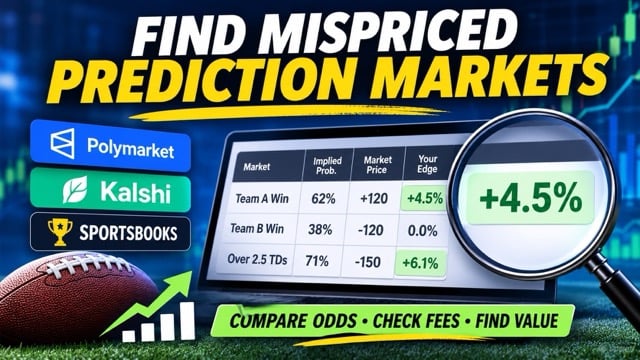
A prediction market is mispriced when the price you can actually pay sits out of line with the real chance of the outcome. Gaps like that are rare, small and short-lived, and most apparent edges turn out to be errors in your own estimate. Use the calculator below to compare markets, then run any gap you find through the fake-gap checks.
Fee formulas and tool details checked November 4, 2026.
Cross-market probability calculator
Enter the price you can buy at and pick the fee you'll pay. Then add at least one reference: a price from another prediction market, sportsbook odds for both sides or your own estimate. The calculator strips the vig from the sportsbook line, averages your market references into one consensus probability and shows your gap, expected value after fees and break-even point. The ruler plots every source on one line so outliers stand out.
Mispriced Probability Calculator
Compare the price you can pay with what other markets imply, after fees.
Your trade
Reference prices
Use American odds, such as +120 or -140. Leave both blank to skip.
| Sportsbook probability (vig removed) | |
| Consensus probability (market references) | |
| Probability used for expected value | |
| Gap vs. your price | |
| Fee per contract | |
| Break-even probability | |
| Expected value per contract, after fees | |
| Expected value on a $100 position |
Fees use Polymarket US and Kalshi's published taker formulas as of November 4, 2026, calculated on a $100 position. Polymarket US makers at the base volume tier pay no fee and earn no rebate. "Too thin to matter" means less than 2 cents of expected value per contract, a margin that small errors in your estimate or fill can wipe out. Results are estimates, not predictions.
A positive result is a reason to look closer, not a sure thing. Every prediction market trade can lose its full cost, so only trade money you can afford to lose. If trading stops feeling like a choice, call 1-800-GAMBLER for confidential support.
What does "mispriced" mean in a prediction market?
A prediction market is mispriced when the price you can actually buy at is meaningfully different from the true probability of the outcome. A YES contract at 30 cents implies a 30% chance. If the real chance is closer to 40%, that contract is underpriced. If it's closer to 20%, it's overpriced.
Three details decide whether a gap is real:
- Price is not probability until you can trade it. A contract's price is the market's best guess, not a fact. The question is always whether that guess is off by more than your own uncertainty.
- Use the best ask, not the last trade. The last traded price is history. The best ask is what buying costs right now, and that's the only number that matters for your trade.
- YES plus NO usually adds up to slightly more than $1. If YES asks 52 cents and NO asks 50 cents, the extra 2 cents is the spread. Buyers pay it on the way in, so a market can look fairly priced at the midpoint and still be a losing trade at the ask.
New to the terms here? Our complete prediction markets guide covers how contracts, prices and settlement work.
Mispricing vs. arbitrage: not the same trade
The two get used interchangeably, but they're different trades with different risks. Arbitrage locks in a payout by holding every outcome, so the result doesn't depend on who wins. Trading a mispricing is a directional position: you buy one side because you believe the market has the odds wrong, and the event can still go against you.
Here's how they compare side by side.
| Mispricing | Arbitrage | |
|---|---|---|
| What you're doing | Buying one side because you think the price is wrong | Buying every side of an outcome for less than the $1 payout |
| Where the edge comes from | Your probability estimate | Price math alone |
| Can you lose? | Yes. You can be right about the price and still lose the trade | Only through fees, slippage, a missed leg or mismatched rules |
| What decides profit | How often your estimate beats the market over many trades | Whether the combined cost stays under $1 after fees |
| Main risk | Your model is the thing that's wrong | Execution and settlement risk |
That distinction matters. A mispricing is an opinion with a price attached, never a guaranteed profit. If you're looking for spreads where both sides cost less than $1 combined, our prediction market arbitrage calculator checks whether they survive each platform's fees.
How to find mispriced prediction markets
Finding a mispricing is less about spotting a cheap number and more about proving to yourself that it's cheap. Work through these five steps in order. Most candidates should fall away by step four, and that's the process doing its job.
Step 1: Start with the price you can actually pay
Open the order book and note the best ask for the side you want, plus how many contracts sit at that price. If you plan to buy more than that, the next price level is part of your real cost. The headline price on a market card is often the last trade or the midpoint, and neither is what you'll pay.
Step 2: Build a reference probability
You need something to compare against. Good references include the same outcome on another prediction market, sportsbook odds with the vig removed and base rates from similar past events. Our no-vig fair odds calculator strips the house margin from a two-sided line, and the implied probability calculator converts any odds format to a percentage. When several independent sources agree, their average is usually a better estimate than any single one, including yours.
Step 3: Turn the gap into expected value after fees
A gap in percentage points isn't profit yet. Subtract the price and the trading fee from your probability to get expected value per contract. Fees on Polymarket US and Kalshi peak near 50 cents, so the same 3-point gap can be worth trading at 85 cents and worthless at 50 cents. The calculator above does this math for you.
Step 4: Rule out fake gaps
This is where most edges die. Check liquidity, resolution rules, timing and your own model before you trust a number. The fake-gap checks below walk through each one.
Step 5: Watch it, then decide
Real mispricings close, usually as news arrives or as the event gets closer. If a gap has stayed open for days in an active market, ask why nobody else is taking it. Set a price where you'd buy, a reason that would change your mind and a maximum position size before you place anything.
Why most mispricings aren't real
Most gaps that look like edges are explained by something the price already knows and the trader doesn't. Before you treat any number as a mispricing, rule out these four causes. They account for the large majority of false alarms.
Thin liquidity: the quote is real, but only for a little size
A price on the screen may only be good for a handful of contracts. In our own Polymarket review testing, a single-player NFL touchdown prop quoted at 15 cents on the way out but filled at 12 cents. That gap, plus the price move, cost 33.6% of the position on a round trip, while the same test on a busy Senate market cost about 4%.
Resolution fine print: you're pricing a different question
Two markets that look identical can settle on different rules. A contract that pays only if inflation comes in above 3.0% loses if the print lands exactly on 3.0%, while a similar market might use 3.0% or higher. Weather contracts settle on one official reporting station, not the reading on your phone, which our weather prediction markets guide explains. Economic markets can also settle on a first-release figure that later gets revised.
Old news: the price moved before you saw it
Prediction markets react to injury reports, polls and data releases within seconds. If your reference is a sportsbook line from this morning or a forecast from yesterday, the market may simply be ahead of you.
Your own model is the likeliest error
This one is the hardest to accept. PredictionMarketsPicks, which ran a paid mispricing scanner, says its standalone model did not beat the market price when checked against settled results, and that its claimed win rate was higher than the actual win rate in every price band. The scanner has since been paused. If a model built for the job couldn't beat the market, treat your own estimate with the same suspicion.
Use the checklist below on any trade you're considering.
Fake-Gap Checklist
Tick each statement that's true for the trade you're considering.
Where mispricings tend to appear
Markets aren't wrong at random. Research and trading experience point to a few places where prices drift from reality more often, though none of them is a reliable strategy on its own.
The favorite-longshot bias
The favorite-longshot bias is the tendency for low-priced contracts to win less often than their price implies, while heavy favorites win slightly more often. A study of more than 300,000 Kalshi contracts by economists Bürgi, Deng and Whelan found that pattern clearly, with a 10-cent contract winning less than 10% of the time. It also found that takers lost almost 32% on average, compared with about 10% for makers, according to the authors' VoxEU summary.
The lesson is about caution, not a system. Cheap longshots feel like bargains, and the evidence says they're often the opposite.
Fast news and thin markets
Prices lag most in the minutes after big news and in markets with little trading. Niche player props, lower-tier leagues and novelty markets fit that profile, and our sports prediction markets guide and pop culture prediction markets page show how wide the range of these markets has become. The catch is that thin markets are also where liquidity costs bite hardest.
Cross-market gaps
The same event can trade at different prices on Polymarket, Kalshi and sportsbooks, and economic outcomes also trade in futures. Our economy prediction markets guide compares Fed-decision odds with CME FedWatch, and our politics prediction markets page tracks election odds across platforms. A persistent cross-market gap is a prompt to check the rules on both sides before it's a reason to trade.
Expected value: is the gap worth it?
Expected value tells you what a trade is worth on average if you could repeat it many times. For a YES contract, the math is simple:
Expected value per contract = your probability - price - fee
Say you buy YES at 42 cents on Polymarket US and believe the true chance is 47%. The taker fee at that price is about 1.7 cents per contract, so expected value is 47 - 42 - 1.7, or about 3.3 cents per contract. On a $100 position, that's roughly $7.87 in expected value, which is small enough that a 3-point error in your estimate erases it.
Price level changes the risk too. A 3-point gap on a 50-cent contract asks you to be right about a coin flip. The same 3 points on a 90-cent contract carries a lower fee but leaves almost no room for error, since one surprise result wipes out many small wins.
Positive expected value is a reason to consider a trade, not a reason to trade bigger. If you size positions at all, keep them small and consistent. Our Kelly criterion calculator shows how estimate errors change what a sensible size looks like, and our prediction market strategies guide covers bankroll rules that apply on any platform.
Mispricing tools compared
A growing set of tools promises to find mispriced markets for you. They fall into three groups: scanners that flag price gaps, AI tools that produce their own fair-value estimates and analytics dashboards that track what other traders are doing. Prices below were checked on each tool's own site, or on our own reviews, on November 4, 2026.
| Tool | What it does | Platforms | Price | Honest limits |
|---|---|---|---|---|
| GamingToday calculator (this page) | Compares your price with other markets and de-vigged sportsbook odds, then shows expected value after fees | Polymarket US, Kalshi, any sportsbook line | No cost | Only as good as the prices you enter; no live data |
| PredictionMarketsPicks Mispricing Scanner | Flagged contracts its model rated off fair value, matched across platforms | Kalshi, Polymarket | Pro plan, $14.99 per month | Paused; the site says its model did not beat the market |
| Antalpha Nina | AI trading agent that blends order book, odds and sentiment for market ideas | Crypto-focused; prediction market venues not named | Listed at $0 per month | Crypto-first tool; you sign and own every trade |
| PillarLab | AI analysis that scores markets and adds cross-platform context | Polymarket, Kalshi | 20 trial credits, then $29 to $1,749 per month | AI estimates can be confidently wrong; credits run out fast on deep dives |
| Polymarket Analytics | Trader leaderboards, whale alerts and wallet histories | Polymarket (Kalshi for price comparisons only) | Basic access at no cost; Premium $20 per month | Shows what traders did, not what a market is worth |
| Unusual Predictions | Flags unusual trades, whale activity and possible insider patterns | Polymarket | About $20 per month or $204 per year | Flow signals, not fair-value estimates |
Read every tool's claims with the fake-gap checks in mind. A scanner can only flag a gap, not explain it, and an AI estimate is one more opinion to compare, not a referee. Tools that sell edges have a reason to show you more of them.
For deeper reads on two of these, see our Polymarket Analytics review and our Hashdive review, the analytics product now sold as Unusual Predictions. Our full roundup of prediction market tools and calculators covers bots, trackers and research aids.
The bottom line on mispriced markets
Real mispricings exist, but they're smaller, rarer and shorter-lived than most tools suggest. The traders who find them start from the price they can actually pay, compare it with independent references, subtract every fee and then try hard to prove themselves wrong.
If you want to put that process to work, start with regulated platforms that show a full order book. Our Polymarket review and Kalshi review break down fees, liquidity and market depth, and our ranking of the best prediction market sites covers the rest of the field. For how event contracts compare with traditional betting, see prediction markets vs. sportsbooks.
Mispriced Prediction Markets FAQ
A market is mispriced when the price you can buy at differs meaningfully from the true probability of the outcome. A 30-cent YES contract implies a 30% chance, so if the real chance is closer to 40%, it’s underpriced. The gap only counts if it holds up after fees and the spread.
Start with the best ask, build a reference probability from other markets and de-vigged sportsbook odds, then convert the gap to expected value after fees. Next, rule out thin liquidity, different resolution rules, stale news and errors in your own model. Our calculator handles the math.
No. Arbitrage buys every side of an outcome for less than $1 combined, so the payout doesn’t depend on who wins. Trading a mispricing means buying one side because you think the price is wrong, and the event can still go against you.
Yes. Even a real mispricing is a probability, not a promise. A contract you correctly buy at 40 cents with a true 50% chance still loses half the time, and you lose the full cost each time it does.
The difference is the spread between buyers and sellers. If YES asks 52 cents and NO asks 50 cents, the extra 2 cents goes to whoever is providing the liquidity. It’s a cost you pay on entry, separate from the trading fee.
It’s the tendency for cheap longshot contracts to win less often than their prices imply and for heavy favorites to win slightly more often. A study of more than 300,000 Kalshi contracts found the pattern clearly, especially among traders who take existing prices rather than post their own.
Convert everything to probabilities. Prediction market prices already are percentages, while sportsbook odds need converting and the vig removed from both sides. Our cross-market calculator does both, and the no-vig fair odds calculator handles sportsbook lines on their own.
They can surface gaps faster than you can, but they can’t tell you whether a gap is real. One paid scanner was paused after its operator said its model did not beat the market. Treat any flagged contract as a lead to check, not a trade to copy.
Big enough to survive fees, the spread and your own estimate error. On mid-priced contracts, taker fees alone run close to 2 cents per contract, so a 2- or 3-point gap rarely leaves real expected value. Our calculator flags anything under 2 cents of expected value as too thin.
Trading on your own research and public information is what markets are for. Trading on material nonpublic information obtained through a breach of duty, such as confidential work data or inside knowledge of a game, can violate CFTC rules and platform rulebooks. This isn’t legal advice, so check each platform’s rules before you trade.

