
Flipr Bot Review: The X Trading Bot for Prediction Markets



Flipr lets you trade Polymarket and Kalshi markets by posting on X, and its web terminal adds up to 10x leverage on top. That makes trading faster, and it makes losing money faster too. This review explains how the bot works, what leverage actually does to a stake, what Flipr costs, and which claims we could and couldn't verify.
Details checked October 16, 2026.
Flipr at a Glance
Here's the short version before we get into the details. Each row reflects Flipr's own documentation and its official X account as of our latest check, and anything we couldn't confirm is labeled that way.
| Detail | Flipr |
|---|---|
| 🔗 Official links | flipr.bot and @fliprbot on X. Type the site address yourself and check the handle letter by letter, since copycat accounts exist. |
| 🤖 What it does | Places prediction market trades from posts on X, plus a web trading terminal with leverage and exit orders |
| 📈 Platforms | Polymarket (account created automatically) and Kalshi (connect your own account) |
| ⚖️ Leverage | 1x to 10x in the trading terminal, adjusted by market conditions; leverage through the X bot is listed as coming soon |
| 💲 Price | No deposit fee; 0.01% fee on standard orders; borrowing fees waived during testing, with 1% planned |
| 🔑 Custody | Non-custodial smart account built on Privy, with trade-execution access granted to Flipr |
| 👥 Team | Not publicly named |
| 📅 Recent activity | The official @fliprbot account hasn't posted publicly since September 29, 2025 |
| 🇺🇸 US access | No published US eligibility terms we could confirm; Polymarket's international platform isn't open to US users |
| ⭐ GamingToday verdict | A clever way to trade from your feed, but high leverage, an anonymous team and a quiet official account make it a tool for experienced, risk-tolerant traders only |
What Is Flipr?
Flipr is a trading bot that runs inside X. You tag @fliprbot in a post, and it places a trade on a Polymarket or Kalshi market for you. A companion web terminal adds leverage of up to 10x, stop-loss and take-profit orders. Flipr is a trading interface, not a prediction market of its own.
Flipr launched in July 2025, starting with Polymarket and adding Kalshi later. Positions settle on the underlying exchange, so the market's rules, prices and resolution come from Polymarket or Kalshi, not from Flipr. What the bot adds is speed and convenience, plus a social layer: trades can post publicly to your feed, and group admins can spin up markets inside a chat. Flipr calls itself "the DeFi layer for prediction markets," and its leverage, lending and risk tools live mainly in the terminal.
The Flipr Bot vs. the $FLIPR Token
Flipr also has a crypto token, $FLIPR, which trades on Solana and was handed out through a six-week "mindshare mining" campaign that began July 7, 2025. You don't need the token to use the bot, and its price has nothing to do with whether your trades win. We don't review or recommend the token here. One more source of confusion: Nate Silver's 2026 midterm election forecast also goes by FLIPR, and it isn't connected to this bot.
How the Flipr Bot Works
Every Flipr trade from X follows the same basic path from your account to the exchange. Here's what happens after you hit post.
- You tag the bot. Mention @fliprbot in a post with what you want to trade, how much and which side, plus a description of or link to the market.
- The bot reads your request. Flipr's AI agent parses the command to work out which market you mean, whether you're buying YES or NO and the dollar amount.
- The trade routes to the exchange. The order goes to the matching Polymarket or Kalshi market, funded from your Flipr account balance.
- The position posts publicly. The bot's reply and your trade show up on X, where other users can see it, copy it or argue with it.
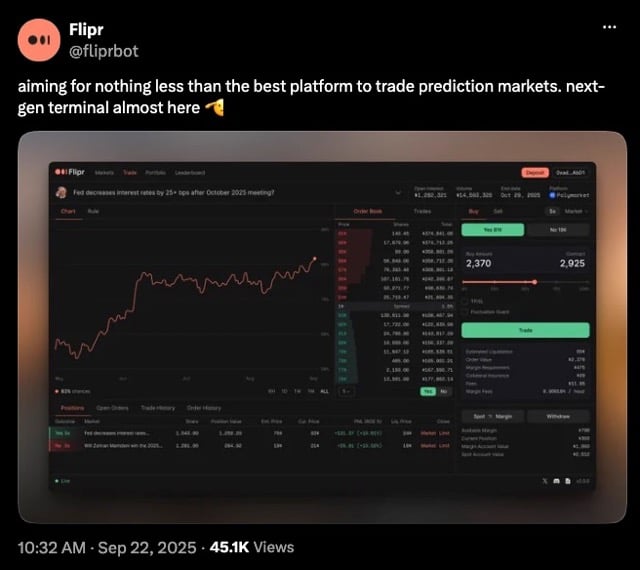
Trading From X With Plain-Language Commands
Flipr's documentation gives a simple format: the action, a dollar amount, YES or NO, and the market. A post like "@FliprBot buy $10 on YES for Bitcoin to 150k in 2025" is enough, and sell and close commands work the same way. That convenience has a cost: the looser the description, the more room there is for the bot to pick the wrong market. Pasting the market link is safer than describing it, especially on markets with similar names, such as different dates or price thresholds. Leveraged trades from X are listed as coming soon, so for now leverage runs through the web terminal.
Polymarket and Kalshi Routing
Polymarket was Flipr's first integration, and a Polymarket account is created and linked automatically when you sign up. You fund it with USDC.e on Polygon or SOL on Solana. Kalshi works differently: you connect your own existing Kalshi account by generating API keys with trading permissions and entering them in Flipr, which means Kalshi's account and eligibility rules still apply. If you're new to how the two exchanges differ, our Polymarket vs. Kalshi comparison covers fees, markets and regulation.
Flipr Leverage Explained: What It Does to Your Money
Leverage is Flipr's headline feature and the part most worth understanding before you use it. In the terminal you can set anywhere from 1x to 10x, though Flipr says the leverage you actually get can be adjusted for a market's volatility and liquidity. Either way, borrowed money multiplies your position, so every cent the contract price moves hits your stake several times harder, in both directions.
Here's the core math. Your position equals your stake times your leverage. If the market resolves YES, your profit equals the position times (1 minus the entry price) divided by the entry price. With no extra protection added, Flipr liquidates the position when the price falls to the entry price times (1 minus 1 divided by your leverage).
The Upside Math
Say you put $100 on YES at 50 cents with 5x leverage. Your $100 becomes a $500 position, which buys 1,000 contracts. If YES wins, each contract pays $1, so you collect $1,000, repay the $400 you borrowed and keep $600. That's a $500 profit on a $100 stake, five times what the same trade earns without leverage. Contract prices work like probabilities, which our implied probability calculator can help you translate.
How Fast Leverage Wipes Out a Stake
The downside moves just as quickly, and it doesn't wait for the market to settle. In that same 5x trade, the borrowed $400 is still owed if the price slips. At 40 cents, your 1,000 contracts are worth $400, exactly what you owe, which is where Flipr's formula liquidates the position. A 10-point dip is all it took, even if YES would have won a week later. The table shows the same $100 trade at a 50-cent entry across common leverage levels, with no insurance collateral or fluctuation guard added.
| Leverage | Position Size | Profit if YES | Liquidation Price | Drop Needed |
|---|---|---|---|---|
| 1️⃣ 1x (none) | $100 | $100 | Only if NO wins | No early wipeout |
| 2️⃣ 2x | $200 | $200 | 25 cents | 25 points |
| 3️⃣ 3x | $300 | $300 | 33.3 cents | 16.7 points |
| 5️⃣ 5x | $500 | $500 | 40 cents | 10 points |
| 🔟 10x | $1,000 | $1,000 | 45 cents | 5 points |
Prediction markets make this worse than it looks on paper. Prices can jump 10 or 20 points in seconds on a single headline, a lineup change or a poll, and thinner markets can gap straight past your exit. A move that would be ordinary noise on an unlevered position can end a leveraged one.
Liquidation, Insurance and Borrowing Costs
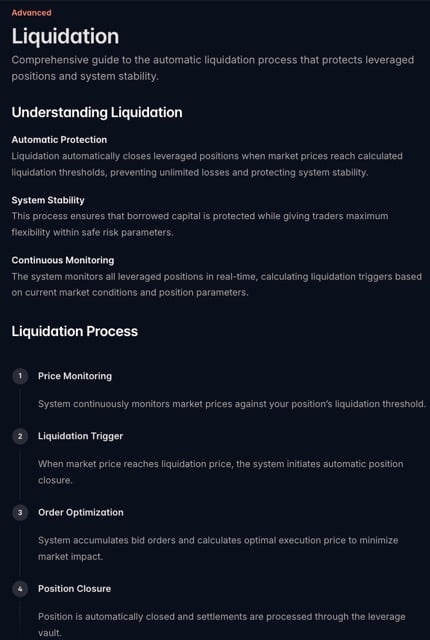
Flipr publishes its liquidation formula: the liquidation price equals the entry price times (1 minus total protection divided by total position value). Total protection is your margin plus any insurance collateral and fluctuation guard money on the position. Flipr's own example is a 5x position at 80 cents with $100 of margin and $50 of insurance collateral, which liquidates at 56 cents. When a liquidation fills, Flipr may price it from the volume-weighted average of the available bids, so you can get less than the trigger price in a thin market.
Some markets also require insurance collateral, a refundable amount locked when you open the position. You get it back on a winning trade, but it can be partly or fully used up on a losing or liquidated one. Flipr limits how much margin you can use through tiers that start at $200 and rise to $2,000 based on performance and volume. Borrowing fees are waived during testing, with a 1% fee listed as standard and tiered annual rates of 5% to 25% planned.
Stop-Loss, Take-Profit and Fluctuation Guard
Flipr lets you attach stop-loss and take-profit orders to a position, set as a percentage move from your entry. A stop-loss can limit damage on a slow slide, but it can't promise a fill at your chosen price when a market gaps, and a stop placed too tight on a volatile market can close a trade you'd have won. Treat these orders as a seatbelt, not a guarantee.
Fluctuation Guard works the other way. It reserves extra capital, anywhere from 1% to 100% of the position, that Flipr spends to keep a position open when it hits its liquidation level, giving a temporary dip time to recover. Flipr's own documentation warns that it increases your maximum potential loss, because if the price keeps falling, you lose the guard money too. Our prediction market strategies guide covers position sizing and exit planning in more depth.
Leverage Reality Check Calculator
Enter an entry price, a leverage level and a stake to see your position size, what you'd make if YES wins and the price at which Flipr's formula would liquidate you. The colored bar shows how much room the price has to move before your money is gone. It leaves out insurance collateral, fluctuation guard and fees, so treat every result as a simplified estimate.
Leverage Reality Check Calculator
See what leverage does to a YES position before you place it.
| Position size | |
| Contracts bought | |
| Borrowed amount | |
| Profit if YES wins | |
| Same trade with no leverage | |
| Loss if NO wins | |
| Liquidation price |
Illustrative only. Uses Flipr's published liquidation formula with no insurance collateral or fluctuation guard. Results exclude trading and borrowing fees and slippage, and Flipr can adjust the leverage you actually receive, so a real position may differ.
Is Flipr Bot Free?
Mostly, for now. Signing up costs nothing, Flipr doesn't charge deposit fees, and gas, the network fee for on-chain transactions, has been sponsored. As of October 16, 2026, Flipr's documentation lists a 0.01% fee on standard orders, with smart orders at 0.03% but currently waived. Leverage borrowing is free during what Flipr calls its testing phase, with a 1% borrowing fee listed as standard and tiered annual rates of 5% to 25% planned.
Flipr says fees will change when it rolls out token-based tiers, so treat today's pricing as temporary. "Low fee to use the bot" also isn't the same as "no cost to trade." Polymarket and Kalshi set their own trading fees on many markets, and network fees still apply when you move money in or out. Our Kalshi review explains how that exchange's fees work.
Is Flipr Bot Legit and Safe?
Flipr is a real product with detailed public documentation and independent coverage going back to its July 2025 launch. Being real isn't the same as being low-risk, though. The team is anonymous, the official X account has been silent for more than a year, and the platform needs permission to trade with your money. That combination calls for small amounts and extra caution.
What We Could Verify
Here's what we could and couldn't confirm as of October 16, 2026.
- Confirmed: Flipr trades Polymarket markets from X and its web terminal, and you can connect a Kalshi account through API keys.
- Confirmed: Accounts are non-custodial smart accounts built on Privy, funded with USDC.e on Polygon or SOL on Solana.
- Confirmed: Leverage from 1x to 10x, a published liquidation formula, stop-loss, take-profit and Fluctuation Guard are documented.
- Confirmed: A fee schedule is published, with borrowing fees waived during testing.
- Red flag: The official @fliprbot account's most recent public post is dated September 29, 2025, when it announced a private beta for a rebuilt terminal.
- Not confirmed: US eligibility terms, the names of the people running the project and whether the X bot currently processes leveraged trades.
Who Runs Flipr
Flipr's site and documentation don't name a founder or company leadership. Developer directories list the product under "Flipr Finance," and the official account announced back-end, data and mobile hires in September 2025, but we couldn't find a registered business address or a named team. Anonymous teams are common in crypto, but they make it much harder to know who's accountable if something goes wrong. Before you deposit, check that the official account and Discord are still active.
Wallet, API Keys and Execution Access
Your funds sit in a smart account created through Privy, a wallet provider used by many crypto apps. Non-custodial means Flipr doesn't hold your money in its own account. For the bot to place trades for you, though, the account has to grant it permission to execute them, and linking Kalshi involves sharing API credentials. Anyone who gains control of your X account could potentially trade through it. Turn on two-factor authentication for X, never share your private keys or seed phrase, and keep only what you're willing to lose in the account.
Impersonators and Scams
Popular crypto bots attract fake accounts, and Flipr is no exception. Copycat handles reply to posts with lookalike names, offer "airdrop" or "token claim" links, or ask you to connect a wallet. The real bot will never ask for your seed phrase. Reach Flipr only through flipr.bot, typed yourself, and the official @fliprbot handle, which joined X in June 2025, and ignore anyone who DMs you first.
Public-by-Default Trades and Privacy
When you trade through a public post, your position shows up on your X feed, tied to your handle. That's part of Flipr's social appeal, but it also tells the world what you're betting on and roughly how much. Trading in the web terminal keeps the command out of your feed, but Flipr says entry orders stay on-chain, where wallet activity can be traced. If privacy matters to you, assume your trading history is visible.
Can US Residents Use Flipr?
Flipr hasn't published US eligibility terms we could confirm as of October 16, 2026, so the safest answer depends on which exchange your trade goes to. Read Flipr's own terms before you fund an account.
Flipr's Polymarket trading runs through Polymarket's international, on-chain platform, which isn't available to US users. Traders in the US have a separate, CFTC-regulated option in Polymarket US, which our Polymarket review covers in detail. Kalshi is also regulated by the CFTC and open to US residents, but you need your own verified Kalshi account, and some contracts, especially sports, aren't offered in every state.
Don't use a VPN or any other workaround to reach a platform that blocks your location. It breaks the platform's terms and can leave your funds frozen. If you want to trade from the US, our guide to the best prediction market sites lists the regulated options.
Deposit $10, Get a $25 Trading Bonus
Live Trade with the Biggest Payouts at the Largest Prediction Market in the World
Deposit $10, Get a $25 Trading Bonus
Live Trade with the Biggest Payouts at the Largest Prediction Market in the World
How to Get Started With Flipr
If you decide to try Flipr, set it up carefully and start small. These steps put the safety checks first. New to event contracts altogether? Start with our prediction markets guide.
- Verify the official handle. Confirm you're dealing with @fliprbot and flipr.bot, typed directly, before you click anything or connect a wallet.
- Read the terms and eligibility rules. Check Flipr's terms, plus Polymarket's or Kalshi's, to make sure you're allowed to trade from where you live.
- Create your smart account. Sign in with X to set up the Privy-based account, and turn on two-factor authentication for your X login first.
- Fund it with a small amount. Deposit USDC.e on Polygon or SOL on Solana, not regular USDC on Polygon, and only an amount you're comfortable losing completely.
- Start without leverage. Place a small, unlevered trade first so you can see how the bot reads your command, how fills look and how positions display before you add any risk.
Flipr Pros and Cons
Flipr does something no exchange app does, letting you act on a market the moment you see it in your feed. The tradeoffs are real, though, and most of them come back to transparency.
Pros
- Trade Without Leaving X | Tagging the bot places a position in seconds, without switching apps or copying market links.
- Two Major Exchanges | Polymarket and Kalshi markets are both reachable from the same bot and the same commands.
- Transparent Liquidation Math | Flipr publishes its liquidation formula, so you can work out exactly where a leveraged position closes before you open it.
Cons
- Quiet Since Late 2025 | The official X account hasn't posted publicly since September 2025, which raises questions about ongoing support.
- Anonymous Team | No founder or company leadership is named, so accountability is unclear if something breaks.
- Public by Default | Trades placed in posts appear on your feed, and the bot needs permission to trade from your account.
Flipr Alternatives
Flipr bundles trading, leverage and social features into one bot, but you can get most of what it offers elsewhere with more transparency. The table groups the main options by job. Third-party details were checked in October 2026 and can change, and our prediction market tools hub covers more.
| Tool | What It Does | Platforms | Leverage | Price | Regulated |
|---|---|---|---|---|---|
| 🤖 Flipr | Trades prediction markets from X posts and a web terminal | Polymarket, Kalshi | Yes, up to 10x in the terminal | 0.01% order fee; borrowing fees waived during testing | No |
| 🟦 Polymarket US | Direct trading on Polymarket's US exchange | Polymarket | No | Free to join; trading fees apply | Yes (CFTC) |
| 🐶 Underdog Predict | Sports event contracts in the Underdog app | Underdog | No | Free to join; trading fees apply | Yes (CFTC-registered exchanges) |
| 🟩 Kalshi | Direct trading on a CFTC-regulated exchange | Kalshi | No | Free to join; trading fees apply | Yes (CFTC) |
| 🐋 Unusual Predictions (formerly Hashdive) | Smart Scores, whale tracking and insider-style flags | Polymarket | No | Included with Unusual Whales Retail plans | No |
| 🖥️ Stand.Trade | Trading terminal with market discovery and whale tracking | Polymarket, Kalshi, Opinion | No | No published fees | No |
| 🧮 GamingToday Arbitrage Calculator | Checks whether a price gap survives fees | Polymarket, Kalshi | No | Free | Not applicable |
Regulated Direct Trading
If you're in the US, trading directly on a regulated exchange is the cleanest option. Polymarket US and Underdog Predict both run under CFTC oversight with published fees and no leverage, and Kalshi works the same way. Our sports prediction markets guide shows what each one lists.
Plus 50% First-Time Deposit Match up to $1,000 (State Dependent)
Make the Correct Prediction Pick to Score Your Payout
Spreads, Totals, Moneylines, and Parlays, all on Underdog
Plus 50% First-Time Deposit Match up to $1,000 (State Dependent)
Make the Correct Prediction Pick to Score Your Payout
Spreads, Totals, Moneylines, and Parlays, all on Underdog
Analytics Tools
If what you like about Flipr is acting on what traders are doing, a research tool may serve you better than a trading bot. Our Hashdive explainer covers Unusual Predictions, and our Polymarket Analytics review breaks down a free option for wallet and leaderboard data.
Terminals and Aggregators
Stand.Trade puts Polymarket, Kalshi and Opinion markets in one terminal, with tools for sorting markets and tracking large traders. It suits people who want a desktop view of several exchanges rather than trading from a social feed. It hasn't published a fee schedule, so check before relying on it.
Arbitrage Tools
Traders who split positions across Polymarket and Kalshi often do it to catch price gaps. Before you chase one, run the numbers through our prediction market arbitrage calculator, since fees erase most gaps.
Our Verdict on Flipr
Flipr is an inventive tool that does what it promises: you can trade Polymarket and Kalshi markets from X in seconds. It may suit experienced traders who live on X, already understand prediction market pricing and want fast, small positions on breaking news.
Most readers should skip the leverage entirely. On binary contracts that swing 10 points on a headline, 5x leverage is liquidated by a 10-point drop, and Fluctuation Guard only raises the amount you can lose. With an anonymous team and an official account that has been quiet since September 2025, we'd treat Flipr as an experiment: confirm it's still active, verify the handle, keep balances small and trade unlevered. If you want macro markets with less noise, our economy prediction markets page is a better starting point.
Flipr Bot FAQ
Flipr is a trading bot on X that places Polymarket and Kalshi trades when you tag @fliprbot in a post. A companion web terminal adds leverage of up to 10x, stop-loss and take-profit orders. Flipr isn’t an exchange itself, so markets, prices and resolution come from Polymarket or Kalshi.
Flipr is a real product with detailed documentation and coverage since its July 2025 launch. It also has real gaps: the team isn’t named, the official X account hasn’t posted since September 2025 and the platform needs permission to trade from your account. Confirm it’s still active and start with small amounts.
Mostly. As of October 16, 2026, Flipr charges no deposit fee and lists a 0.01% fee on standard orders. Leverage borrowing is free during testing, with a 1% fee listed as standard. Flipr says pricing will change with token-based tiers, and Polymarket or Kalshi trading fees can still apply.
Flipr’s documentation lists leverage from 1x to 10x in its web terminal, with the leverage you actually get adjusted for each market’s volatility and liquidity. Margin is capped by tier, starting at $200. Leverage through the X bot is listed as coming soon. At 5x, a 10-point drop on a 50-cent contract triggers liquidation.
Flipr says automatic liquidation is designed to stop losses from exceeding your account balance. You can still lose more than your initial margin, though: insurance collateral can be used up on losing trades, and Fluctuation Guard adds reserved capital that’s lost if the price keeps falling. Liquidations can also fill below the trigger price.
Yes. A Polymarket account is created automatically when you sign up, and you fund it with USDC.e on Polygon or SOL on Solana. For Kalshi, you connect your own existing account by generating API keys with trading permissions and entering them in Flipr, so Kalshi’s account rules still apply.
Flipr hasn’t published US eligibility terms we could confirm. Its Polymarket trading uses Polymarket’s international platform, which isn’t available to US users. Kalshi is CFTC-regulated and open to US residents with a verified account. Read Flipr’s terms first, and never use a VPN to get around a location block.
No. $FLIPR is a separate crypto token on Solana, first distributed through a rewards campaign in July 2025. You don’t need it to use the bot, and its price has no effect on your trades. The FLIPR name also appears on Nate Silver’s 2026 midterm forecast, which is unrelated.
Trades placed by tagging @fliprbot in a post are public, because the command and the bot’s reply appear on X. Trading in the web terminal keeps them off your timeline, but Flipr says entry orders stay on-chain, where wallet activity can be traced. If privacy matters, assume your trading history is visible.
For regulated trading in the US, use Polymarket US, Underdog Predict or Kalshi directly. For research, Unusual Predictions (formerly Hashdive) and Polymarket Analytics track trader and wallet data. Stand.Trade offers a multi-exchange terminal, and GamingToday’s arbitrage calculator checks whether price gaps survive fees.
Trading prediction markets carries real financial risk, and leverage magnifies it. No bot, signal or strategy guarantees a profit. Set a budget before you trade and stick to it. If trading stops feeling like a choice, confidential help is available 24/7 at 1-800-GAMBLER. You must be 18 or older, or the minimum age in your state, to participate.

