

 Share
Share 



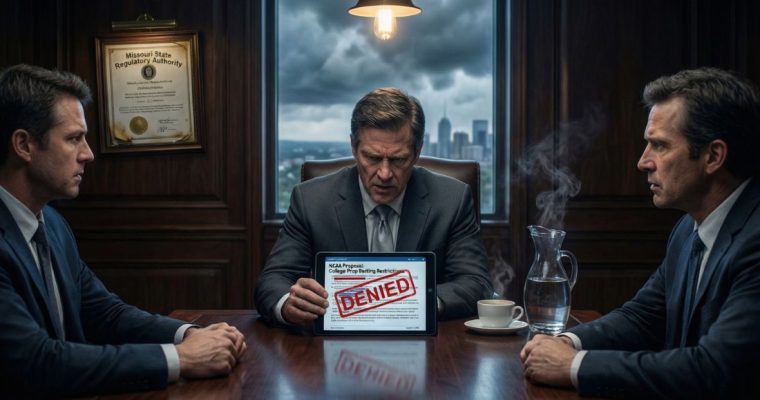
Missouri regulators are not rushing to rewrite the rules on college sports betting, even as pressure mounts from the NCAA. This week, state officials rejected a request to ban certain college wagers, choosing caution over quick action in a market that is still finding its footing.
A young market meets a tight deadline
The Missouri Gaming Commission voted 3-0 to deny the NCAA’s request to prohibit college player prop bets and certain specialty wagers, including first-half unders. The decision followed a letter sent earlier this month by NCAA President Charlie Baker.
Missouri law left regulators little breathing room. Once the request arrived, the commission had just seven days to act — a timeline that proved to be a major sticking point, particularly given that legal sports betting in Missouri debuted on Dec. 1.
Commission Chair Jan Zimmerman said the state does not yet know enough. Data is limited, trends are still forming, and early decisions could carry unintended consequences. In her words, Missouri sports betting is “not even in its infancy yet.”
The NCAA’s case against player prop bets
The NCAA’s request came after federal indictments against numerous former college basketball players were made public. Prosecutors allege the players were involved in performance manipulation tied to betting schemes.
Those cases reignited concerns about college athletes’ vulnerability, especially when wagers focus on individual performances rather than game outcomes.
According to Baker, player prop bets expose athletes to risks of intimidation, coercion and bribery. While he has urged states to act independently in the short term, his broader goal is a nationwide ban. Only a handful of states have adopted that approach so far.
Sportsbooks argue bans would backfire
Sports betting operators strongly opposed the NCAA’s request.
Caesars and Circa submitted written comments, along with the Sports Betting Alliance, which represents DraftKings, FanDuel, BetMGM, Fanatics Betting & Gaming and bet365.
Their argument was consistent: Regulated sportsbooks help identify suspicious activity through integrity monitoring and data sharing. Eliminating legal betting options, they said, would not eliminate demand but instead push bettors toward offshore or illegal markets with no safeguards.
Caesars also noted that college player prop bets typically carry lower betting limits, making them less attractive targets for large-scale manipulation.
Missouri looks to other states for clarity
Commission staff pointed out that only four of the 39 states with legal sports betting — Louisiana, Maryland, Ohio and Vermont — currently ban college player prop bets entirely. Missouri already restricts some wagers, including props tied to in-state college teams, while allowing others.
Executive Director Michael Leara added that conversations with Nevada regulators indicated no immediate plans to impose similar bans there.
Commissioners emphasized that the issue remains open. Additional data, clearer trends and more time to evaluate how other states regulate college betting could prompt further discussion.
For now, Missouri is choosing patience, signaling that sweeping changes to a brand-new market will require more than urgency and headlines.

