


 Share
Share 



Lawmakers packed the chamber for Connecticut’s annual State of the State address, ready for applause lines, policy proposals and the usual partisan tension. What few of them likely realized was that every word was also being tracked by online traders.
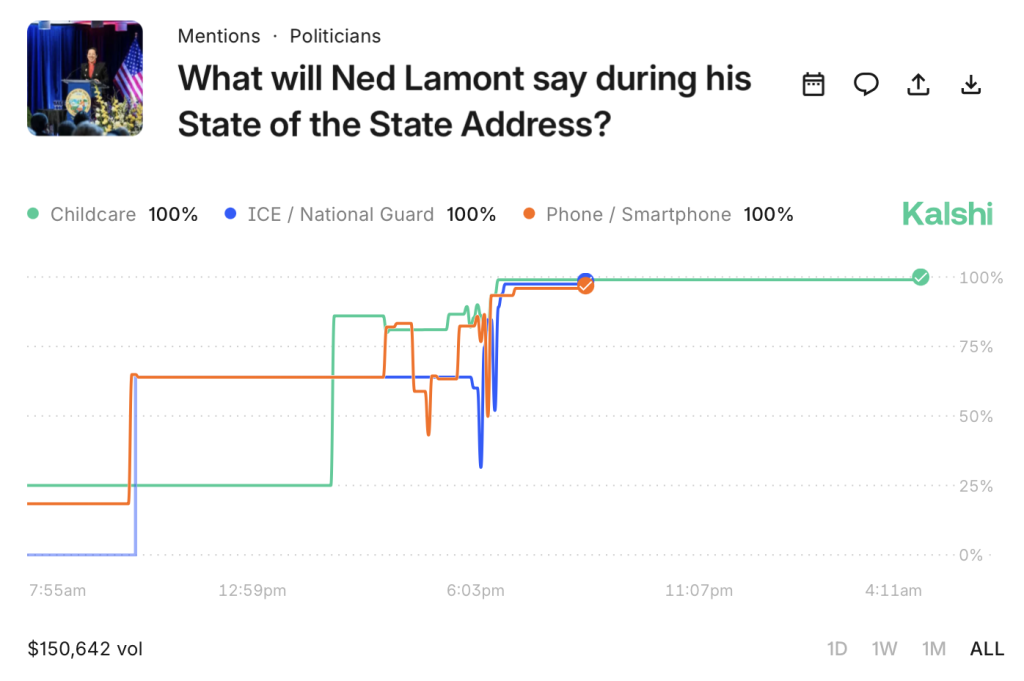
On the prediction market platform Kalshi, users weren’t just watching Gov. Ned Lamont speak; they were wagering real money on the exact phrases he would use. By the time the speech wrapped, roughly $150,000 in total market value had been tied to contracts related to Lamont’s remarks. For a policy speech in Hartford, it was a surprisingly high-stakes side story.
The Hartford trading floor
Kalshi allows users to trade “event contracts,” typically structured as yes-or-no outcomes. In this case, the outcomes revolved around specific words and phrases Lamont might say. Traders could buy contracts predicting whether the governor would mention terms such as “ICE,” “phone,” “smartphone,” “small business” and “rebate.” If the word was spoken exactly as listed, the contract paid out. If not, it expired worthless.
Some bets proved profitable. Lamont’s call for ICE to “go home” drew cheers from Democrats and a walkout from some Republican lawmakers, while also rewarding those who correctly predicted the mention. His proposal to restrict phones in schools and a rebate program that could put hundreds of dollars back into families’ pockets also triggered winning contracts.
Other traders were less fortunate. Contracts tied to “Trump,” “immigration” and “mental health” did not pay. Frustration even bubbled up over Lamont’s use of “inflationary” rather than “inflation,” which meant a narrowly written contract failed to cash. Precision matters when money is on the line.
Policy proposals vs. real-time volatility
The speech focused on several headline items: a push for phone-free classrooms, support for small businesses and a sizable rebate initiative funded in part by strong state finances. Each topic sparked real-time market movement as viewers listened closely for confirmation.
This type of wagering transforms a traditional political event into something closer to a live trading floor. Traders are not evaluating ideology or debating policy merits; they are parsing language, tone and likelihood, much like analysts breaking down earnings calls.
Supporters of prediction markets argue that this structure reflects collective intelligence. Critics see something different: a blurring of lines between civic life and speculative gambling.
Closing the “Wild West” loophole
The Lamont administration responded quickly. Proposed legislation in Connecticut would significantly tighten the rules around prediction markets operating in the state.
Among the proposals:
-
Raising the minimum participation age to 21.
-
Banning targeted advertising to minors and on college campuses.
-
Restricting contracts tied to political outcomes, war, emergencies or death.
Officials also want platforms to implement self-exclusion tools and adopt consumer protections similar to those governing legalized sports betting. State officials have described the current environment as a “Wild West,” particularly because prediction markets are federally regulated by the Commodity Futures Trading Commission rather than by state gaming authorities.
The future of political accountability
The $150,000 tied to a single gubernatorial speech illustrates how quickly political prediction markets are expanding. What once seemed like niche financial experimentation is now intersecting directly with state politics.
Whether Connecticut’s proposed rules gain traction or spark legal challenges remains to be seen. What is clear is that political speeches are no longer just about applause lines and policy substance. For some viewers, every word now carries a price tag.

