
Manifold Markets Review September 2026: How It Works, Mana, and Is It Legit?





- Zero Financial Risk to Trade | Every market runs on free Mana, so you can trade as often as you want without ever risking real money — a rare setup among the platforms reviewed on this site.
- The Widest Question Variety We've Reviewed | Because anyone can create a market, Manifold covers niche topics, especially in AI and tech, that no real-money exchange offers.
- Genuinely Open for Builders | A public API, WebSocket feed, and bulk data access give technical users a level of access none of the real-money exchanges on this site provide.

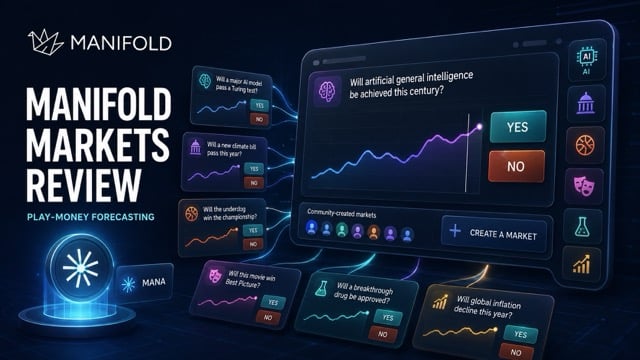 Manifold Markets Signup Bonus: Free Mana to Get Started
There’s no promo code and no trading bonus to claim, because Manifold doesn’t run on real money in the first place. What you get instead is a starting stack of Mana (Ṁ), Manifold’s play-money currency, split across a few quick steps: roughly 100 Mana just for creating an account, another 500 for verifying your phone, email, and date of birth, and a final 400 for placing your first trade, for 1,000 Mana total. No deposit, no card, and no promo code required.
Refer a friend, and you’ll pick up another 1,000 Mana once they sign up through your link; daily prediction streaks, market-sharing, and weekly market-creation quests all add smaller amounts on top of that. None of it converts to cash (more on that below) but it’s enough to start trading real markets from day one.
| Detail | Info |
|---|---|
| 🎁 Signup Bonus | ~1,000 Mana total: 100 for creating an account, 500 for verifying your phone, email, and date of birth, and 400 for placing your first trade |
| 🎟️ Promo Code | None needed — there's no promo code because Manifold doesn't run on real money in the first place |
| 🔁 Referral Bonus | 1,000 Mana once a friend signs up through your referral link |
| 💲 Contract Price Range | 1% to 99% per market; no real-money minimum, ever |
| 🪪 Account Verification | No KYC required for normal use; verifying your phone, email, and date of birth is optional and simply unlocks bonus Mana |
| 🎂 Minimum Age | 13+ per Manifold's Terms of Service; users under 18 need parental permission to use the platform |
| 🌎 Eligible Countries | No fixed country whitelist — available broadly worldwide, subject to local law |
| 🏛️ Regulator | None — Manifold isn't a CFTC-regulated exchange, a deliberate choice since it never involves real-money contracts |
| 📊 Markets Offered | Politics, AI and technology, sports, culture and entertainment, business and economics, crypto, science, and unlimited user-created markets |
| 💳 Payment Methods | Card purchase for optional Mana packages; no deposit is required to trade |
| 🧮 Trading Fees | None on trades themselves; slippage is the only real cost, and only on thin, lightly traded markets |
| 💎 Membership Subscription | Optional Plus, Pro, and Premium tiers add quest multipliers, higher leverage limits, streak-freeze protection, and cosmetic upgrades |
| 💸 Cash Withdrawals | None — Mana can never be redeemed for cash under any circumstances |
| 📱 Platform Access | Full-featured browser-based site plus iOS and Android apps |
| 💬 Customer Support | Email (help@manifold.markets), a public Discord community, and self-serve docs — no live chat or phone line |
| 📅 Terms | Set by Manifold — confirm current bonus amounts and category list directly on the site before signing up |
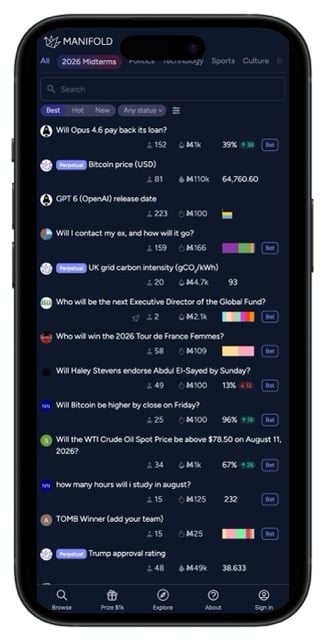
What Is Manifold Markets? Prediction Market Explained
Being one of the more unusual entries among the best prediction market sites, Manifold Markets skips real money entirely. It’s a play-money forecasting platform where you trade shares in the outcome of real-world questions using Mana instead of dollars, and where literally anyone, not just the platform, can create a market.
How Manifold Markets Works
Every Manifold market is a question with a price between 1% and 99%, and that price is the crowd’s live estimate of how likely the outcome is. Buy “Yes” shares if you think the price is too low, buy “No” if you think it’s too high, and if you’re right when the market resolves, your shares settle at their final value. You can also sell out of a position before resolution instead of holding it to the end.
The catch, and it’s a significant one: none of this happens with real money. Manifold explicitly avoids classification as a gambling or financial trading platform by keeping Mana non-redeemable for cash. You’re trading real conviction on real questions, just not real dollars.
So What’s Attractive About Manifold Markets?
The biggest draw is that anyone can build a market, not just the platform’s own team. That opens the door to questions no regulated exchange would ever list: niche forecasting questions about AI research timelines, individual companies, ongoing internet drama, or a friend group’s private bet, alongside the usual politics and sports fare. If you’ve ever wanted to create your own prediction market rather than just trade on someone else’s, Manifold is one of the few places that actually lets you.
It’s also a genuinely low-stakes way to learn how prediction markets work before putting real money anywhere. Our prediction markets guide covers the mechanics that carry over directly: reading a price as a probability, buying and selling shares, and watching a market move as new information comes in.
Is Manifold Markets Legit and Where Is It Available?
Yes, Manifold Markets is a legitimate platform, just not the kind of “legit” most prediction market reviews are checking for. It isn’t registered with the CFTC and doesn’t hold a gaming license, because it was never built to offer real-money contracts in the first place. Manifold is upfront about that trade-off: no regulator to answer to, but also no path from Mana back to cash. Here’s how that plays out in practice.
Regulation & Oversight
Manifold isn’t a regulated exchange, and it isn’t trying to be. Unlike Kalshi or Polymarket, which operate as CFTC-registered derivatives markets, Manifold states outright that it is “not a regulated prediction event exchange.” That’s a deliberate design choice, not an oversight: keeping Mana non-redeemable for cash is what keeps the platform out of gambling and securities regulation in the first place. There’s no federal or state gaming license behind Manifold, because the product isn’t structured to need one.
How Your Mana Is Protected
Worth being direct about this: since trading itself never involves real money, there’s no FDIC, SIPC, or CFTC-style customer-fund protection to speak of, and none is needed for your Mana balance specifically. The only point where real money enters the picture is if you choose to buy additional Mana or a membership subscription, and those purchases run through standard card payment processing. Account security otherwise comes down to normal login protections; sign-up runs through Google or Apple accounts rather than a bank-grade identity-verification flow.
Where Is Manifold Markets Available?
Access is global, with no published country whitelist or state-by-state restriction list the way regulated exchanges publish. That’s a direct consequence of Manifold not being a regulated financial product: there’s no license to be tied to a jurisdiction. That said, “no official restrictions” isn’t the same as “guaranteed to be fine everywhere,” since local laws around online platforms and youth access can still apply. If you’re unsure, that’s worth checking on your own before you sign up.
How to Get Started on Manifold Markets
Getting started on Manifold is faster than on any real-money platform reviewed on this site, since there's no identity verification to clear before you can trade. The whole process runs in four quick steps, each one unlocking another slice of your starting Mana.
Create an Account
Head to manifold.markets and sign up with your Google or Apple account. There’s no lengthy application, no bank information, and no waiting period, since no real money is involved at this stage. You’ll land in the app with your first 100 Mana already credited.
Verify Your Phone, Email, and Date of Birth
Confirming these three details unlocks another 500 Mana. It’s a lighter check than the identity verification real-money platforms require, since Manifold isn’t handling deposits or withdrawals of actual currency at this stage, just confirming you’re a real person.
Explore the Markets
Browse by category or search for a specific question. Because anyone can create a market, the range runs from mainstream politics and sports questions down to hyper-specific ones a single user built for their own community, so it’s worth spending a few minutes scrolling before you commit any Mana.
Place Your First Trade
Pick a market, decide whether you think “Yes” or “No” is underpriced, and buy shares accordingly. Placing this first trade unlocks the final 400 Mana of your starting bonus, rounding out the 1,000 Mana total.
How to Place a Trade on Manifold Markets
Placing a trade on Manifold follows the same basic shape as any event contract platform: find a market, decide which side is underpriced, and commit some Mana. There’s no dollars-versus-contracts toggle to think about here, since Mana is the only unit on the table either way.
How Manifold Bets Actually Work
Open a market and you’ll see a live price between 1% and 99%, representing the crowd’s current probability estimate. Enter how much Mana you want to put behind “Yes” or “No,” and the app shows your potential payout and how much your trade will move the price before you confirm. Bigger bets move thin markets more, the same way a large order moves a shallow order book on any exchange. You can sell out of a position before resolution if you change your mind, rather than holding it all the way to settlement.
Manifold Markets Trading Fees and Pricing
There are no trading fees on bets themselves. The real cost to watch for is slippage: on a popular, heavily traded market, moving the price a percentage point or two is cheap, but on a thin market with few active traders, even a modest bet can shift the price sharply against you. That’s less a fee than a liquidity problem, and it’s worth checking a market’s trading volume before committing a large chunk of your Mana to it. If you want a deeper framework for thinking about position sizing and when a price actually represents value, our prediction market strategies guide covers the same research and discipline habits that carry over from real-money trading.
What Markets Can You Trade on Manifold Markets?
Manifold’s category list is broader than almost anything else in this space, mostly because the platform’s users are the ones building it. A few of the biggest categories:
Politics
Elections, legislation, and policy outcomes are some of the most heavily traded questions on the platform, following the same broad territory covered on our political prediction markets page, just without the real money or CFTC oversight attached.
AI and Technology
Manifold has a genuinely deep bench of AI and tech forecasting questions, from model release timelines to research benchmarks, reflecting the platform’s roots in the effective-altruism and rationalist forecasting communities. This is one category where Manifold’s breadth outpaces every real-money competitor reviewed on this site.
Sports
Game outcomes, award races, and season-long questions show up constantly, covering similar ground to our sports prediction markets page, though resolution here depends on the market’s creator rather than a data feed.
Pop Culture and Entertainment
Awards shows, reality TV outcomes, and celebrity news questions pop up constantly, the same territory our pop culture prediction markets page covers on the real-money side.
User-Created Markets
This is Manifold’s real differentiator: anyone can spin up a market on anything with a resolvable outcome, from a niche economic indicator to a private bet with friends. That long tail of markets doesn’t exist on regulated exchanges at all, since a platform like Kalshi or Polymarket has to get every contract approved before it goes live.
| Category | Example Markets |
|---|---|
| 🗳️ Politics | Elections, legislation, congressional votes, and geopolitical outcomes, from US races down to niche policy questions |
| 🤖 AI and Technology | Model release timelines, research benchmarks, and AI company milestones — one of Manifold's deepest categories, reflecting its roots in forecasting communities |
| 🏈 Sports | Game outcomes, award races, and season-long questions across most major leagues and tournaments |
| 🎬 Culture and Entertainment | Awards shows, reality TV outcomes, celebrity news, and music chart predictions |
| 💹 Business and Economics | Fed decisions, inflation prints, jobs reports, and company-level milestones |
| ₿ Crypto | Bitcoin and other price thresholds, along with major crypto industry events |
| 🔬 Science | Research breakthroughs, space missions, and math and science forecasting questions |
| 🎲 Fun and Personal | Casual, low-stakes questions users create about everyday life, hobbies, and communities they're part of |
| 🧑💻 User-Created Markets | Anyone can spin up a market on any resolvable question — the platform's real differentiator, and the source of its long tail of niche topics no regulated exchange offers |
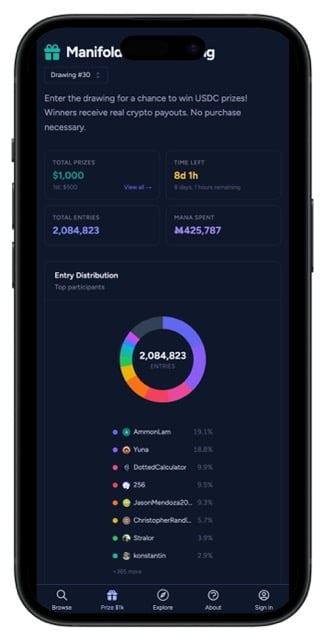
Manifold Markets App and Platform Review
Unlike a lot of the real-money platforms reviewed on this site, Manifold isn’t tucked inside a broader finance or sportsbook app.
It’s a standalone product built entirely around markets and forecasting, and that focus shows up in both how it looks and what it offers traders willing to dig past the basics.
Web and Mobile Experience
Manifold runs as a browser-based site plus iOS and Android apps, and the mobile experience mirrors the web version closely rather than trimming down features.
Both let you browse markets by category, place trades, and track your positions and Mana balance.
It’s a clean, functional interface built around discovery and trading rather than showing off advanced charting, and it doesn’t try to fix the core issue with any user-generated platform: market quality and resolution clarity vary a lot depending on who created the question.
Key Features for Traders
The standout feature for more technical users is Manifold’s public API, WebSocket feed, and bulk data access, which make it genuinely useful for building trading bots or pulling historical data for research, something none of the real-money platforms reviewed on this site offer as openly.
Manifold has also run a Creator Partner Program that pays qualifying market creators real cash based on trader engagement, rewarding people who consistently build popular, well-resolved markets (terms have shifted over time, so check Manifold’s own site for the current structure).
Add in leaderboards, a public Discord community, and league-style seasonal competition, and Manifold leans harder into community and creator tools than any exchange built around a single company’s own contract menu.
Manifold Markets Mana Shop: Buying More Mana
Say it plainly upfront: there is no cash-out path on Manifold. Mana cannot be redeemed for cash under any circumstances, whether you earned it from trading, quests, referrals, or bought it outright. Money only ever flows one direction here, from your card into Mana, never back.
If you burn through your starting balance and want to keep trading without waiting on quests and streaks, Manifold sells Mana in fixed packages, roughly M500 for $5, M2.5k for $25, M11k for $100, and M120k for $1,000 as of this writing, though exact tiers can shift over time. There’s also an optional membership subscription that multiplies quest rewards (1.5x on daily and weekly quests reported by subscribers), adds higher-leverage betting limits, cosmetic profile upgrades, and streak-freeze protection, on top of whatever Mana package you buy.
None of this is an investment in any sense a regulated platform would use that word. You’re paying for a better experience inside a game, not for anything that converts back to dollars later.
| Item | Price | What You Get |
|---|---|---|
| 🪙 Mana Package — Small | $5 | 500 Mana |
| 🪙 Mana Package — Medium | $25 | 2,500 Mana |
| 🪙 Mana Package — Large | $100 | 11,000 Mana |
| 🪙 Mana Package — XL | $1,000 | 120,000 Mana |
| ⭐ Plus Membership | Subscription (Mana-denominated; check site for current price) | Quest multiplier, streak-freeze protection, cosmetic upgrades, entry-level leverage boost |
| ⭐ Pro Membership | Subscription (Mana-denominated; check site for current price) | Higher quest multiplier and leverage limits than Plus, plus all Plus perks |
| ⭐ Premium Membership | Subscription (Mana-denominated; check site for current price) | Highest leverage limits and quest multiplier tier, plus all Pro perks |
| 💸 Cash Withdrawal | Not available | Mana can never be redeemed for cash under any circumstances |
Manifold Markets vs. The Competition
Manifold’s play-money model puts it in a different category than the other platforms we cover on this site, which all trade real money on CFTC-regulated infrastructure. If free Mana has you curious about what a real-money exchange actually offers, here’s what each of the major platforms brings to the table on its own terms.

Manifold vs. FanDuel Predicts
FanDuel Predicts is FanDuel’s dedicated prediction market app, launched through a partnership with CME Group and expanded in 2026 with a second contract source via Crypto.com’s OG Prediction Markets.
That gives it two distinct pools of event contracts to draw from rather than relying on a single exchange partner. The app covers sports, politics, and financial markets, structured the same way as most event contract platforms: buy “Yes” or “No” on an outcome, and the price reflects the market’s implied probability.
FanDuel Predicts is available to trade in all 50 states, though sports-specific contracts are limited to states where FanDuel doesn’t already run a licensed sportsbook. New users get a $25 trading bonus for signing up, kept walled off from any FanDuel Sportsbook or Casino wallet.
Get $100 in Predicts Bonus When You Trade $1 for 5 Days
Make Predictions on Real World Events Right in Your Phone
Trade on Sports to Culture, Financials, Crypto and More
Get $100 in Predicts Bonus When You Trade $1 for 5 Days
Make Predictions on Real World Events Right in Your Phone
Trade on Sports to Culture, Financials, Crypto and More
FanDuel Predicts Pros
- $25 Signup Bonus, No Deposit Required | New users get $25 in trading credit just for signing up, held in a wallet that's separate from any existing FanDuel Sportsbook or Casino balance.
- Sports Contracts in All 50 States | Unlike several competitors that carve out entire states, FanDuel Predicts is technically live nationwide, even though sports-specific contracts get pulled in states where FanDuel already runs a licensed sportsbook.
FanDuel Predicts Cons
- Only Three Categories So Far | Sports, politics, and financial markets is a narrower menu than rivals like Polymarket or Kalshi, which branch into culture, weather, and more.
- Bonus Can't Touch Your Sportsbook Balance | The $25 credit stays walled off from any existing FanDuel account balance, so even loyal FanDuel users are starting from scratch here.

Manifold vs. Polymarket
Polymarket built its reputation as one of the largest prediction markets in the world before it was even legal for most US traders to use directly.
That changed when Polymarket US, a CFTC-regulated Designated Contract Market, began onboarding US users in December 2025, and the platform has been expanding its domestic footprint since. Today it covers politics, sports, crypto, finance, culture, and breaking news, with prices that move in real time as people trade rather than sitting fixed until something changes.
Funding an account leans crypto-first, with deposits running through USDC and on-ramps like Coinbase and MoonPay depending on your account and location. Each market sets its own resolution rules and settlement source, so reading those carefully before buying a position matters more here than on platforms with a simpler, standardized rulebook.
Deposit $10, Get a $50 Trading Bonus
Live Trade with the Biggest Payouts at the Largest Prediction Market in the World
Deposit $10, Get a $50 Trading Bonus
Live Trade with the Biggest Payouts at the Largest Prediction Market in the World
Polymarket Pros
- Enormous Global Trading Volume | Polymarket built its reputation processing billions in volume on political and current-events markets years before most US traders could access it directly.
- No State-By-State Restrictions | Because Polymarket isn't tied to a sportsbook license, it doesn't carve out states the way sports-licensed competitors do.
Polymarket Cons
- Each Market Writes Its Own Rules | Resolution criteria and settlement sources are set market-by-market rather than following one standardized rulebook, so reading the fine print matters more here.
- US Product Is Brand New | Polymarket US only began onboarding domestic traders in December 2025, so it doesn't have the multi-year domestic track record older regulated exchanges do.

Manifold vs. DraftKings Predicts
DraftKings Predicts is DraftKings’ entry into event contract trading, running on DKeX, an exchange the company self-certified with the CFTC after acquiring Railbird, a prediction market exchange, to get into the category in the first place.

Manifold vs. Kalshi
Kalshi was the first CFTC-licensed event contract exchange in the country, and it’s still the backbone a lot of the industry runs on, with several other trading apps routing a portion of their event contracts through Kalshi’s exchange rather than building their own.

Manifold vs. Crypto.com
Crypto.com Predictions lives inside the main Crypto.com app, right alongside the crypto trading, cards, and other financial products the company is best known for.
Event contracts run through Crypto.com | Derivatives North America (CDNA), the CFTC-regulated entity that also supplies contracts to other partners in this space, including Underdog and FanDuel Predicts. Coverage spans sports, politics, and financial markets, with one notable exclusive: an entertainment tie-in with Hollywood.com that powers dedicated markets for the Oscars, the Grammys, and other awards shows and premieres.
Funding an account benefits from the same infrastructure Crypto.com already runs for its core exchange, including instant bank transfers and card deposits, along with SOC 2 compliance and cold storage backing the security side.
Complete a Task in the Crypto.com App to Unlock up to 1 Bitcoin Worth of CRO Rewards
America’s All-In-One Trading Platform
Manage Your Crypto, Stocks, Predictions & Card Spend Seamlessly
Complete a Task in the Crypto.com App to Unlock up to 1 Bitcoin Worth of CRO Rewards
America’s All-In-One Trading Platform
Manage Your Crypto, Stocks, Predictions & Card Spend Seamlessly
Crypto.com Pros
- Its Exchange Powers Other Platforms Too | Crypto.com | Derivatives North America, the CFTC-regulated entity behind Predictions, also supplies contracts to competitors like Underdog and FanDuel Predicts.
- Security Built for a Crypto Exchange | SOC 2 compliance and cold storage back the platform, a higher security bar than most single-purpose prediction apps publish.
Crypto.com Cons
- No Standalone App | Unlike OG, its own sister platform, Crypto.com Predictions has no dedicated app — you're using the full Crypto.com exchange app just to place a trade.
- Predictions Branding Is Still New | Even though the exchange behind it has powered contracts for multiple partners, Crypto.com's own-branded Predictions product doesn't have the track record of a dedicated single-purpose platform.

Manifold vs. OG
OG is Crypto.com’s standalone prediction market app, built and regulated separately from its sister platform, Crypto.com Predictions, as its own Designated Contract Market through Crypto.com Derivatives North America.
Rather than living inside a broader crypto exchange, OG is built purely around event contract trading, covering sports, politics, economics, crypto, and culture. OG leans harder into sports than its sister platform does, building out game winners, player props, and season-long outcomes alongside the standard politics and economics contracts.
Huge Range of CFTC-Approved Markets (Sports, Tech, and More)
Compete with Others & Climb the Leaderboards
No User Limiting on Trades
Huge Range of CFTC-Approved Markets (Sports, Tech, and More)
Compete with Others & Climb the Leaderboards
No User Limiting on Trades
OG Pros
- Independently Registered, Not Just a Feature | OG holds its own Designated Contract Market registration through Crypto.com Derivatives North America, rather than piggybacking on its sister platform's approval.
- Sports-First Market Design | Beyond standard game outcomes, OG builds out player props and season-long markets, a deeper sports menu than most compliance-first platforms bother building.
OG Cons
- Very Young Platform | Having launched in February 2026, OG is one of the newest entrants covered on this site, and that youth shows up in thinner trading volume on some markets.
- Smaller Footprint Than Its Sister App | Because Crypto.com Predictions already covers similar ground inside a much larger app, OG has to build its own audience from scratch rather than inheriting one.
Manifold Markets Customer Support
Manifold doesn’t run a live chat widget or a phone line. Support runs through email at help@manifold.markets for account issues, with separate addresses for privacy and data requests, plus a public FAQ and documentation site at docs.manifold.markets that covers most common questions upfront.
The more active support channel is Manifold’s public Discord server, where community moderators and Manifold staff answer questions, take bug reports, and field requests to fix a mis-resolved market. It’s a community-driven model rather than a traditional support ticket queue, which fits a platform built around user-generated markets in the first place.
| Support Channel | Details |
|---|---|
| 📩 Email Support | help@manifold.markets for account issues, with separate addresses for privacy (privacy@manifold.markets) and commercial data requests (data@manifold.markets) |
| 💬 Discord Community | Manifold's public Discord server, where community moderators and staff answer questions, take bug reports, and field requests to fix a mis-resolved market |
| 📚 Docs & Help Center | Self-serve documentation at docs.manifold.markets covering account setup, Mana, verification, and trading mechanics |
| 🏷️ In-Market Moderation | Tag @mods in a comment on any market to flag a resolution dispute or other issue directly where it happened |
| 🚫 No Live Chat or Phone Line | Support runs asynchronously through email and community channels — there's no real-time chat widget or phone number to call |
Manifold Markets Pros and Cons
After working through Manifold’s signup flow, placing trades across a handful of categories, and digging into how the Mana economy actually works, a few things stand out clearly, for better and worse. Here’s the honest breakdown.
Manifold Markets Pros
- Zero Financial Risk to Trade | Every market runs on free Mana, so you can trade as much as you want without ever risking real money, a rare setup among the platforms reviewed on this site.
- Anyone Can Create a Market | The user-generated model means a question you can't find anywhere else, from a niche AI benchmark to a private bet with friends, can go live in minutes.
- Genuinely Open Data Access | A public API, WebSocket feed, and bulk data exports give technical users a level of access none of the real-money exchanges on this site offer.
Manifold Markets Cons
- No Cash-Out, Ever | Mana can't be redeemed for cash under any circumstances, so there's no way to turn a good trading record into real money.
- Market Quality Varies | Because anyone can create a market, resolution clarity and question quality depend entirely on who wrote it, unlike a regulated exchange where every contract goes through an approval process.
- Support Is Community-First | There's no live chat or phone line, so getting a quick answer to an account issue often means posting in Discord and waiting on a volunteer moderator or staff member.
Healthy Use on Manifold Markets
Because every market runs on Mana instead of real money, trading on Manifold doesn’t carry the financial risk that comes with a real-money exchange. That doesn’t mean there’s nothing to be mindful of. Daily streaks, quest multipliers, and referral bonuses are all designed to bring you back to the app regularly, and it’s worth noticing if checking Manifold starts to feel more like a habit than a hobby.
The one place actual money enters the picture is the optional Mana shop and membership subscription. Treat that the same way you’d treat any other in-app purchase: set a budget you’re comfortable with before you buy, and remember that Mana packages and subscription perks improve your experience inside the game, not your finances outside it.
- Set a Personal Spending Cap: If you plan to buy Mana or subscribe for the leverage and quest perks, decide on a monthly limit ahead of time rather than topping up on impulse.
- Watch for Compulsive Checking: Streaks and daily quests are built to pull you back into the app. If tracking them starts to feel obligatory rather than fun, that’s worth stepping back from.
- Remember It’s Play Money: Mana has no cash value and never converts to real money, so treat wins and losses on the platform as entertainment, not financial outcomes.
Manifold Markets Review: Final Verdict
Manifold Markets isn’t trying to be another CFTC-regulated exchange, and it shouldn’t be judged like one. It’s a free, play-money forecasting platform where anyone can create a market, and that openness produces a category list, especially in AI, technology, and internet culture, that no real-money competitor comes close to matching. If you want to trade actual dollars on sports, politics, or crypto outcomes, Kalshi or Polymarket are better fits. But for forecasting practice, niche questions you won’t find anywhere else, or just seeing how good your predictions really are with zero financial downside, Manifold delivers something genuinely different from everything else covered in our prediction markets guide.
- 🎲 Zero financial risk to trade: Every market runs on free Mana, so you can trade as much as you want without risking real money.
- 🌐 The widest question variety we’ve reviewed: User-generated markets mean niche topics, especially in AI and tech, that no real-money exchange offers.
- 🔓 Genuinely open for builders: A public API, WebSocket feed, and bulk data access make Manifold useful well beyond placing individual trades.
- 🚫 No path to real money: Mana can’t be cashed out under any circumstances, so there’s no financial upside to a strong trading record.
- 💬 Community-first support: Discord and documentation stand in for live chat or phone support, which fits the platform’s grassroots feel but won’t suit everyone.
Manifold Markets FAQs
Yes, but not in the same way a regulated exchange is. Manifold isn’t registered with the CFTC and doesn’t offer real-money contracts at all, trading only in Mana, a play-money currency with no cash value. That’s a deliberate design choice that keeps it outside the regulatory framework real-money platforms like Kalshi and Polymarket operate under.
No promo code is needed. New accounts get roughly 100 Mana just for signing up, another 500 for verifying your phone, email, and date of birth, and a final 400 for placing your first trade, for 1,000 Mana total, all automatically.
Either works. Manifold runs as a full-featured browser-based site plus iOS and Android apps, and the mobile experience mirrors the web version closely rather than trimming down features.
None. Every new account starts with free Mana just for signing up, and there’s no real money required to open an account or place a trade, ever.
No. There’s no KYC requirement for normal use, and you can sign up and start trading with Mana without uploading a government ID. Verifying your phone number, email, and date of birth is optional and simply unlocks bonus Mana.
There’s no fixed country whitelist. Manifold is broadly accessible worldwide, though access still depends on local law, so it’s worth checking the rules where you live before signing up.
Nothing. There are no trading fees on bets themselves. The real cost to watch for is slippage on thin, lightly traded markets, where even a modest bet can move the price against you.
No. Mana has no cash value and can’t be redeemed for real money under any circumstances, whether you earned it from trading, quests, referrals, or bought it outright.
You can’t. There is no cash-out path on Manifold. Money only ever flows one direction, from your card into Mana if you choose to buy more, never back out as cash.
It depends on how often you trade and create markets. The subscription multiplies quest rewards, raises your leverage limits, and adds streak-freeze protection and cosmetic upgrades, but it’s an optional purchase that improves your experience inside the game rather than anything with a financial return.

