
 Share



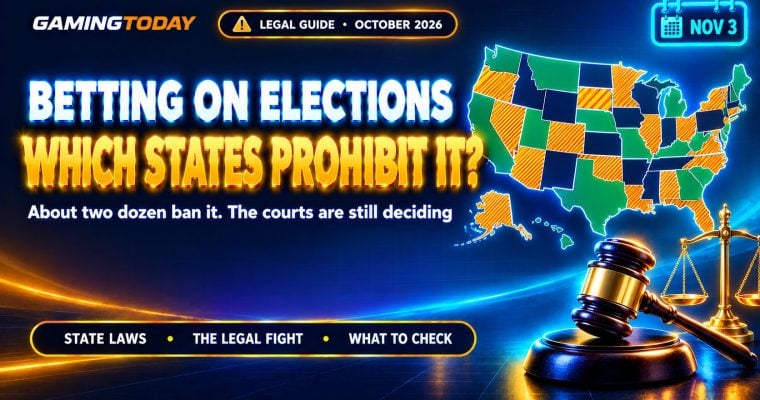
About two dozen states ban election betting outright, and Wisconsin’s election commission has warned that betting on an election and voting in it could be a felony. Prediction markets say their contracts are not bets at all, and that argument is now being tested in court.
Deposit $10, Get a $25 Trading Bonus
Live Trade with the Biggest Payouts at the Largest Prediction Market in the World
Deposit $10, Get a $25 Trading Bonus
Live Trade with the Biggest Payouts at the Largest Prediction Market in the World
Get $200 in Bonuses Paid Over 21 Days
Plus 3 Months of NBA League Pass on DraftKings
Browse Markets like Sports, Crypto, Tech & More
Get $200 in Bonuses Paid Over 21 Days
Plus 3 Months of NBA League Pass on DraftKings
Browse Markets like Sports, Crypto, Tech & More
Here is where election betting stands in October 2026: which states prohibit it, what is being challenged, what a new poll found, and what readers should check before they trade anything.
Trade on Sports, Politics, and MORE
Largest Prediction Market in the US
Hundreds of Markets to Choose From
Trade on Sports, Politics, and MORE
Largest Prediction Market in the US
Hundreds of Markets to Choose From
This is general information, not legal advice. Laws are changing and their application to prediction markets is disputed. Check your own state’s law.
The Short Answer
- Roughly two dozen states prohibit betting on election outcomes, according to National Conference of State Legislatures data.
- Eighteen states have no law on election betting.
- Prediction markets argue they offer swaps or exchanges regulated by the federal CFTC, not betting, and so fall outside those state laws.
- States and election officials in several places say the laws apply, and some have taken legal action.
- The question is unsettled and is expected to reach the Supreme Court.
States That Prohibit Election Betting
Nexstar, citing NCSL data, names these 24 states as having blanket prohibitions on election betting:
| Region | States |
|---|---|
| West and Mountain | Idaho, Nevada, Utah, Arizona, Colorado |
| Plains and Southwest | Nebraska, Oklahoma, Texas, Iowa, Arkansas, Louisiana |
| Midwest | Illinois, Michigan |
| South | Tennessee, Mississippi, Georgia, South Carolina, North Carolina, West Virginia |
| Mid-Atlantic and Northeast | Maryland, Delaware, New Jersey, Pennsylvania, Rhode Island |
Other states restrict election betting in some circumstances, which is why counts differ. A Pew Research Center analysis of NCSL data in June counted 23 states that ban election betting entirely. Pew’s headline finding was that more than half of states restrict election betting in at least some circumstances.
States With No Election Betting Law
According to NCSL, these 18 states do not have a specific prohibition: Alaska, Hawaii, California, Washington, Montana, Wyoming, New Mexico, Kansas, Missouri, Ohio, Kentucky, Virginia, Alabama, Florida, Connecticut, Maine, Vermont and New Hampshire.
No law on election betting does not mean it is allowed. Some states have broader gambling rules that officials say cover it, and Kentucky has since acted against political prediction markets in other ways.
The Legal Fight in Brief
| Development | What happened |
|---|---|
| The platforms’ argument | Contracts are swaps or exchanges under federal commodities law, so state betting bans do not apply |
| Minnesota, May 2026 | Became the first state to ban prediction markets. A federal judge halted the ban before it took effect, after the CFTC, Kalshi and Polymarket sued, finding federal law likely preempts it |
| Arizona and Kentucky | Have taken legal action against prediction market companies for allegedly violating state laws against election betting |
| Wisconsin, July | The election commission warned voters that betting on an election and voting in it could lead to a felony charge |
| Maryland | The state elections administrator said election contracts violate the plain meaning of the state’s ban |
| States and the CFTC | 39 states and the District of Columbia reportedly filed an amicus brief on 8 October describing a “national turf war” that only the Supreme Court can resolve |
A federal bill introduced in March, the STOP Corrupt Bets Act, would prohibit prediction market betting on elections and other events. It has not advanced beyond committee.
What Americans Think
A Reuters/Ipsos poll released on 12 October found that most Americans oppose betting on elections through prediction markets.
| Response | Share |
|---|---|
| Oppose | 60% |
| Support | 13% |
| Unsure | 24% |
| Democrats opposed | 69% |
| Republicans opposed | 61% |
The poll surveyed 4,506 US adults. Kalshi called it biased, saying it asked leading questions, and noted that it does not offer markets on war. Ipsos’s pollster said most respondents view prediction markets as a form of gambling and do not see elections as an appropriate subject.
The Ethics Debate
- Election officials’ concerns. Some say prediction sites could create new avenues for disinformation about voter fraud and weaken confidence in elections. One North Carolina county elections director called it “something we have to live with”.
- Insiders. Kalshi blocks election trades by politicians and campaign workers and has suspended a handful of candidates for betting on their own races. Former Representative George Santos agreed to pay $35,000 to settle CFTC allegations over trades on whether he would attend the State of the Union.
- Young people. A WFAE Charlotte Talks discussion this week covered the ethical questions raised by election betting and youth engagement with it.
- The platforms’ case. Kalshi and Polymarket say their markets give people unbiased, accurate information.
What This Means for Readers
- Reading odds is not the same as trading. Following prediction market prices for information carries no legal question. Trading on elections may.
- Check your state before trading. If you live in one of the 24 states above, election betting may be prohibited for you.
- Mind the voting rule in Wisconsin. Officials say you cannot legally bet on an election and cast a ballot in it.
- Expect change. Court rulings can alter the picture quickly. A ruling this week may not apply next month.
- Remember the risk. Prediction markets are not sportsbooks and you can lose your whole stake.
For what prices currently say, see our guide to prediction market odds for the midterm 2026 election. For how much is being traded, see our trading volume report.
Frequently Asked Questions
Is it legal to bet on elections?
It depends on the state. About two dozen states prohibit election betting under existing law, and 18 have no specific law. Whether those laws apply to prediction markets is disputed and being decided in the courts.
Which states ban election betting?
According to NCSL data cited by Nexstar: Idaho, Nevada, Utah, Arizona, Colorado, Nebraska, Oklahoma, Texas, Iowa, Arkansas, Louisiana, Illinois, Michigan, Tennessee, Mississippi, Georgia, South Carolina, North Carolina, West Virginia, Maryland, Delaware, New Jersey, Pennsylvania and Rhode Island.
Are prediction markets betting?
The platforms say no. They describe their contracts as swaps or exchanges under federal law. Several states say yes, and the Supreme Court is expected to be asked to decide.
Can you get in trouble for betting on an election and voting?
Wisconsin election officials say you cannot legally make a bet on an election and cast a ballot in it, and that doing so could lead to a felony charge. Rules differ by state.
What does the public think of election betting?
A Reuters/Ipsos poll released on 12 October found 60% oppose it, 13% support it and 24% are unsure.
Is this legal advice?
No. It is general information. Check your own state’s law or speak to a lawyer.
This article is general information and is not legal, financial or voting advice. Laws change and their application to prediction markets is disputed. Prediction markets are not sportsbooks. Event contract trading involves significant risk and is not appropriate for everyone. You can lose your entire stake. Platforms are typically 18+ and are not available in all states, and some states prohibit betting on elections. GamingToday does not endorse any candidate or party. If gambling or trading stops being fun, call 1-800-GAMBLER for confidential support.