
Coinbase Predictions Review





- One Login, Two Markets | Your existing Coinbase account, verification, and balance carry straight over — there's no separate predictions sign-up, app download, or new KYC step to trade your first contract.
- Kalshi-Grade Market Menu | Because contracts route through Kalshi's exchange, the category list (politics, sports, economics, crypto, entertainment, weather, and more) matches one of the deepest regulated prediction markets in the U.S., not a stripped-down in-app version.
- Funding Flexibility Crypto Traders Already Have | ACH, wire, debit card, and crypto transfers all work from a wallet most users have already funded, so there's no need to open a new bank link just to start trading events.
Coinbase has folded event contract trading directly into its main crypto app, letting the exchange’s existing users buy and sell Yes/No and multi-outcome contracts on politics, sports, economics, and pop culture from the same account they already use to hold crypto. The contracts themselves trade on Kalshi’s CFTC-regulated exchange, with Coinbase simply acting as the on-ramp.
That said, we don’t recommend Coinbase Predictions right now. There’s no dedicated welcome bonus or promo code for the predictions product, unlike several rivals in this space, and Coinbase’s own bonuses and promotions score is its weakest category. On top of that, trades route through Kalshi at a markup, with at least one documented example running roughly 25% higher than the same trade placed directly on Kalshi, and the app only supports market orders with no visible order book or price history to judge whether you’re getting a fair price. Convenience is the real draw here, not value, and that isn’t enough to clear the bar we hold prediction market platforms to.
Here are the prediction market sites we do recommend in September 2026:
Get $100 in Predicts Bonus When You Trade $1 for 5 Days
Make Predictions on Real World Events Right in Your Phone
Trade on Sports to Culture, Financials, Crypto and More
Get $100 in Predicts Bonus When You Trade $1 for 5 Days
Make Predictions on Real World Events Right in Your Phone
Trade on Sports to Culture, Financials, Crypto and More
Huge Range of CFTC-Approved Markets (Sports, Tech, and More)
Compete with Others & Climb the Leaderboards
No User Limiting on Trades
Huge Range of CFTC-Approved Markets (Sports, Tech, and More)
Compete with Others & Climb the Leaderboards
No User Limiting on Trades
Deposit $10, Get a $50 Trading Bonus
Live Trade with the Biggest Payouts at the Largest Prediction Market in the World
Deposit $10, Get a $50 Trading Bonus
Live Trade with the Biggest Payouts at the Largest Prediction Market in the World
America's #1 Sports Prediction Market
Same Sports Moments, Bigger Payouts
Choose from Straights, Player Props, Parlays & More
America's #1 Sports Prediction Market
Same Sports Moments, Bigger Payouts
Choose from Straights, Player Props, Parlays & More
Get $150 in Bonuses Paid Over 14 Days
DraftKings is Now Available Nationwide
Browse Markets like Sports, Crypto, Tech & More
Get $150 in Bonuses Paid Over 14 Days
DraftKings is Now Available Nationwide
Browse Markets like Sports, Crypto, Tech & More
Complete a Task in the Crypto.com App to Unlock up to 1 Bitcoin Worth of CRO Rewards
America’s All-In-One Trading Platform
Manage Your Crypto, Stocks, Predictions & Card Spend Seamlessly
Complete a Task in the Crypto.com App to Unlock up to 1 Bitcoin Worth of CRO Rewards
America’s All-In-One Trading Platform
Manage Your Crypto, Stocks, Predictions & Card Spend Seamlessly
Coinbase Predictions Bonus and Promo Code for September 2026
Coinbase built its name on crypto trading, and it’s folded event-contract trading directly into that same app. Coinbase Predictions (also called “Coinbase Predict”) lets the exchange’s tens of millions of existing users buy and sell Yes/No and multi-outcome contracts on sports, politics, economics, and pop culture, all from the account they already use to hold Bitcoin. The contracts themselves trade on Kalshi’s CFTC-regulated exchange, Coinbase is simply the on-ramp. Below, we break down what that structure means for fees, funding, and whether it’s worth trading predictions here instead of going straight to Kalshi or another venue in our prediction markets hub.
Unlike several rivals in this space, Coinbase doesn’t run a dedicated welcome bonus for its predictions product. There’s no “deposit $X, get $Y in trading credit” offer, and no promo code to enter anywhere in the predictions flow. If you’re specifically shopping for a first-trade bonus, Polymarket and FanDuel Predicts both currently have one, see our full prediction markets comparison for the latest terms.
What About Coinbase’s General Sign-Up Offer?
New Coinbase customers can still qualify for the exchange’s standard crypto welcome offer: a spin on a prize wheel for a random Bitcoin bonus after a qualifying crypto purchase, typically $30 to $100, with a small chance at a bigger payout. Two things to know here. First, that offer requires an actual crypto purchase made with a funding method like a card or bank transfer, not just moving existing assets in. Second, and more importantly, prediction trades don’t count toward it. Funding a predictions position alone won’t trigger or advance the crypto bonus, so treat the two products as separate ledgers if you’re chasing any promotional credit.
So Why Trade Predictions on Coinbase at All?
Without a bonus to lean on, the pitch here is convenience and market depth rather than free money. Since contracts route through Kalshi’s exchange, you get access to the same regulated categories covered in our prediction markets guide, without opening a second account, re-verifying your identity, or linking a new bank. For traders who already hold crypto on Coinbase and want to dip into event contracts occasionally, that single-login convenience is the real draw, not a signup credit.
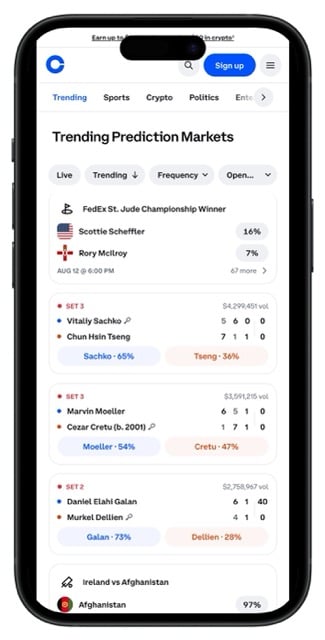
What Is Coinbase Predictions? Prediction Market Explained
Coinbase Predictions is the event-contract trading feature built into the main Coinbase app and website. Rather than standing up its own order book, Coinbase partnered with Kalshi — a CFTC-regulated exchange — so that when you place a trade in the Coinbase interface, it’s actually executing on Kalshi’s market. Coinbase’s own regulated entity, Coinbase Financial Markets (CFM), is registered with the CFTC as a futures commission merchant and holds NFA membership, which lets it legally introduce customer orders into that exchange. If you want the mechanics of event contracts spelled out from first principles, our prediction markets guide walks through how contract pricing reflects probability.
How Coinbase Predictions Contracts Work
Every market on Coinbase Predictions is built around a yes/no (or multi-outcome) question with a defined resolution date — “Will the Fed cut rates in September?” or “Will [Team] win the game?” Contracts trade between $0.01 and $0.99, and that price is a running estimate of the market’s probability: a contract trading at $0.65 implies traders collectively see roughly a 65% chance of that outcome. Buy the side you think is underpriced, and if you’re right, each contract settles at $1; if you’re wrong, it settles at $0. You can also close a position early by selling back into the market before resolution, locking in a gain or loss rather than riding it to settlement.
So What’s Attractive About Coinbase Predictions?
The single biggest draw is that it removes a step. Millions of people already have a verified Coinbase account sitting on their phone; Predictions turns on inside that same app rather than asking them to download something new, re-run KYC, or link a fresh bank account. Add in that the underlying market is Kalshi’s — one of the broader regulated prediction venues in the U.S., covering everything from politics to sports — and you get a fairly deep product bolted onto an interface a lot of people already trust for something else entirely.
Here’s the whole product at a glance before we get into the details:
| Detail | Info |
|---|---|
| 🏢 Operator | Coinbase Predictions, via Coinbase Financial Markets (CFM) |
| 🔗 Exchange Partner | Kalshi (CFTC-designated contract market) |
| 🏛️ Regulator | CFTC / NFA (CFM is a registered futures commission merchant) |
| 📅 Rollout Date | Announced December 2025; live to all U.S. users by January 28, 2026 (as of this writing) |
| 🎁 Welcome Offer | None specific to predictions as of this writing |
| 🏷️ Promo Code | Not applicable — no dedicated code |
| 💵 Minimum Trade | $1 per contract |
| 📈 Contract Price Range | $0.01–$0.99 |
| 🪪 Account Verification | Full Coinbase KYC: government ID, SSN/TIN, financial background review |
| 🔞 Minimum Age | 18+ |
| 🗺️ Eligible States | 49 states + D.C. (Nevada excluded); some categories restricted state-by-state |
| 🗂️ Markets Offered | Politics, sports, economics, crypto, entertainment, weather, science & tech, financials |
| 📄 Contract Types | Binary (Yes/No), multi-outcome, range contracts |
| 🖱️ Order Types | Market orders only, as of this writing |
| 💳 Payment Methods | ACH, wire, debit card, Apple Pay, PayPal, crypto transfer, Coinbase gift card |
| 💰 Trading Fees | Not publicly disclosed as a flat schedule; shown per-trade at order preview |
| 🕒 Withdrawal Timing | Predictions balance auto-sweeps to main balance every 2 hours, 6am–4pm ET, business days only |
| 📱 Platform Access | iOS, Android, Web |
| ☎️ Customer Support | General Coinbase support: 24/7 phone, AI chat, help center, social |
Is Coinbase Predictions Legit and Where Is It Available?
Coinbase is a publicly traded company (Nasdaq: COIN) and one of the most heavily scrutinized crypto exchanges in the country, and it extended that same regulated posture to Predictions rather than launching an offshore-style betting product. That said, “legit” here means something specific — it means the contracts trade on a federally regulated exchange, not that the product is a casual sportsbook clone. Understanding that distinction matters for how you should think about the difference between prediction markets and sports betting before you fund an account.
Regulation and Oversight
Coinbase Predictions is offered through Coinbase Financial Markets, a CFTC-registered futures commission merchant and NFA member. CFM doesn’t operate its own exchange for these contracts — it routes orders to Kalshi, which holds its own CFTC designation as a contract market. In practice that means two layers of federal oversight sit between you and the trade: Coinbase’s broker registration and Kalshi’s exchange designation. It’s the same regulatory logic used by Kalshi itself and by other CFTC-pathway operators like Crypto.com and OG, rather than the state-by-state gaming licenses that govern traditional sportsbooks.
How Your Funds Are Protected
Money you deposit specifically for predictions trading sits in a separate ledger from your crypto holdings, and Coinbase’s standard account security — two-factor authentication, device management, and its broader custody practices — applies across both. As with any CFTC-regulated venue, customer funds used for trading are subject to segregation requirements distinct from how a casino or unregulated offshore book would (or wouldn’t) hold customer money.
Where Is Coinbase Predictions Available?
As of this writing, Coinbase Predictions is available to eligible U.S. customers 18 and older in 49 states, with Nevada excluded. Availability can still vary by specific market category — some political or sports contracts may be paused or geofenced in individual states pending regulatory review, a dynamic that has affected multiple CFTC-pathway operators (including Kalshi directly) in states such as Connecticut, Illinois, and Michigan at various points. Always check the in-app eligibility notice for your state and the specific market before assuming a contract is tradeable where you live.
How to Get Started on Coinbase Predictions
Because Predictions lives inside the main Coinbase app, getting started is mostly a matter of turning on a feature rather than building a new account from zero — unless you're new to Coinbase entirely, in which case you'll go through the exchange's standard onboarding first.
Open or Log Into Your Coinbase Account
If you already trade crypto on Coinbase, your existing login, verified identity, and 2FA setup carry over automatically — there’s no separate predictions account to create. New users will need to sign up and complete Coinbase’s standard identity verification, which includes government ID checks and, for full account access, an SSN or TIN and basic financial background information.
Find the Predictions Tab
Once logged in, Predictions appears as its own section within the app (iOS and Android) or on the web, separate from the main crypto trading and portfolio views. First-time visitors typically see a short in-app explainer on how contracts and pricing work before their first trade.
Fund Your Predictions Balance
Predictions trading draws from a distinct balance rather than your main USD or crypto wallet. You can move funds in via ACH transfer, wire, debit card, Apple Pay, PayPal, a Coinbase gift card, or crypto conversion — see the payment methods table further down this page for fees and timing on each. A $1 minimum applies at the contract level, so you don’t need much capital to place a first trade.
Browse and Select a Market
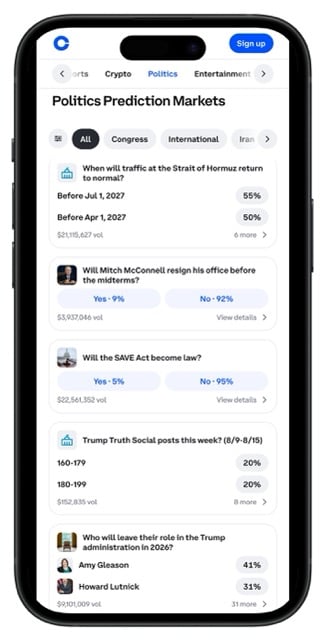
From there, browsing works much like Coinbase’s crypto markets screen: categories across politics, sports, economics, crypto, and entertainment, each showing live contract pricing. Once you’ve found a question you have a view on, you’re ready to place your first trade — covered in detail in the next section.
How to Place a Trade on Coinbase Predictions
Placing a trade on Coinbase Predictions is a short flow, but a couple of details — order types and fee visibility — are worth understanding before you commit money, especially if you’ve traded on a more advanced venue like Kalshi directly.
Place Your First Trade
Open a market, choose Yes or No (or the specific outcome, for multi-outcome contracts), and enter how many contracts you want at the displayed price. The app shows an order preview with your total cost and the fee before you confirm — that preview screen is currently the only place Coinbase discloses the exact fee for a given trade, since there’s no published flat-rate fee schedule. Confirm the order and it executes against Kalshi’s order book.
Order Types and Limitations
As of this writing, Coinbase Predictions supports market orders only — you’re taking whatever price is currently available rather than setting a limit price and waiting for it to fill. There’s also no visible full order book or price-history chart in the app the way there is on Kalshi’s own site, which makes it harder to judge whether the price you’re getting is favorable versus recent trading activity. If order-book depth and limit orders matter to your strategy, trading directly on Kalshi may be the better fit — our prediction market strategies guide covers why order type and price transparency matter for tactics like value trading and arbitrage.
Coinbase Predictions Trading Fees and Pricing
Coinbase doesn’t publish a public fee schedule for Predictions the way some competitors do; fees are disclosed per-trade on the order preview and appear to include both Kalshi’s underlying exchange fee and a Coinbase markup on top. In at least one documented example, a small order carried an effective fee in the high-2% range — reportedly around 25% more than the equivalent trade placed directly on Kalshi. Because fee structures like this can shift, always check the order preview for the actual cost before confirming, and don’t assume the rate you paid last month still applies today.
What Markets Can You Trade on Coinbase Predictions?
Because Coinbase Predictions routes into Kalshi’s exchange, the category list is broad for an in-app feature rather than a narrow, hand-picked slice — spanning politics, sports, the economy, crypto, and pop culture. The table below summarizes the main categories; the sections after it dig into a few of the categories traders ask about most.
| Category | Example Markets |
|---|---|
| 🏈 Sports | NFL, NBA, MLB, NHL, and soccer game winners, spreads, and player/team props |
| 🗳️ Politics & Elections | National and state election outcomes, confirmation votes, legislative decisions |
| 📊 Economics | Federal Reserve rate decisions, CPI inflation prints, monthly jobs reports |
| ₿ Crypto | Bitcoin and Ethereum price targets, industry and regulatory milestones |
| 🎬 Entertainment & Pop Culture | Awards show winners, box office milestones, celebrity and media events |
| 🌤️ Weather | Storm tracks, seasonal temperature and precipitation records |
| 🔬 Science & Technology | Product launch timing, space and research milestones |
| 🏢 Financials & Companies | Corporate earnings outcomes, business and leadership events |
Sports
Sports contracts cover major U.S. leagues — NFL, NBA, MLB, NHL — plus soccer and other recurring events, typically framed around game winners, point totals, or season-long outcomes. Depth varies by sport and by state, since sports contracts are one of the categories most exposed to the ongoing state-by-state regulatory disputes affecting CFTC-pathway operators. See our sports prediction markets guide for how this category compares across platforms.
Politics and Elections
Election and legislative outcomes are one of the categories Kalshi built its reputation on, and that depth carries over into Coinbase’s version — from national election contracts to narrower questions about confirmation votes or policy decisions. Our politics prediction markets page tracks how these compare across the regulated venues.
Economics
Macro contracts — Federal Reserve rate decisions, CPI inflation prints, jobs reports — let traders take a position on data releases well before they’re published. This is a category where prediction markets genuinely function like financial instruments rather than betting products; our economy prediction markets coverage compares these contracts against traditional benchmarks like CME FedWatch.
Crypto
Given Coinbase’s core business, crypto-linked contracts are a natural fit — short-term and year-end price-target questions on assets like Bitcoin and Ethereum, along with occasional contracts tied to industry events. It’s one of the few categories where Coinbase’s own market data and user base give it a genuine home-field advantage over rivals offering the same underlying Kalshi contracts.
Entertainment and Pop Culture
Awards shows, box office milestones, and other cultural moments round out the category list, alongside occasional weather and science/technology contracts. These markets tend to be lower-volume than sports or politics, so check liquidity before sizing a position — our pop-culture prediction markets page rounds up what’s currently trading across platforms.
Coinbase Predictions App and Platform Review
Because Predictions lives inside an existing, mature app rather than being built as a standalone product, the overall experience feels more polished than many newer prediction market apps, aside from a few rough edges tied to how the feature was bolted on.
Web and Mobile Experience
Coinbase Predictions is available on iOS, Android, and the Coinbase website, all using the same account and login as the exchange’s crypto products. Markets load quickly, and pricing updates in close to real time. The most commonly cited friction point is search. The in-app search tool pulls from Coinbase’s full catalog of crypto assets and prediction markets together, and it can jump to conclusions about search intent, so a search for a team or ticker doesn’t always surface the prediction market you’re looking for on the first try.
Key Features for Traders
The interface favors simplicity, with clean category browsing, a straightforward buy Yes/No flow, and an order preview that shows your total cost before you confirm. What it doesn’t currently offer is the deeper toolkit some dedicated prediction market traders expect: no limit orders, no visible full order book, and no advanced charting. If that matters to your trading style, it’s worth reading how the experience compares on platforms built specifically around order-book depth, like Polymarket or Kalshi.
One Portfolio, Two Products
Because predictions and crypto sit inside the same app, your positions show up alongside your crypto holdings instead of being tucked into a section you have to dig for, which is a genuine convenience if you’re already checking your Coinbase balance daily. The tradeoff is that predictions and crypto use separate internal balances even though they share one login, which is worth understanding before you fund an account (more on that in the payment methods section below).
Coinbase Predictions Payment Methods: Deposits and Withdrawals
Funding a Coinbase Predictions account works differently from funding a pure crypto trade, because predictions money sits in its own internal balance. The table below covers the main funding options and their costs; the sections after it explain how getting money back out actually works, which has one quirk worth knowing before you deposit.
| Method | Deposit Fee | Deposit Time | Withdrawal Fee | Withdrawal Time |
|---|---|---|---|---|
| 🏦 ACH Bank Transfer | Free | 1–5 business days | Free | 1–5 business days |
| 🔌 Wire Transfer | $10 | 1–3 business days | Free | 1–3 business days |
| 💳 Debit Card / Apple Pay / PayPal | ~3.99% | Instant | Not supported for withdrawal | — |
| ₿ Crypto Transfer | Network fee only (typically free) | Instant to ~1 hour | Network fee only | Varies by network |
| 🎁 Coinbase Gift Card | Free | Instant | Not supported | — |
| ⏱️ Predictions Balance Sweep | N/A | N/A | N/A | Every 2 hours, 6am–4pm ET, business days only, before standard withdrawal timing applies |
Funding Your Predictions Balance
ACH bank transfers are free and typically the cheapest way to fund an account, though they can take one to five business days to clear. Wire transfers post faster (one to three business days) but carry a flat fee. Debit card, Apple Pay, and PayPal deposits post instantly but carry the steepest percentage-based fee of the available methods, and crypto transfers from an existing Coinbase balance are generally fee-free aside from standard network costs. A Coinbase gift card, where applicable, funds instantly at no cost.
Withdrawals and Hold Periods
This is the one structural quirk worth flagging clearly: you can’t withdraw straight out of your predictions balance on demand. Funds first auto-transfer from the predictions ledger back to your main Coinbase account balance — as of this writing, that sweep runs every two hours between 6 a.m. and 4 p.m. ET on U.S. business days only, with no transfers overnight, on weekends, or on holidays. Once the money lands in your main Coinbase balance, standard Coinbase withdrawal rules and timing apply from there (typically one to five business days via ACH, or one to three business days via wire). In practice, that means a Friday-evening close-out of a position might not actually reach your bank until the following week — plan around that timing if you’re counting on quick access to winnings.
Coinbase Predictions vs. The Competition
Coinbase isn’t the only regulated on-ramp into event-contract trading, and it isn’t even the only one built on top of Kalshi’s exchange. Here’s how six other prediction-market platforms stack up on their own terms — worth a look before you decide where to put your first trade.
FanDuel Predicts
FanDuel Predicts brings event-contract trading to the millions of existing FanDuel sportsbook and daily-fantasy users, operating as a registered derivatives marketplace tied to CME Group under CFTC oversight. Its lineup leans hard into sports — pro football, basketball, hockey, golf, and tennis — alongside financial and economic contracts, and its wallet is deliberately kept separate from FanDuel’s sportsbook balance.
Get $100 in Predicts Bonus When You Trade $1 for 5 Days
Make Predictions on Real World Events Right in Your Phone
Trade on Sports to Culture, Financials, Crypto and More
Get $100 in Predicts Bonus When You Trade $1 for 5 Days
Make Predictions on Real World Events Right in Your Phone
Trade on Sports to Culture, Financials, Crypto and More
Polymarket
Polymarket built its reputation as a crypto-native, largely unregulated market before relaunching in the U.S. as a CFTC-regulated Designated Contract Market. It remains funded primarily through crypto transfers rather than traditional banking rails, and its market list — politics, sports, culture, finance, and breaking news — tends to react fastest to live events of any platform in this comparison.
Deposit $10, Get a $50 Trading Bonus
Live Trade with the Biggest Payouts at the Largest Prediction Market in the World
Deposit $10, Get a $50 Trading Bonus
Live Trade with the Biggest Payouts at the Largest Prediction Market in the World
DraftKings Predictions
DraftKings runs its event contracts through its own self-certified exchange, DKeX, under CFTC oversight and NFA membership — giving existing DraftKings Sportsbook, casino, and DFS users a single login across all three products, even though balances stay separate. Its standout feature is Combos, which bundles multiple contracts into a parlay-style structure that will feel immediately familiar to sports bettors.
Get $150 in Bonuses Paid Over 14 Days
DraftKings is Now Available Nationwide
Browse Markets like Sports, Crypto, Tech & More
Get $150 in Bonuses Paid Over 14 Days
DraftKings is Now Available Nationwide
Browse Markets like Sports, Crypto, Tech & More
Kalshi
Kalshi is the exchange several other platforms in this comparison quietly build on top of, and trading directly with it cuts out any intermediary markup. It holds its own CFTC designation as the first federally regulated prediction market in the U.S., with a deep category list spanning politics, sports, crypto, economics, and entertainment, plus a $1 minimum deposit that makes it accessible to small accounts.
Crypto.com
Crypto.com Predictions runs through Crypto.com | Derivatives North America, a CFTC-regulated exchange available in 49 states, and it markets itself on tight integration with the broader Crypto.com app — instant crypto-to-USD conversion and a unified portfolio view. Its fee structure is tiered by contract size, with reduced or waived settlement fees for winning positions.
Complete a Task in the Crypto.com App to Unlock up to 1 Bitcoin Worth of CRO Rewards
America’s All-In-One Trading Platform
Manage Your Crypto, Stocks, Predictions & Card Spend Seamlessly
Complete a Task in the Crypto.com App to Unlock up to 1 Bitcoin Worth of CRO Rewards
America’s All-In-One Trading Platform
Manage Your Crypto, Stocks, Predictions & Card Spend Seamlessly
OG.com
OG is a newer, federally regulated exchange created by Crypto.com, positioned as a leaner, more transparent alternative to some of its competitors. It offers a genuinely deep order book with early-exit capability, a modern interface, and no artificial limits on trade size, spanning sports, crypto, macro, and political categories.
Huge Range of CFTC-Approved Markets (Sports, Tech, and More)
Compete with Others & Climb the Leaderboards
No User Limiting on Trades
Huge Range of CFTC-Approved Markets (Sports, Tech, and More)
Compete with Others & Climb the Leaderboards
No User Limiting on Trades
Coinbase Predictions Customer Support
Coinbase Predictions doesn’t have its own dedicated support line — questions about a predictions trade route through the same general Coinbase support system that handles every other account issue. That’s convenient in the sense that it’s a single point of contact, but it also means agents aren’t necessarily specialized in event-contract mechanics the way a dedicated prediction-market support team might be.
| Support Channel | Details |
|---|---|
| 📞 Phone Support | 1-888-908-7930, available 24/7 for account and security issues |
| 💬 AI Chat Assistant | In-app and web chatbot for routine account and trading questions |
| 📧 Help Center | Searchable self-serve articles; fastest way to resolve common issues |
| 🐦 Social Support | @CoinbaseSupport and @CoinbasePredict on X for public support requests |
| 🎟️ Support Tickets | Escalation path via the help center for issues chat and phone can't resolve |
Coinbase’s help center is generally easier to find your way to than a live human, and the AI chat assistant handles a lot of routine account questions before any handoff to a person. For anything urgent — a stuck withdrawal, a disputed trade, a security concern — phone support is available around the clock, and Coinbase also monitors dedicated social accounts for public support requests. If you need help specifically with a predictions position, be ready to explain the context clearly, since the support rep on the other end may be more used to crypto account questions than event-contract disputes.
Coinbase Predictions Pros and Cons
Pulling together everything above, here’s the short version of where Coinbase Predictions earns its keep — and where it falls short of dedicated prediction-market platforms.
Coinbase Pros
- No New Account Needed | Existing Coinbase users can start trading predictions immediately using their current login, verification, and 2FA setup.
- Kalshi-Grade Market Depth | Because contracts route through Kalshi's exchange, the category list is genuinely deep rather than a thin, hand-picked slice.
- Flexible Funding Options | ACH, wire, debit card, Apple Pay, PayPal, gift card, and crypto transfer all work, covering most funding preferences.
- Unified Portfolio View | Predictions positions sit alongside crypto holdings in the same app, rather than requiring a separate product to check daily.
Coinbase Cons
- No Predictions-Specific Bonus | There's currently no dedicated welcome offer for trading event contracts, and Coinbase's general crypto bonus doesn't count predictions activity.
- Fees Aren't Transparently Published | Costs only show up on the order preview screen, and at least one documented example ran meaningfully higher than trading the same contract directly on Kalshi.
- Market Orders Only | There's no limit-order capability or visible order book, making it harder to judge whether you're getting a fair price.
- Delayed Withdrawal Path | Predictions funds auto-sweep to your main balance only every two hours during business hours, adding a step and potential delay before you can withdraw.
Responsible Trading and Where to Get Help
Coinbase Predictions trades in real money, and while event contracts are structured and regulated as financial instruments rather than wagers, the psychological pull can feel a lot like sports betting — especially on sports and pop-culture markets. It’s worth trading with the same discipline you’d apply to any other financial position.
Set a fixed amount you’re willing to risk before you start, and treat that as a hard stop rather than a target to chase past. Position-sizing discipline matters here just as much as it does in crypto trading — our prediction market strategies guide covers bankroll management approaches, including keeping individual trades to a small percentage of your total available funds. Because Coinbase Predictions currently supports market orders only, be especially deliberate about position size going in, since you can’t set a limit price and simply let an order sit unfilled while you reconsider.
If you notice trading event contracts is affecting your finances, sleep, work, or relationships, or if you’re chasing losses rather than trading a thesis, it’s worth stepping back and talking to someone. The National Council on Problem Gambling operates a free, confidential helpline at 1-800-MY-RESET (1-800-697-3738), available by call, text, or online chat, and its website (ncpgambling.org) has state-by-state resources. Coinbase’s own support channels (see the customer support section above) can also help with account-level tools like withdrawal limits or temporary account restrictions if you want to build in a circuit-breaker.
Coinbase Predictions Review: Final Verdict
Coinbase Predictions isn’t trying to out-trade the dedicated exchanges it draws from, it’s trying to make event-contract trading a one-tap extension of an app tens of millions of people already have installed. On that narrow goal, it succeeds. Existing users trade under the same login and verification they already have, and because contracts route through Kalshi’s exchange, the market menu itself is genuinely deep rather than a stripped-down afterthought. Where it comes up short is anywhere that requires more than convenience: no dedicated bonus, fees that only surface at the order-preview stage, and a market-orders-only structure that leaves more serious traders without the price transparency they’d get trading directly.
- 📱 No New Account Required | Existing Coinbase users can start trading event contracts immediately using the login, verification, and 2FA they already have set up, with no separate app or fresh KYC process.
- 📊 Kalshi-Grade Market Depth | Because every contract routes through Kalshi’s exchange, the category list spans politics, sports, economics, crypto, and entertainment rather than a thin, hand-picked slice built just for the app.
- 💳 Flexible Funding Options | ACH, wire, debit card, Apple Pay, PayPal, crypto transfer, and even a Coinbase gift card all work, covering more funding preferences than most dedicated prediction market platforms.
- 💸 Fees You Can’t See Until Checkout | There’s no published fee schedule; costs only appear on the order-preview screen, and at least one documented trade ran meaningfully higher than the same contract priced directly on Kalshi.
- 🖱️ Market Orders Only, With No Visible Order Book | There’s no limit-order option and no order-book or price-history view, making it harder to judge whether the price you’re getting is actually favorable.
If you already hold crypto on Coinbase and want to dabble in event contracts occasionally without opening a second account, this is a genuinely convenient way to do it. But if you plan to trade predictions seriously, sizing positions carefully, watching order-book depth, and hunting the best available fee, Polymarket and Kalshi are worth trading on directly instead, with Kalshi in particular being the exact exchange Coinbase’s own contracts route through.
How We Rate and Review Prediction Markets
Our Coinbase Predictions review followed the same process we apply to every prediction market platform: a funded account, real contracts traded, and a close look at what happens once you go past the marketing pitch and into the actual mechanics of placing and closing a trade.
- Convenience Versus Depth | When a platform builds trading into an app people already use, we weigh how much that convenience actually costs in market sophistication, rather than assuming easier access is automatically the better product.
- Fee Transparency at the Point of Trade | We check whether costs are published upfront or only surface once you’re already at checkout, and we compare what a trade actually costs against placing the same trade on the underlying exchange directly.
- Order Type Sophistication | We look at whether a platform supports limit orders and shows real order-book depth, or whether it restricts traders to market orders with no visibility into recent pricing activity.
- Regulatory Pass-Through Structure | When a platform routes trades to a separate underlying exchange, we verify both layers of oversight independently rather than assuming a familiar parent company’s reputation covers the whole chain.
- Fund Accessibility After a Trade | We test how quickly funds move from a trading balance back to a spendable one, since a delayed or scheduled sweep is a real friction point even when the trade itself executes instantly.
- Support Specialization | We check whether support staff can actually speak to event-contract mechanics specifically, or whether questions get routed through a general account-support team unfamiliar with how these products work.
A familiar app and a deep market menu only tell part of the story. What actually shapes our verdict is whether the fees, order types, and fund mechanics hold up once you look past the convenience of a one-tap experience. See our full how we rate and review online gambling sites guide for the complete methodology.
Coinbase Predictions FAQs
Yes. Coinbase Predictions is offered through Coinbase Financial Markets, a CFTC-registered futures commission merchant and NFA member, and contracts execute on Kalshi’s CFTC-regulated exchange rather than through an offshore or unregulated platform.
No. As of this writing, Coinbase does not offer a dedicated welcome bonus or promo code for its predictions product. Coinbase’s general crypto welcome offer exists separately, but predictions trades do not count toward it.
Yes. Trades placed in the Coinbase app or website route directly into Kalshi’s exchange, so the contracts, pricing, and settlement are the same as trading the equivalent market on Kalshi directly, though Coinbase applies its own fee on top.
Coinbase Predictions has a $1 minimum per contract, so you can open a position with a small amount of capital rather than needing a large deposit up front.
No. Predictions trading uses your existing Coinbase login, identity verification, and two-factor authentication. You do not need to create a new account or complete a second KYC process.
As of this writing, Coinbase Predictions is unavailable in Nevada, and specific market categories (particularly sports and politics) may be paused or restricted in additional states depending on ongoing regulatory developments. Always check your state’s eligibility in the app before trading.
Coinbase does not publish a flat fee schedule; the exact fee for a given trade appears on the order preview screen before you confirm. Reported examples suggest the effective fee can run higher than trading the same contract directly on Kalshi, so it’s worth checking the preview every time rather than assuming a fixed rate.
Yes, crypto transfers from your existing Coinbase holdings are one of the supported funding methods, alongside ACH transfer, wire, debit card, Apple Pay, PayPal, and Coinbase gift cards.
Funds first auto-transfer from your predictions balance to your main Coinbase account balance, which happens every two hours between 6 a.m. and 4 p.m. ET on business days only. From there, standard Coinbase withdrawal methods and timing apply, such as ACH or wire transfer to your bank.
It depends on what you value. Coinbase Predictions offers convenience for existing Coinbase users who don’t want a second account, while trading directly on Kalshi typically means lower fees, full order-book visibility, and access to limit orders that Coinbase Predictions does not currently support.

