
 Share



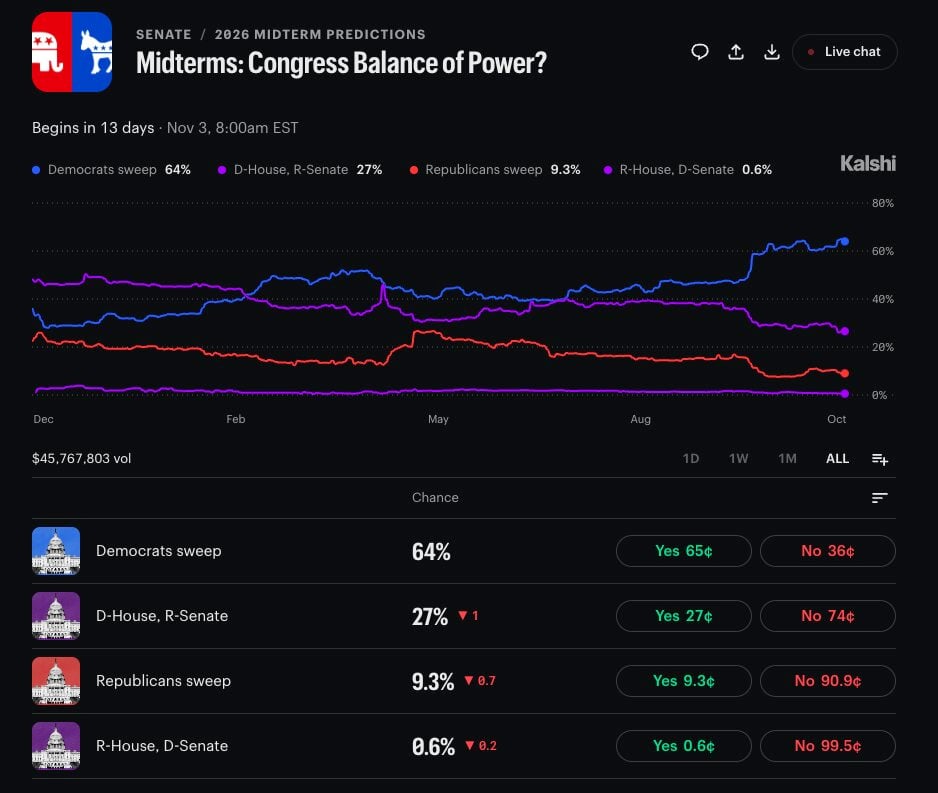
With 13 days to go, prediction markets give Democrats about a 90% chance of winning the House and about 63% of winning the Senate. Polling averages and forecasting models point the same direction. The difference is how sure each one is, and that difference is the real story of the 2026 midterms.
Trade on Sports, Politics, and MORE
Largest Prediction Market in the US
Hundreds of Markets to Choose From
Trade on Sports, Politics, and MORE
Largest Prediction Market in the US
Hundreds of Markets to Choose From
Get $200 in Bonuses Paid Over 21 Days
DraftKings is Now Available Nationwide
Browse Markets like Sports, Crypto, Tech & More
Get $200 in Bonuses Paid Over 21 Days
DraftKings is Now Available Nationwide
Browse Markets like Sports, Crypto, Tech & More
Here is what the three main kinds of forecast say about the 3 November election, where they agree, and why the Senate is much closer than the House.
Deposit $10, Get a $25 Trading Bonus
Live Trade with the Biggest Payouts at the Largest Prediction Market in the World
Deposit $10, Get a $25 Trading Bonus
Live Trade with the Biggest Payouts at the Largest Prediction Market in the World
All figures are dated snapshots from the sources named, not predictions or guarantees. For live odds, see our 2026 midterm elections predictions hub.
The Short Answer
| Source | Type | House | Senate | As of |
|---|---|---|---|---|
| Kalshi | Prediction market | Democrats 90% | Democrats 63% | 19 Oct |
| Polymarket | Prediction market | Democrats 91% | Democrats 63% to 65% | 17 to 19 Oct |
| Split Ticket | Forecasting model | Democrats 89% | Democrats 65% | 14 Oct |
| Silver Bulletin | Polling average | Democrats lead the generic ballot 49.8% to 41.0%, up from a 6.7 point lead on 1 September | 12 Oct | |
| Cook Political Report | Race ratings | More seats lean Democratic than Republican | Seven Senate toss-ups | 6 Oct |
Every source leans the same way. None of them says it is certain.
What the Polls Say
The generic congressional ballot asks voters which party they would back in their district, without naming candidates. Democrats lead in most averages. A collection of averages gathered by The New York Times showed leads between about 5 and 11 points as of 16 October, and the Silver Bulletin average had Democrats ahead by 8.8 points on 12 October.
That is a snapshot, not a forecast. Polls measure how voters feel now. Prediction markets and models try to estimate what will happen on 3 November, which includes the chance that the polls are off.
The House: Markets Are Nearly Certain
Republicans currently hold a 220 to 215 majority, and 218 seats are needed. The last three House elections were won with 222, 222 and 220 seats, so each party’s majority has been thin.
- Markets: about 90% for Democrats on both major platforms.
- The caution: redistricting has reduced the number of competitive seats in some states, and favourable court rulings in Florida and Virginia improved Republican chances of holding the House, according to Covers.
- Why it can still move: with so few seats in play, a handful of results can swing control.
The Senate: A Four-Seat Climb
Republicans hold the Senate 53 to 47. Democrats need a net gain of four seats, not three, because Vice President JD Vance would break a 50-50 tie in Republicans’ favour.
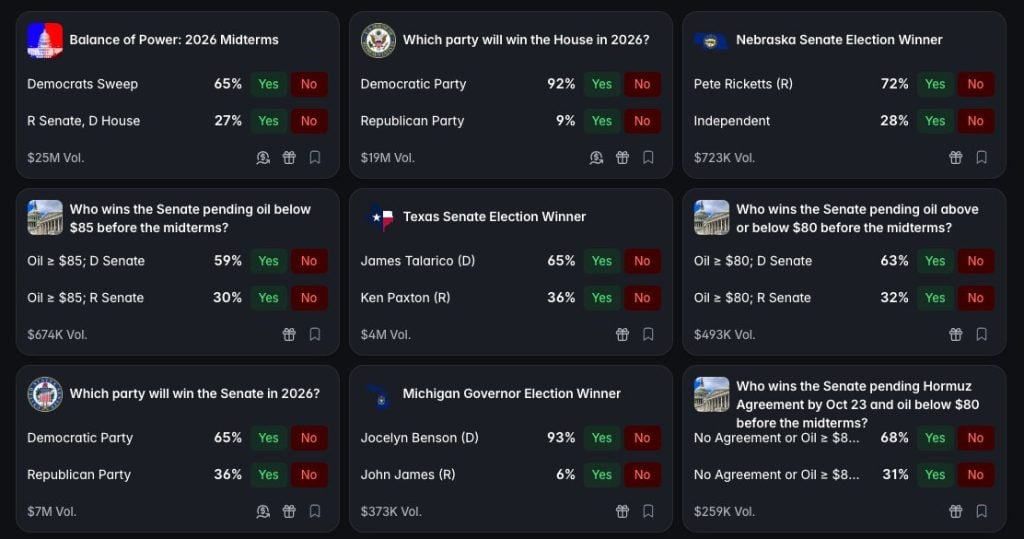
Cook rates seven Senate races as toss-ups: Texas, Maine, Ohio, Iowa, Kansas and Alaska, which Republicans hold, and Michigan, an open Democratic-held seat. Covers counts a slightly different set of seven battlegrounds and says markets favour Democrats in five of them. That is why the Senate odds sit near 63% and not near 90%. Our Senate battlegrounds guide has the race-by-race numbers.
Why Markets, Polls and Models Differ
- Probability versus margin. A poll can show a 3 point lead and still leave the winner uncertain. A market turns that uncertainty into a percentage.
- Different information. Markets react to news, fundraising and rumours within minutes. Polls take days.
- Different quality. Control markets are heavily traded. Many individual House races have less than $100,000 in volume, so their prices are less reliable.
- Different incentives. Operators earn from trading, so treat their own commentary as a data source, not a verdict.
Covers notes that markets are often more tempered than headline polling because they weigh forward-looking volatility instead of treating a snapshot as a result. A watchdog group, by contrast, says many markets are thin enough for small trades to move prices. Both points are worth keeping in mind.
What Could Still Change the Picture
- Turnout. Midterm turnout is lower than in presidential years and hard to model.
- Late-breaking news. Several big Senate races have had recent developments, including in Texas.
- The polls themselves. If they are wrong in the same direction across states, many races move together.
- Counting time. Close races can take days to call, and markets settle on official or consensus results.
Key Dates
| Date | What happens |
|---|---|
| 19 to 30 October | In-person early voting in Texas |
| 3 November | Election Day. All 435 House seats and 35 Senate seats are on the ballot |
| Days after | Close races may be called later, and markets settle once results are confirmed |
A Note on Election Betting
Prediction markets let people trade on these outcomes, but election betting is prohibited under state law in roughly two dozen states, and most Americans polled say they oppose it. We explain the legal picture in our guide to election betting by state on our politics prediction markets page. Nothing here is a recommendation to trade.
Frequently Asked Questions
Who is predicted to win the 2026 midterm elections?
Prediction markets, polling averages and forecasting models all lean Democratic, most strongly in the House. Kalshi gives Democrats about 90% for the House and about 63% for the Senate. These are probabilities, not results.
What do the polls say about the midterms?
Democrats lead the generic congressional ballot, by roughly 5 to 11 points depending on the average. The Silver Bulletin average had a lead of 8.8 points on 12 October.
Why is the Senate closer than the House?
Republicans hold 53 seats and Democrats need a net gain of four. That means winning most of a small group of toss-up races, mainly in Republican-leaning states.
Can the forecasts be wrong?
Yes. A 63% chance means the other outcome happens about once in three. Markets and models rest on polls, which can miss.
When is the 2026 midterm election?
Tuesday 3 November 2026.
How many seats are up?
All 435 House seats and 35 Senate seats.
Prediction markets are not sportsbooks. Event contract trading involves significant risk and is not appropriate for everyone. You can lose your entire stake. Platforms are typically 18+ and are not available in all states, and some states prohibit betting on elections. Forecasts are snapshots, not guarantees. This article is informational and is not financial, legal or voting advice. GamingToday does not endorse any candidate or party. If gambling or trading stops being fun, call 1-800-GAMBLER for confidential support.